Physical Address
304 North Cardinal St.
Dorchester Center, MA 02124
Physical Address
304 North Cardinal St.
Dorchester Center, MA 02124

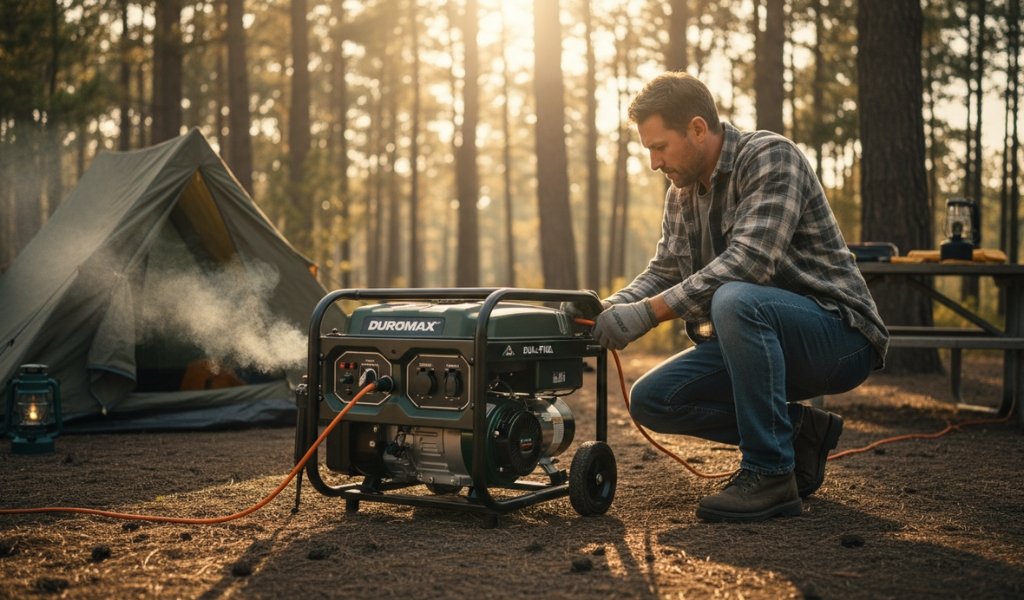
Whether you are preparing for an emergency power outage, setting up for a music festival, or heading out in an RV, the generator is an indispensable piece of power equipment. However, one question always follows their use: “How loud is it going to be?”
Generator noise can range from a soft hum to a deafening roar. In many cases, if a generator exceeds local noise ordinances or campground rules, it becomes unusable regardless of how much power it provides. Understanding how to measure these levels and how to dampen the engine noise is critical for any owner.
Portable generators are incredible for providing emergency power, but they are notorious for being disruptive. If you’ve ever tried to sleep in a quiet campground while a standard contractor-grade generator rumbles nearby, you know the frustration.
Beyond personal comfort, there are legal and social implications:
Knowing the exact output of your unit allows you to pick the right model and the right location for it.
To reduce noise, we must first understand its source. Essentially an internal combustion engine mated to an alternator.
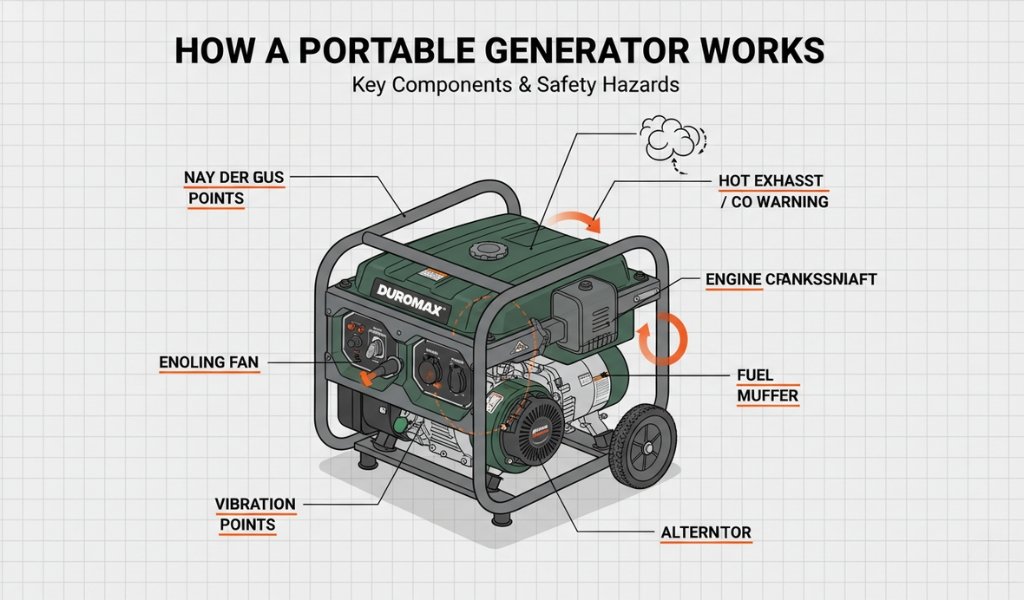
The noise comes from several distinct areas:
It is vital to understand that the decibel scale is logarithmic, not linear. This means that a small numerical increase represents a massive jump in sound intensity.
When reading manufacturer specs, remember that brands like Honda, Generac, or Pulsar may use different testing distances, making “salt-of-the-earth” comparisons difficult without your own testing.
While you can’t easily test a generator before you buy it, knowing how to measure your own unit helps you comply with regulations
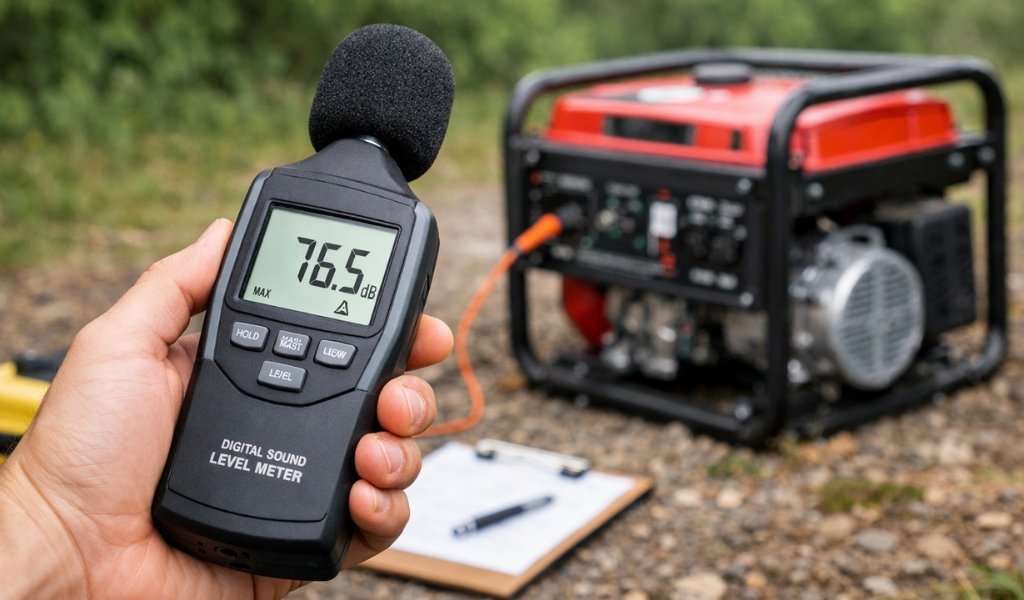 or decide if you need a soundproof enclosure.
Ensure your meter is set to A-weighting (dBA). This scale adjusts the readings to reflect how the human ear actually hears different frequencies, filtering out very high and very low frequencies that humans don’t perceive well.
Turn the generator off. Measure the background noise. If your “quiet” backyard is already at 55 dBA because of a nearby highway, you need to account for that in your final assessment.
The industry standard for measuring noise is 7 meters (approximately 23 feet).
“Idle” is much quieter than one under pressure.
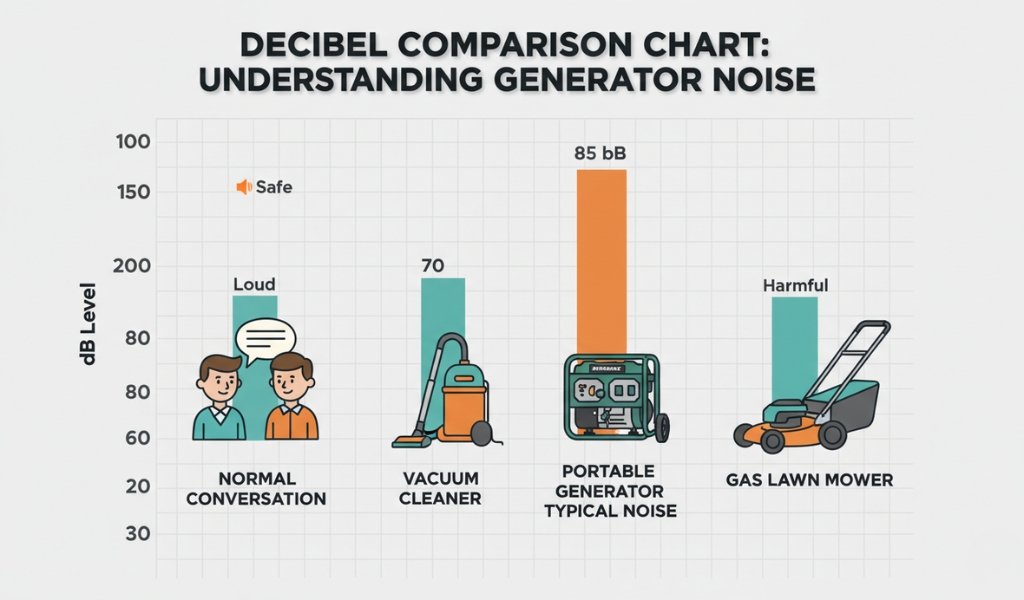
| Generator Type | Typical Decibel Range (at 7m) | Comparable Sound |
| Inverter | 50–65 dBA | Normal conversation / Background music |
| Quiet Portable | 60–70 dBA | City traffic / Large office |
| Standard Portable | 70–85 dBA | Vacuum cleaner / Lawn mower |
| Industrial | 80–120 dBA | Chainsaw / Jet take-off |
If silence is your priority, inverters are the gold standard. Unlike traditional generators that must run at a constant 3,600 RPM to maintain electricity frequency, an inverter can “throttle down” when demand is low. This results in significantly less engine noise. Furthermore, they almost always feature a “closed-frame” design, where the engine is encased in sound-dampening plastic.
If you already own a loud portable unit, you can use a soundproof enclosure (often called a “Zombie Box” or “Baffle Box”).
A poorly maintained engine is a noisy engine. Power equipment requires regular upkeep to stay within its original decibel specs.
Managing noise is a blend of choosing the right technology—like inverter generators—and using smart physics. By measuring your unit at the standard 7-meter distance and applying sound-dampening strategies, you can ensure your emergency power doesn’t become a public nuisance. Always prioritize safety and ventilation over silence, and keep your equipment maintained to ensure the smoothest, quietest operation possible.
Q: Can I use a car muffler on my generator to make it quieter?
A: While theoretically possible, it is not recommended for beginners. Generators are tuned for specific back-pressure. Adding a heavy car muffler can reduce engine efficiency, cause overheating, or even damage the exhaust valves if not engineered correctly.
Q: Why is my generator louder than the box says it is?
A: Manufacturers often test in “open field” conditions at 25% load. If you are using your generator near a wall (which reflects sound) or running it at 100% capacity, it will naturally be much louder than the advertised rating.
Q: Are battery power stations better than generators?
A: For noise, yes. They are virtually silent. However, they are not “generators” because they don’t create energy; they only store it. For long-term emergencies, a gas-powered generator is usually necessary because it can be refueled instantly, whereas a battery station takes hours to recharge via solar or AC.
Q: What is the “A-weighting” on a sound meter?
A: A-weighting (dBA) is a setting that adjusts the frequency response of the meter to match the human ear’s sensitivity. Since we don’t hear all frequencies equally, dBA provides a more accurate representation of how “annoying” or “loud” a sound feels to a person.
Q: Is it safe to put a generator in a shed to block noise?
A: Never put a running generator inside a standard shed or garage. The buildup of Carbon Monoxide is lethal, and the heat will destroy the engine. Only use sheds specifically designed as soundproof enclosures with high-volume active ventilation.