Physical Address
304 North Cardinal St.
Dorchester Center, MA 02124
Physical Address
304 North Cardinal St.
Dorchester Center, MA 02124

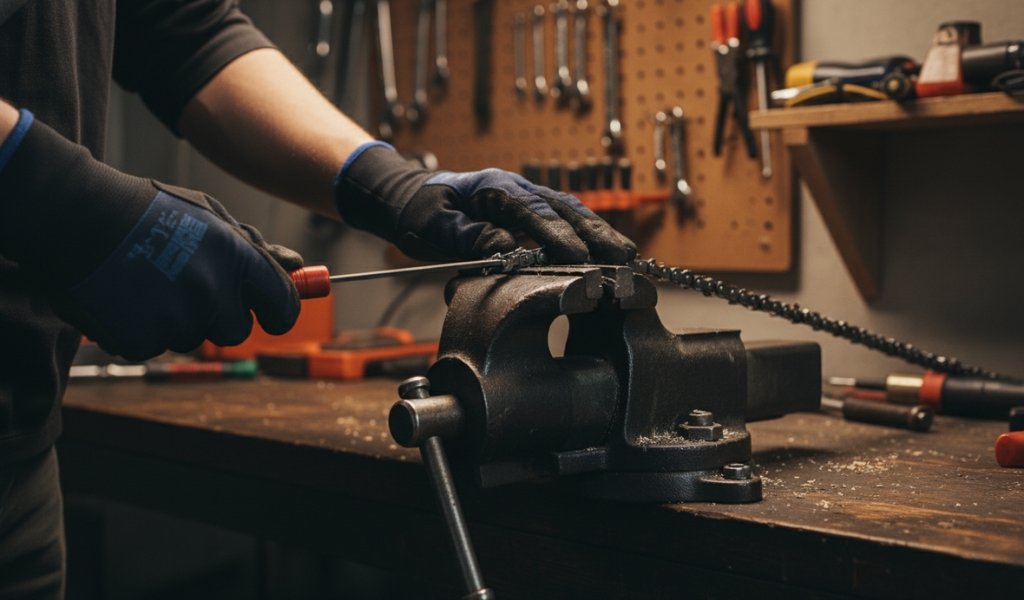
A chainsaw is one of the most powerful tools in a homeowner’s or professional’s arsenal, but its utility is entirely dependent on the sharpness of its teeth. Whether you are using a rugged gas chainsaw or a modern electric chainsaw, a dull blade turns a productive afternoon into a dangerous, exhausting chore.
Knowing how to sharpen a chainsaw is not just about maintenance; it’s about safety, efficiency, and extending the life of your equipment. In this comprehensive guide, we will walk through the signs of a dull saw, the tools you need, and the step-by-step process of chainsaw maintenance.
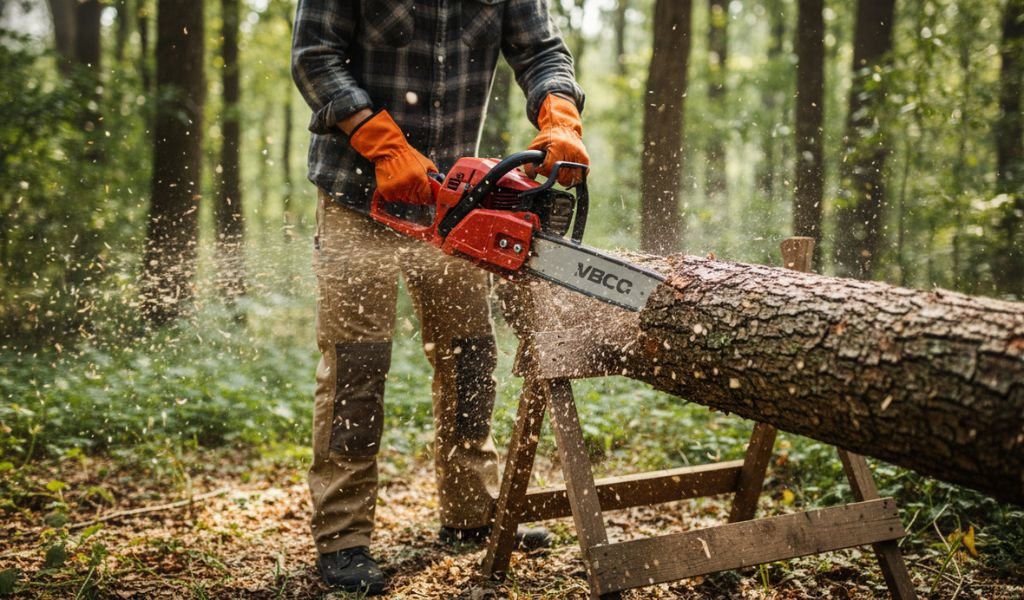
Cutting wood with a dull chainsaw is inefficient and often downright dangerous. A chain with even a slightly dulled edge makes every cutting task slower and more tiring. Beyond the physical strain on the operator, a dull blade forces the engine (or motor) to work harder, burning more fuel or draining batteries faster than necessary.
Furthermore, a dull chain increases the risk of “kickback,” which occurs when the cutters fail to grab the wood cleanly and instead snag, potentially throwing the bar back toward the user. Proper chainsaw maintenance ensures that the tool pulls itself through the wood, allowing you to guide it rather than muscle it.
How do you know when it’s time to stop and sharpen? You don’t need a microscope to tell; the evidence is in the debris and the physical feedback of the saw.
The Golden Rule: It is always faster and easier to “touch up” a chain frequently than it is to restore a completely blunt one. For a gas chainsaw, check the chain every time you refill the gas tank. For an electric chainsaw, aim for a touch-up every 5 to 10 hours of active use.
To learn how to sharpen a chainsaw blade correctly, you need the right diameter tools.
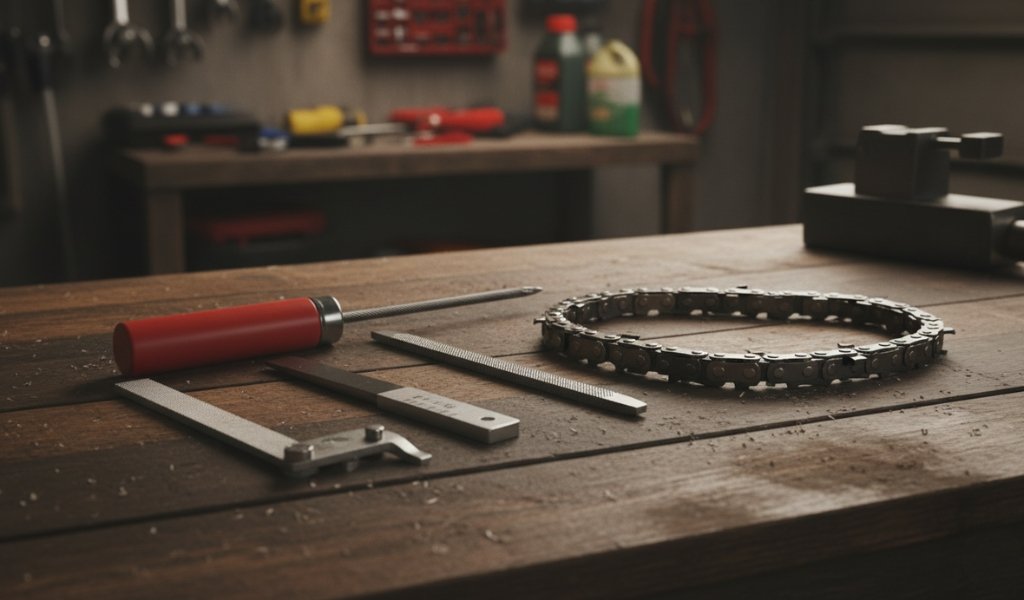
Files are not “one size fits all.”
Before you start filing, you must understand what you are looking at. Each link in a saw chain serves a purpose.
| Component | Function |
| Cutter (Tooth) | The sharpened “hook” that shaves the wood. It has a top plate and a side plate. |
| Depth Gauge (Raker) | The shark-fin-shaped bump in front of the tooth. It determines how deep the tooth bites into the wood. |
| Drive Link | The bottom part of the chain that fits into the guide bar groove and is driven by the sprocket. |
| Tie Strap | The plates that hold the cutters and drive links together. |
Safety first. Engage the chain brake. If using a gas chainsaw, ensure it’s off; if using an electric chainsaw, remove the battery. Clamp the guide bar in a bench vise. If you are in the field, use a “stump vise” hammered into a log.
Look for the “master link” or a tooth that looks different (some are gold or have unique markings). If they all look the same, mark one with a permanent marker or a dab of paint so you know where you started.
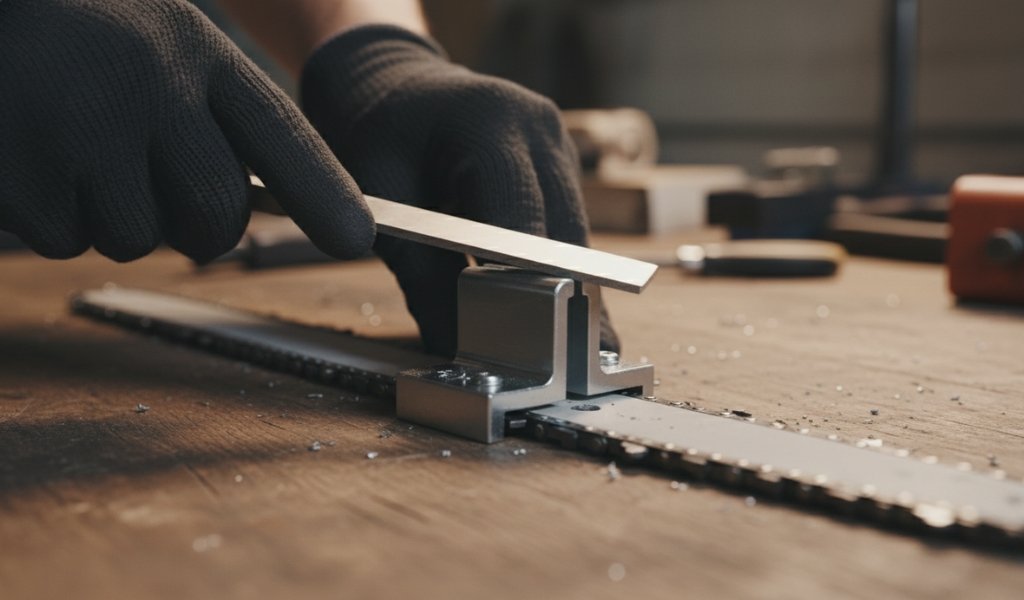
Place the round file into the gullet of the cutter. Align the file guide markings so they are parallel with the bar. Most chains require a 30-degree angle.
Push the file forward in a smooth, steady motion.
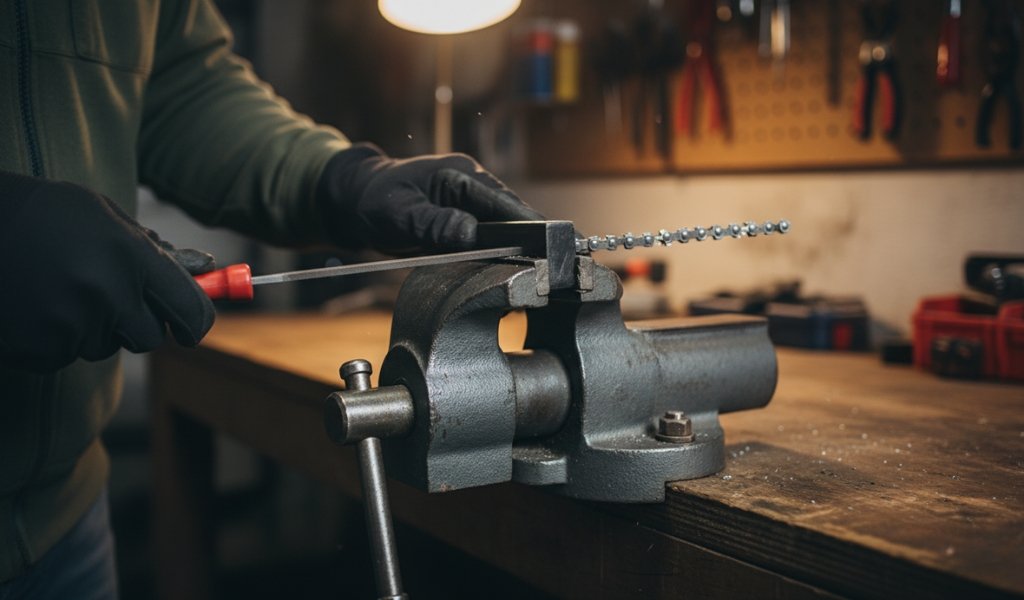
Only file in one direction (away from you). Do not use a back-and-forth sawing motion, as this ruins the file and the edge. Usually, 2 to 3 strokes per tooth are sufficient.
Sharpen all the cutters facing one direction. Once you complete the loop, move to the other side of the bar and sharpen the cutters facing the opposite direction.
If you find manual filing tedious, a bench-mounted sharpener is a game-changer. These use a 4-inch grinding wheel to hone the edge.
As you sharpen the cutting teeth, they become shorter. Because the teeth are tapered, they also become lower in height. If you don’t lower the depth gauges (the metal fins in front of the teeth), the teeth won’t be able to reach the wood.
Electric vs. Gas Chainsaw Maintenance
While the saw chain itself is sharpened the same way regardless of the power source, the maintenance routines differ slightly.
Sharpening the teeth is only half the battle. To keep your chainsaw running like new, follow these additional maintenance steps:
Mastering how to sharpen a chainsaw is a rite of passage for any woodcutter. It transforms the tool from a frustrating burden into a precision instrument. Remember: work slowly, maintain consistent angles, and never neglect your depth gauges. If you find the process overwhelming, don’t hesitate to take your chain to a professional once a year for a “reset” to ensure the geometry is perfect.
Would you like me to help you find the specific file size recommended for your specific chainsaw model?
Q: How often should I sharpen my chainsaw?
A: For a gas chainsaw, a quick touch-up every time you refuel is ideal. At a minimum, sharpen whenever you notice sawdust instead of wood chips.
Q: Can I use a regular rat-tail file to sharpen my saw?
A: No. Chainsaw files are specifically designed with a consistent diameter and a particular “cut” to sharpen the hardened steel of a saw chain. A standard hardware store file will likely be the wrong size and won’t produce a sharp edge.
Q: My chainsaw is still not cutting straight after sharpening. Why?
A: This usually happens because the teeth on one side of the chain were filed more than the other, or you missed a few teeth. Use a caliper or a bench-mounted sharpener to ensure all cutters are the same length.
Q: Is it worth sharpening a cheap chainsaw chain?
A: Yes. Even an inexpensive saw chain can be sharpened many times. However, if the teeth are worn down to the “witness mark” (the small line etched on the back of the tooth), it is time to replace the chain.
Q: Do electric chainsaws need special sharpening tools?
A: No. The electric chainsaw uses the same types of chains as gas saws. You simply need to match the file size to the chain’s pitch and gauge.