Physical Address
304 North Cardinal St.
Dorchester Center, MA 02124
Physical Address
304 North Cardinal St.
Dorchester Center, MA 02124

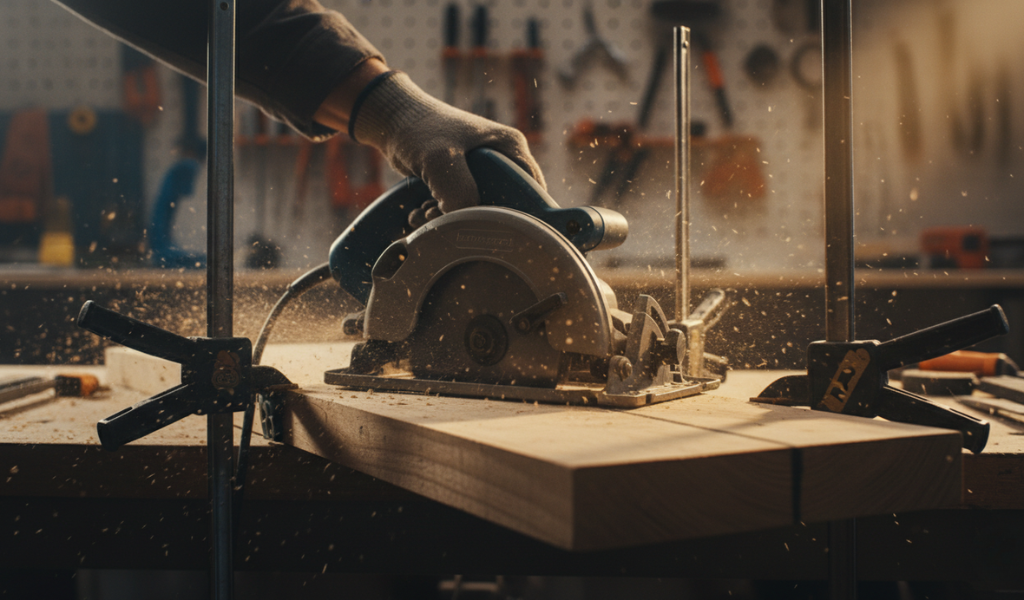
For many DIY enthusiasts and budding woodworkers, the circular saw is the ultimate gateway to serious construction. It is the tool that moves you past the slow, exhausting world of hand saws and into the realm of professional-grade speed and accuracy. However, that power comes with a significant responsibility. As many experts note, not knowing how to use a circular saw safely is often the biggest hurdle holding people back from tackling home improvement projects.
Whether you are looking into a mini circular saw for craft projects or a heavy-duty cordless circular saw for job site efficiency, understanding the mechanics, safety protocols, and techniques is vital. This guide will provide a deep dive into the use of a circular saw, ensuring you can cut with confidence and precision. If you’ve ever wondered how to safely use a circular saw as a beginner, this guide will walk you through every step with proper safety techniques and expert tips.
At its core, a circular saw is a power tool that uses a toothed or abrasive disc (the blade) to cut different materials using a rotary motion spinning around an arbor. While they can be mounted to a table, the most common form is the hand-held version used on job sites and in home workshops worldwide.
This saw is the workhorse of the framing world. It consists of a motor, a handle with a trigger switch, a base plate (also called a shoe) that rests on the material being cut, and a blade guard that protects the user from the spinning teeth.  Modern engineering has evolved these tools into various specialized forms, including the cordless circular saw, which offers unparalleled mobility, and the mini circular saw, designed for one-handed operation and tight spaces.
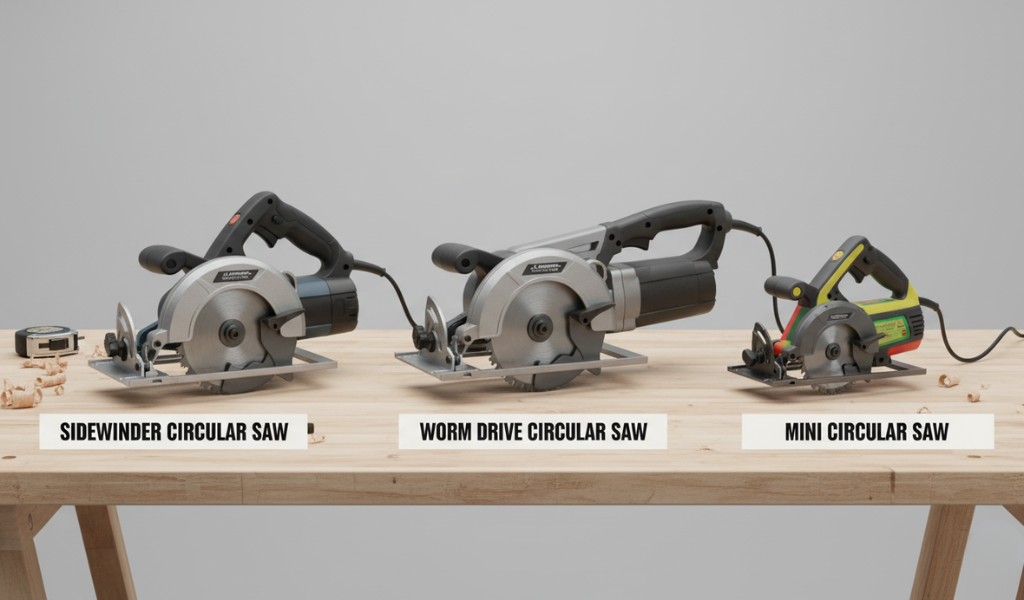
Before knowing how to use a circular saw, it is helpful to understand that not all saws are built the same. There are three main mechanical designs you will encounter:
This is the most common type for DIYers. The motor sits on the side of the blade, making the tool shorter and lighter. Sidewinders usually have a higher blade speed, which is excellent for general-purpose tasks around the house.
In these saws, the motor is positioned at the rear. The power is transmitted through gears that increase torque but lower the blade speed. They are longer, heavier, and preferred by professional framers because they are harder to “stall” when cutting through thick, wet lumber.
These are scaled-down versions designed for one-handed operation. They use smaller blades (often around 4.5 inches) and are perfect for light trim work, cutting thin plywood, or working in tight spaces where a full-sized saw simply won’t fit.
 When to Use a Circular Saw (and When Not To)
Understanding when to use a circular saw is just as important as knowing how to pull the trigger. It is primarily designed for straight-line woodcutting where speed and portability are prioritized over the surgical precision of a stationary shop saw.
The market is filled with options, but your choice should depend on your specific needs and comfort level.
Traditional corded saws offer unlimited runtime and consistent power. They are ideal for ripping heavy amounts of timber where a battery might struggle. However, you must always be mindful of the cord to avoid accidental cutting or tripping.
The cordless circular saw has become the industry standard for most DIYers. Powered by high-voltage lithium-ion batteries (18v or 20v), these tools provide freedom of movement. They are significantly safer for beginners because there is no cord to accidentally sever. Modern models from brands like Milwaukee or Makita now rival the power of corded versions.
A mini circular saw is a fantastic entry point for those intimidated by the size of a standard 7-1/4 inch blade. These smaller tools are easier to control and are perfect for cutting thinner materials or making quick repairs where a full-sized saw would be overkill.
Before we discuss the actual cutting, we must address the protective gear. A circular saw is a high-speed cutting machine; it demands respect.
A major mistake beginners make is leaving too much blade exposed. This increases friction and makes the saw more likely to “kick back.”
Unplug the saw (or remove the battery). Rest the base plate on your wood and loosen the depth adjustment lever. Adjust the blade so that the teeth extend only about 1/8 to 1/4 inch (3-6mm) below the bottom of the wood. This ensures the most efficient cut and keeps the blade from overheating.
Follow these steps to ensure a clean, safe cut every single time.
Never try to hold the wood with one hand and saw with the other. Use clamps to secure your timber to a stable workbench. Ensure the part of the wood you are cutting off is free to fall away without “pinching” the blade as it drops.
Use a carpenter’s pencil and a speed square to draw a clear line. Expert Tip: Remember the “kerf.” The blade itself has thickness (usually about 1/8 inch). Always cut on the “waste side” of your line so your final piece isn’t too short.
Stand to the side of the cut line, never directly behind the blade. If the saw kicks back, you want it to fly past your torso, not into it. Keep a firm, two-handed grip on the handles.
Place the front of the saw’s base plate on the wood. Ensure the blade is not touching the wood yet. Squeeze the trigger and let the motor reach full speed.
Slowly guide the saw forward. Follow your line by looking at the “notch” on the front of the base plate or by watching the blade itself. Do not force the saw. If the motor sounds like it is straining, slow down your forward movement.
As you reach the end, stay steady. Let the waste piece fall. Release the trigger and wait for the blade to stop spinning completely before lifting the saw off the wood.
Kickback is the most dangerous event in the use of a circular saw. It occurs when the blade becomes pinched or jammed in the cut, causing the saw to be violently propelled backward toward the user.
Once you master the basics of how to use a circular saw, you can improve your accuracy with these professional tips:
For perfectly straight long rips on plywood, clamp a straight-edged board (a fence) to your material. You can run the side of your saw’s base plate against this guide to ensure a factory-straight line.
When cutting large sheets, lay them on a sheet of rigid foam insulation on the floor. You can set your blade depth to cut through the wood and slightly into the foam. This supports the entire sheet of plywood, preventing the offcut from splintering as it falls.
If you are worried about the wood splintering on the top surface, use a utility knife to “score” (cut) the wood fibers along your pencil line before sawing. This creates a clean break point for the blade.
A well-maintained tool is a safe tool. Follow these simple maintenance checks:
Mastering the circular saw opens up a world of DIY possibilities, from building garden decks to crafting custom furniture. By prioritizing safety, choosing the right tool—be it a cordless circular saw for ease or a mini circular saw for precision—and practicing proper body positioning, you turn a potentially intimidating tool into a reliable partner.
Always remember: respect the blade, secure your work, and never rush a cut. With patience and the right technique, you will find that the circular saw is the most valuable tool in your arsenal.
A: Modern high-end cordless circular saws (18v or 36v) are incredibly powerful and can handle almost any task a DIYer needs. However, for continuous, heavy-duty ripping of 2-inch thick hardwoods all day long, a corded saw still offers the advantage of consistent, unlimited power.
A: Yes, but you must use the correct blade. A standard wood blade will be destroyed instantly by metal. You need a specialized diamond blade for masonry or a carbide-tipped metal-cutting blade for steel or aluminum.
A: A mini circular saw is excellent for cutting trim, paneling, and thin plywood. Its small size makes it less intimidating for beginners and very easy to transport for quick home repairs.
A: This is usually due to one of three things: the wood is not supported correctly and is pinching the blade, you are trying to cut a curve instead of a straight line, or the blade is too dull to clear the sawdust effectively.
A: If you have positioned yourself correctly to the side and are holding it with two hands, you should be able to maintain control. Immediately release the trigger. Do not try to fight the kickback while the motor is still spinning.
A: If you find you have to push the saw harder than usual, if the wood shows dark burn marks, or if the cut edges are ragged and splintered, your blade is dull and needs to be replaced.