Physical Address
304 North Cardinal St.
Dorchester Center, MA 02124
Physical Address
304 North Cardinal St.
Dorchester Center, MA 02124

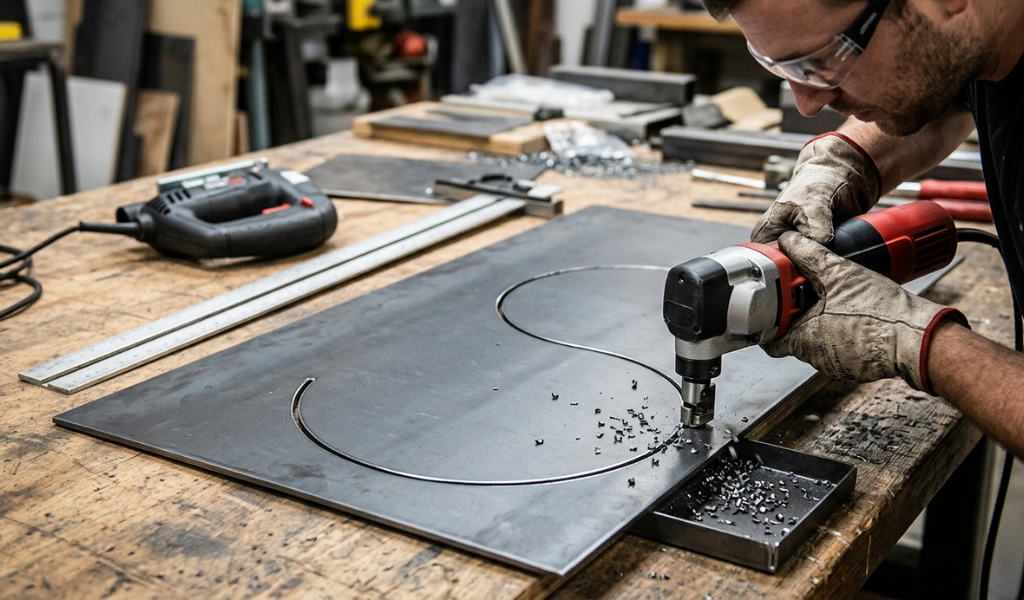
If you have ever stood in your workshop staring at a sheet of steel, wondering how to make a clean curved cut without ruining the material, you are not alone. Choosing between a nibbler vs jigsaw is a common dilemma for DIYers and pros alike. While both tools are popular choices for following patterns and intricate shapes, they operate in completely different ways.
In this guide, we will break down the strengths of a nibbler and jigsaw, helping you decide which tool is better for your next metal cutting project. Whether you are trimming roofing sheets or crafting custom brackets, the right choice will save you a lot of ‘elbow grease’ and prevent a messy finish.
A nibbler is better for thin sheet metal, curved cuts, and clean edges without sparks. A jigsaw is better for thicker materials and offers more versatility for cutting wood, plastic, and metal. The best choice depends on the type of metal cutting project you are working on.
To truly understand the differences between these tools, you first have to look under the hood at the engineering that drives each tool. A nibbler is a fascinating piece of machinery because it doesn’t actually “cut” in the traditional sense of a moving blade. Instead, it operates using a high-speed punch-and-die system. Imagine a very fast, very powerful office hole punch. As you push the tool forward, a small metal pin (the punch) moves up and down thousands of times per minute, shearing out tiny, half-moon-shaped chips of metal against a fixed plate (the die). This unique action allows the tool to move through metal without the friction or heat associated with traditional sawing.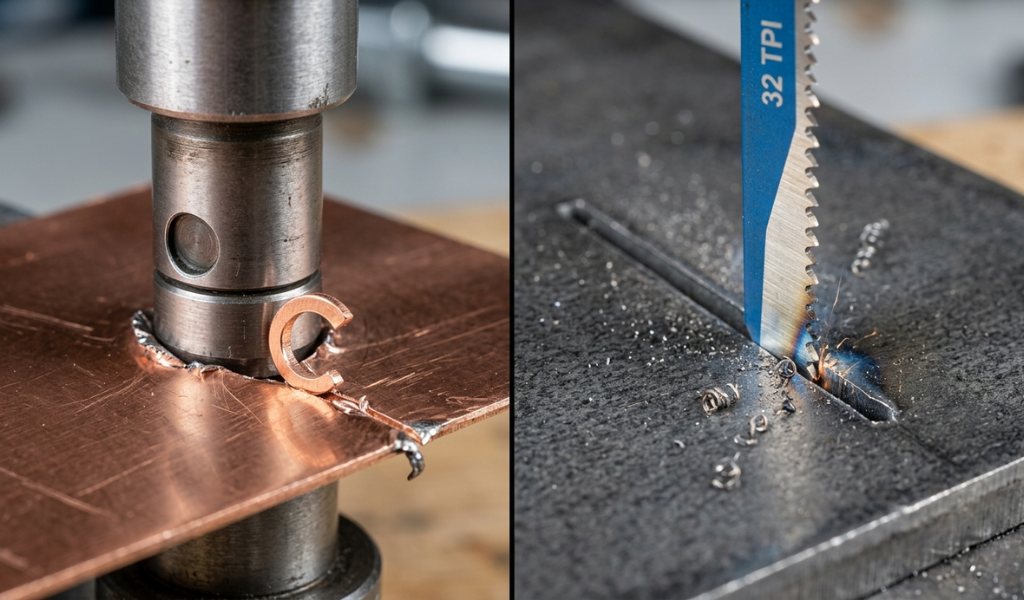
On the other hand, the jigsaw is a member of the reciprocating saw family. It uses a thin, vertical blade that moves rapidly up and down. When you pull the trigger, the blade’s teeth “bite” into the material, removing a thin line of waste known as the kerf. While the tool itself is universal, its success in metal cutting depends entirely on the blade you choose. Wood blades have large, aggressive teeth that would shatter against steel, but a bi-metal blade with 18 to 32 teeth per inch (TPI) allows the jigsaw to slowly but surely grind through various metal thicknesses. Because the jigsaw relies on the friction of teeth against metal, the physics involved are much more aggressive than the shearing action of the nibbler.
Despite their mechanical differences, these two tools are often compared because they occupy the same “niche” in the workshop. Both are designed to provide maneuverability that a circular saw or an angle grinder simply cannot match. If you need to cut a circle out of a piece of aluminum or follow a complex wavy line on a sheet of copper, these are the two tools you will reach for. They both offer a level of “handheld freedom” that allows you to take the tool to the workpiece, which is essential when you are working on something large like a car body panel or a piece of installed HVAC ductwork.
Furthermore, both tools are available in a variety of power formats to suit different environments. Professionals who work in a fixed shop often prefer pneumatic (air-powered) versions because they are lighter and can run all day without overheating. However, for the average DIYer or contractor on the move, cordless battery-powered versions have become the gold standard. They share a similar weight class and can typically be operated with one hand for light work, though two hands are usually recommended to maintain the highest level of accuracy during a long metal cutting session.
The nibbler is often considered the ‘popular choice’ of the metal fabrication world. One of its greatest strengths is that it leaves the metal workpiece virtually undistorted. Because the punch shears the metal in a very localized area, it doesn’t apply the kind of broad vertical pressure that a jigsaw blade does. This makes it the absolute best choice for thin-gauge materials that are prone to bending or vibrating. If you’ve ever tried to cut a thin piece of flashing with a jigsaw, you know the metal can often “chatter” or fold; a nibbler avoids this entirely, providing a stable, calm cutting experience that feels more like drawing with a pen than operating a power tool.
However, the specialized nature of the nibbler comes with a few trade-offs. The most notable one is the mess it leaves behind. Since the tool works by punching out tiny pieces of metal, it creates thousands of sharp, “C-shaped” chips. These chips are notoriously difficult to clean up and can easily embed themselves in the soles of your shoes or the tires of your car. Additionally, the nibbler is a specialized tool designed mainly for sheet metal work. While it is king at sheet metal, it lacks the versatility to handle wood or thick plastic. It is a precision instrument designed for a specific set of materials, and within that realm, it is nearly impossible to beat for ease of use and quality of finish.
In contrast to the specialized nibbler, the jigsaw is a highly versatile tool. If you are a homeowner or a hobbyist who only wants to buy one cutting tool, the jigsaw is almost always the smarter investment. 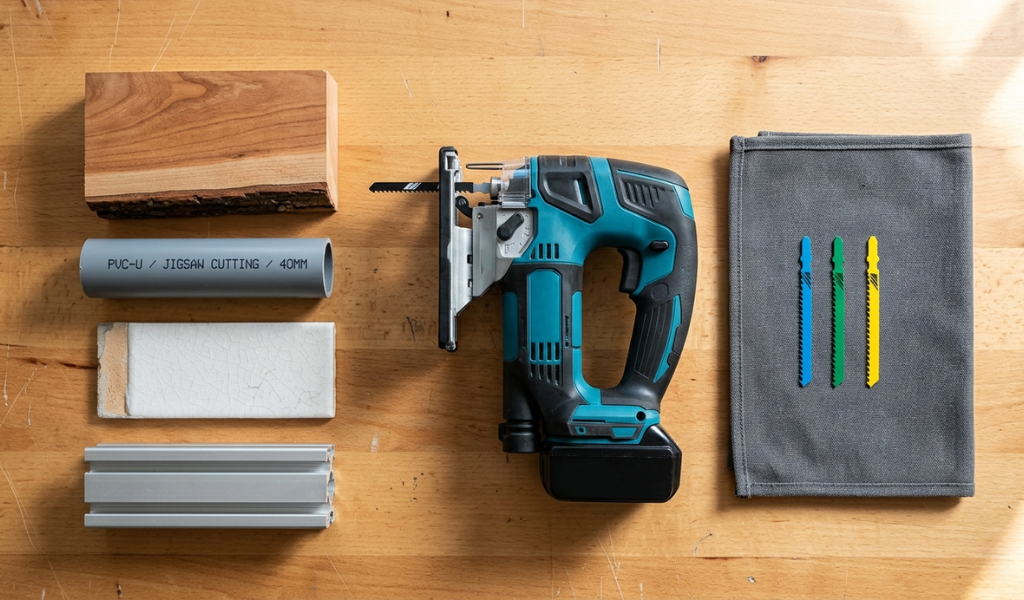 Its ability to switch between wood, plastic, ceramic tile, and metal just by changing a five-dollar blade makes it incredibly valuable. When used for metal cutting, the jigsaw offers a familiar handle and a clear line of sight, allowing the operator to follow patterns with a high degree of confidence. Because the blade is much longer than a nibbler’s punch, the jigsaw can also handle much thicker materials, ranging from thin tin to thick steel plates and even aluminum extrusions.
However, using a jigsaw on metal requires a lot more patience and physical effort. The tool generates significant vibration, which can be tiring for your hands and arms over long periods. You also have to deal with the heat generated by the reciprocating motion. If you move too fast, the friction will dull your blade in seconds, often turning the metal blue from the intense heat. This heat can also damage the finish on pre-painted metal sheets. Furthermore, because the blade is thin and flexible, it has a tendency to “deflect” or bend when you try to turn a curve too sharply, which can result in an edge that is not perfectly square. Despite these challenges, the jigsaw remains a versatile tool that can handle almost any material you throw at it.
When comparing their overall performance the first thing to consider is the “gauge” of the metal. Nibblers are generally designed for sheet metal. Most standard models can handle up to 10 or 12 gauge in aluminum and about 14 to 18 gauge in mild steel. If you try to push a nibbler beyond its rated capacity, you risk snapping the punch or burning out the motor. The jigsaw, however, has a much higher ceiling. With the right blade and a slow, steady hand, a high-end jigsaw can cut through steel plates that are a quarter-inch thick or even more. This makes the jigsaw the default choice for structural metalwork, while the nibbler stays in the world of cladding and fabrication.
Precision and the “quality of the cut” are where the nibbler really pulls ahead. Because the nibbler shears the metal, the resulting edge is typically very clean and free of burrs. In many cases, you can go straight from cutting to assembly without needing to touch a file or sandpaper. The jigsaw, by its very nature, leaves a jagged, “toothed” edge that almost always requires secondary finishing. In terms of comfort, the nibbler is the much more pleasant tool to operate. It is quieter, produces less vibration, and doesn’t require the same amount of downward force to keep the tool from bouncing. For users who value a clean finish and better comfort during use, the nibbler is usually the preferred choice.
In a real-world workshop setting, the choice between these two tools often depends on the specific geometry of the cut you are trying to make. For long, straight lines, the jigsaw is usually the faster option, especially if you use a straight-edge guide or a track. While a nibbler can cut straight, its “chewing” action is inherently slower, and it can be difficult to keep the tool perfectly on course over a distance of several feet. 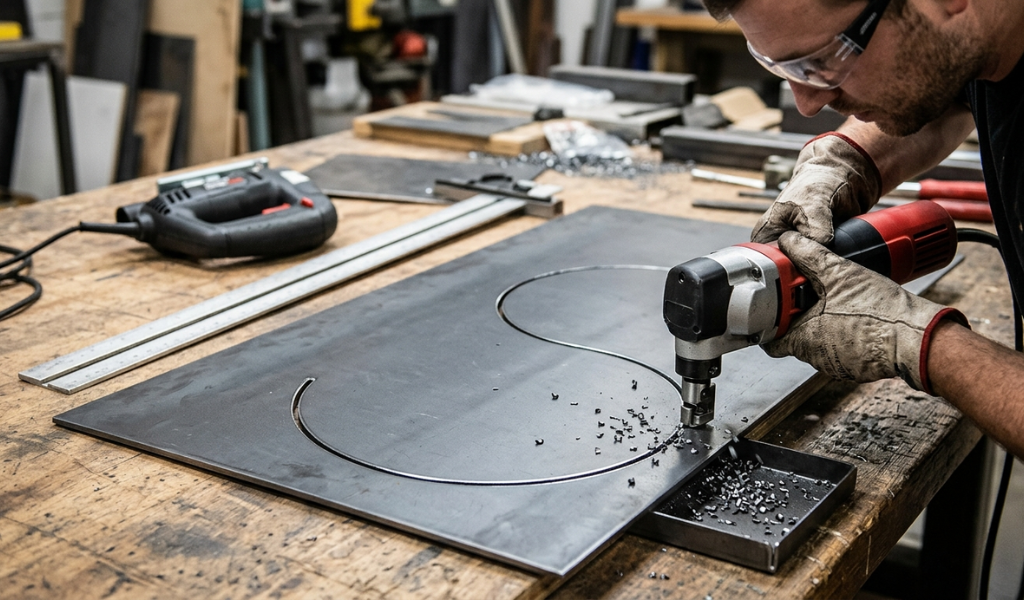 However, if you are looking for a tool to cut intricate curves or tight circles, the nibbler is the undisputed champion. A nibbler can rotate 360 degrees within its own footprint, allowing for “U-turns” and complex scrollwork that would snap a jigsaw blade instantly.
When it comes to notching or cutting into tight corners, the nibbler or jigsaw debate gets interesting. Nibblers are excellent at cutting small “V” or “U” shaped notches in the edge of a panel, as the punch-and-die can simply bite into the metal with great precision. Jigsaws struggle in these tight spaces because the footplate of the tool often gets in the way of the workpiece. However, if you need to cut a hole in the middle of a panel, the jigsaw is often the more convenient choice for larger openings. While both tools require a starter hole to be drilled first, the jigsaw can move more quickly through the interior of a large cutout once the blade is inserted.
The shape of the material you are cutting is just as important as its thickness. One area where the nibbler shines is in the world of corrugated metal. If you are building a shed or a roof, you will often find yourself needing to cut across the “waves” or ridges of the metal. A jigsaw is a nightmare for this task; the flat base of the jigsaw will snag on every ridge, causing the tool to bounce and likely damaging the metal. A nibbler, because it doesn’t rely on a large flat base to remain stable, can easily move across corrugated sheets and provide a smooth cut without damaging the roofing material.
Conversely, the jigsaw is much better suited for hollow workpieces like metal pipes, tubes, or square extrusions. A nibbler needs to be able to “straddle” the edge of the metal to work, which means it cannot easily cut through the wall of a pipe. A jigsaw blade, however, can easily reach through the hollow center of a pipe to cut both the top and bottom walls. For structural components like metal studs, angle iron, or thick plates, the jigsaw’s aggressive reciprocating action and deep blade reach make it the only logical choice. It is a more rugged tool for ‘rough-in’ work, whereas the nibbler is a finesse tool for surface materials.
While comparing both tools, it is worth noting that sometimes neither tool is the right choice. If you are doing demolition work or need to slice through very thick, hardened steel, you might want to reach for an angle grinder or a reciprocating saw (Sawzall). These tools use abrasive discs or heavy-duty blades that can tackle rebar and thick structural beams that would destroy a jigsaw blade or stall a nibbler. However, the trade-off is a massive increase in sparks, noise, and heat. An angle grinder is not a precision tool; it creates a wide, messy cut that is rarely suitable for finish work or decorative fabrication.
If you are working in a shop that requires 100% spark-free operation—perhaps due to the presence of flammable materials or sensitive electronics—the nibbler becomes your best friend. It is one of the few power tools that can cut metal with absolutely no sparks or high-heat zones. This “cold-cutting” capability is a major safety advantage in industrial environments. If you find yourself in a situation where precision is paramount and you cannot afford to leave a jagged edge, but the material is too thick for a nibbler, you might consider an electric metal shear. Shears work like giant scissors, offering a different set of pros and cons, but for most DIY and light professional work, the nibbler and jigsaw remain the primary contenders.
Regardless of which tool you choose, safety in metal cutting cannot be overstated. When using a jigsaw, the primary danger is the reciprocating blade and the high-velocity metal splinters (swarf) it throws into the air. Wrap-around safety glasses are a non-negotiable requirement. For the nibbler, the danger is less about flying debris and more about the “crumbs” left on the floor. These chips are incredibly sharp and can cause deep punctures if stepped on or handled with bare hands. Always keep a powerful magnet or a shop-vac nearby to clean up your workspace immediately after a nibbler session.
Maintenance is also important for improving the lifespan of your tools. Jigsaw blades are disposable, and you should never try to use a dull one; it will only lead to overheating and poor results. Nibblers, however, have a punch and die that can be replaced or occasionally sharpened. You should periodically apply a few drops of machine oil to the cutting head of your nibbler to reduce friction and help the punch slide easily through the metal. For jigsaws, using a dedicated cutting wax or oil on the blade while working on thick steel will significantly extend the life of your teeth and prevent the metal from “welding” itself to the blade through heat.
When deciding on a nibbler vs jigsaw, the choice boils down to your specific project needs. If you find yourself frequently working with thin sheet metal, corrugated roofing, or complex artistic shapes that require a perfectly clean, spark-free edge, the nibbler is the specialized tool you’ve been looking for. It offers a level of finesse and ergonomic comfort that makes metal fabrication a pleasure rather than a chore.
However, if you are a multi-disciplinary maker who needs a single tool to handle everything from cutting a hole in a wooden cabinet to trimming a metal bracket or a PVC pipe, the jigsaw is the clear winner for versatility. In a perfect world, having both a nibbler and jigsaw in your arsenal is the best way to handle any metal cutting task that comes your way. Each tool has its own strengths, and knowing when to use them can improve the quality of your metal cutting projects.