Physical Address
304 North Cardinal St.
Dorchester Center, MA 02124
Physical Address
304 North Cardinal St.
Dorchester Center, MA 02124

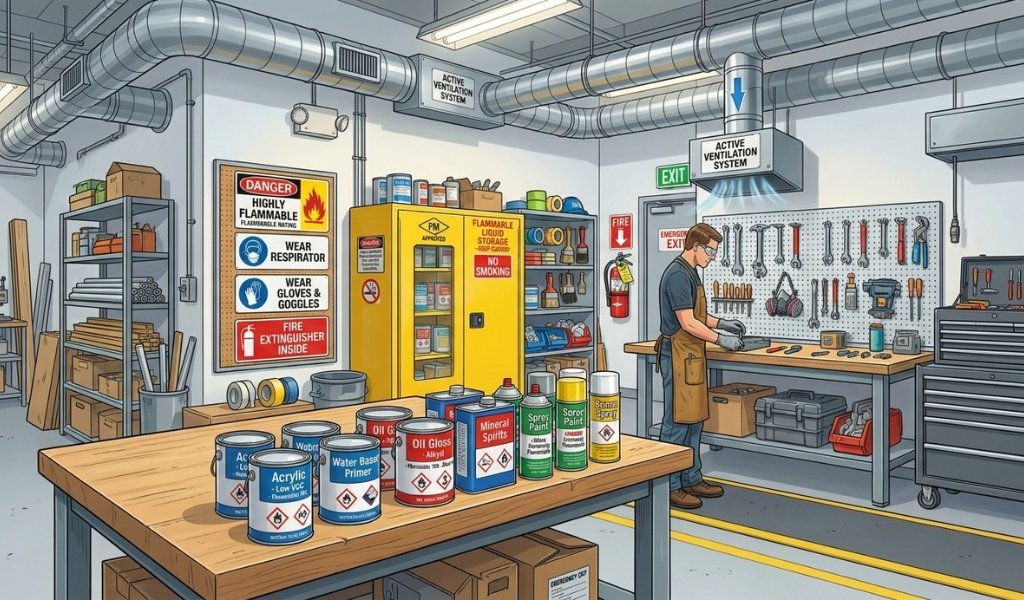
Paint is one of the most commonly used and commonly misunderstood chemical products in construction, manufacturing, and DIY projects. Most people know that certain paints can catch fire. Fewer understand why, when, or which specific conditions turn a can of paint into a genuine fire hazard. That knowledge gap creates real risks on job sites, in workshops, and even in residential garages.
This guide covers exactly what professionals and safety-conscious DIYers need to know: how flammability varies across paint types, what flash points and OSHA/NFPA ratings actually mean, why paint fumes can be more dangerous than the liquid itself, and how to store, handle, and dispose of flammable materials correctly. If you’ve ever wondered about a related question like is spray paint flammable when dry the answer depends heavily on the paint’s formulation and how far along the drying process is. That same principle applies across every paint category covered here.
By the end, you’ll have a clear, technically grounded framework for making fire-safe decisions on any painting project.
The terms “flammable” and “combustible” are often used interchangeably, but they carry distinct regulatory meanings under OSHA and NFPA standards and the difference matters for compliance, storage, and safety labeling.
Under OSHA’s Hazard Communication Standard (29 CFR 1910.1200) and NFPA 30 (Flammable and Combustible Liquids Code), flammable liquids have a flash point below 100°F (37.8°C). Combustible liquids have a flash point at or above 100°F. This distinction directly determines how a product must be stored, labeled, and handled on a worksite.
Many oil-based paints, solvent-based coatings, and aerosol spray paints fall into the flammable liquid category. Some slower-evaporating coatings and varnishes qualify as combustible. Water-based paints typically fall into neither classification under normal conditions.
The fire risk of any paint is not static it changes significantly as paint transitions from liquid to solid. In its liquid state, paint contains volatile solvents that evaporate rapidly, generating flammable vapors that can accumulate in enclosed spaces. This is where the greatest ignition hazard exists.
As paint dries, those solvents evaporate and vapor pressure drops. Once a paint film has fully cured all solvents have off-gassed and only the pigments, binders, and resins remain the fire risk decreases substantially. Dry paint is generally not considered a flammable liquid hazard. However, “dry to touch” is not the same as “fully cured.” During the intermediate drying phase, residual solvent vapors continue to off-gas, maintaining some level of ignition risk in poorly ventilated spaces.
Oil-based paints can take 24–48 hours to dry and significantly longer to fully cure. During that entire window, the surrounding air can carry enough vapor concentration to constitute a fire hazard near open flames or ignition sources.
The flash point of a liquid is the lowest temperature at which it produces sufficient vapor to ignite momentarily when exposed to an open flame. It is the primary metric used by OSHA and NFPA to classify flammable and combustible liquids.
Autoignition temperature is a separate but related concept: the temperature at which a substance ignites without an external flame. For most paint solvents, autoignition temperatures range from 450°F to over 900°F, depending on the solvent type.
Every commercial paint product is required to disclose these values in its Safety Data Sheet (SDS), formerly called a Material Safety Data Sheet (MSDS). Reviewing the SDS before using or storing any paint is a non-negotiable safety practice.
Not all paints carry the same fire risk. The chemistry of the carrier solvent not the pigment or colorant is what determines a paint’s flammability classification.
Oil-based paints, alkyd enamels, varnishes, lacquers, and solvent-based coatings represent the highest flammability risk in the paint category. These products use petroleum-derived solvents mineral spirits, naphtha, xylene, toluene, or acetone as their carrier medium. These solvents typically have flash points well below 100°F, placing them firmly in OSHA’s flammable liquid category.
Mineral spirits, one of the most common paint thinners, has a flash point around 104–140°F depending on the grade technically combustible. Acetone-based solvents have flash points as low as 0°F (-18°C), making them among the most dangerous flammable liquids in any workshop environment.
Lacquer thinners and contact cement solvents are similarly hazardous. The SDS for any solvent-based coating will specify the exact flash point, and that figure should drive every storage and handling decision.
Varnishes deserve special mention. Many varnishes contain high concentrations of petroleum-based solvents and dry oils (like linseed oil) that carry a secondary risk: spontaneous combustion in application rags. More on that in the storage section.
Water-based paints including acrylic paints, latex paint, and most interior wall paintsuse water as the primary carrier. Because water itself is non-flammable, these formulations are not classified as flammable liquids under OSHA or NFPA 30 standards in their liquid state.
Latex paint typically contains less than 1% flammable solvents (primarily co-solvents like glycol ethers at very low concentrations). The flash point of most latex formulations exceeds 200°F, placing them outside the flammable and combustible liquid classifications entirely.
Acrylic paints behave similarly. Both liquid and dried acrylic paint are generally considered non-flammable under standard conditions. This makes acrylic and latex products the default choice when fire safety is a priority particularly in occupied buildings, schools, or facilities with strict fire protection requirements.
That said, “non-flammable” does not mean zero risk. Large accumulations of dried latex or acrylic paint on surfaces can still contribute to fire spread as a combustible material, even if they don’t initiate ignition.
Aerosol spray paint presents a compounded fire risk because it combines two flammable components: the paint formulation itself and the propellant that pressurizes the can. Most aerosol propellants are hydrocarbon-based gases propane, butane, or isobutane which are highly flammable and have flash points well below 0°F.
Even water-based aerosol formulations carry significant flammability risk because the propellant remains flammable regardless of the paint chemistry. The aerosolized delivery mechanism also increases surface area exposure, meaning any flammable components can mix with air and reach ignition concentration very quickly.
Aerosol varnish and lacquer products carry the highest combined risk: both propellant and resin solvents are flammable. These products should always be treated as flammable liquids, stored accordingly, and used only in well-ventilated areas away from all ignition sources.
Liquid paint catching fire is a well-understood hazard. Vapor accumulation is more insidious and often more dangerous.
Solvent vapors are heavier than air, meaning they settle and accumulate at floor level rather than dispersing upward. In an enclosed or poorly ventilated room, vapors from oil-based paints, lacquers, or solvent-based coatings can rapidly reach the Lower Explosive Limit (LEL) the minimum vapor concentration required to support combustion. Once vapor concentration reaches the LEL, a single spark, open flame, hot surface, or even a static discharge can trigger ignition or explosion.
Mineral spirits vapor has a LEL of approximately 0.8% by volume in air. This threshold is reachable faster than most people assume, particularly when painting in basements, enclosed garages, or rooms with limited airflow.
Spontaneous combustion in oil-soaked rags is a related and frequently underestimated hazard. Rags saturated with linseed oil, alkyd varnish, or oil-based paint generate heat through an exothermic oxidation reaction as they dry. When rags are wadded or piled, heat cannot dissipate and the internal temperature rises until the material ignites without any external flame. This is a documented cause of structure fires in residential and commercial settings.
Controlling vapor accumulation requires active airflow management, not simply opening a window. OSHA’s 29 CFR 1910.94 and NFPA 33 (Standard for Spray Application Using Flammable or Combustible Materials) require that spray painting operations in enclosed spaces use mechanical ventilation systems capable of maintaining vapor concentrations below 25% of the LEL.
Key protocols include:
Personal protective equipment (PPE) is non-negotiable when working with flammable paint products:
Standard dust masks provide zero protection against solvent vapors. Painters working with highly flammable coatings in enclosed or semi-enclosed environments should use supplied-air respirators when vapor concentrations cannot be adequately controlled.
Proper storage of flammable and combustible paints is a legal requirement under OSHA, NFPA 30, and in many jurisdictions, local fire codes. Non-compliance creates both safety risks and significant liability exposure.
OSHA 29 CFR 1910.106 establishes specific flammable liquid storage requirements for workplaces. Key provisions include:
For facilities storing larger quantities, fire-rated paint storage buildings and dedicated hazmat storage lockers are required. NFPA 30 specifies construction standards for these structures, including fire-resistance ratings, ventilation requirements, and electrical classification (explosion-proof fixtures for Class I locations).
Every paint product used on a commercial or industrial site must be accompanied by a current Safety Data Sheet (SDS). The SDS contains flash point data, LEL/UEL values, storage requirements, incompatibility information, and emergency response guidance. OSHA requires SDS documents to be readily accessible to all employees who work with or near hazardous chemicals.
For a comprehensive framework covering all aspects of chemical handling beyond paint, consult a workshop chemical storage and safety compliance guide that addresses regulatory requirements across multiple hazardous material categories.
Disposal of flammable paint and associated materials is regulated under EPA hazardous waste rules (40 CFR Part 261) and varies by jurisdiction. The following practices apply broadly:
Liquid paint disposal:
Solvent-soaked rag disposal:
Paint thinners and solvents:
Preparation before a fire event is what determines whether an incident is contained or catastrophic. Reacting without prior planning in the presence of flammable liquid fires is extremely dangerous.
Never use water on a flammable liquid fire. Water spreads burning liquid, dramatically expanding the fire’s footprint. Flammable paint fires require extinguishing agents rated for Class B fires:
Emergency response sequence:
Facilities should conduct regular fire suppression training, maintain extinguishers at rated capacity, and ensure all personnel can locate suppression equipment immediately in an emergency.
Fully dried paint whether oil-based or water-based — is generally not classified as a flammable liquid once all solvents have evaporated and the film has cured. However, dried paint can still contribute to fire spread as a combustible solid material on surfaces. The key distinction is that it will not produce flammable vapors at room temperature once fully cured.
Yes. Rags soaked in oil-based paint, linseed oil, or alkyd varnish can spontaneously combust without any external ignition source. As the oils oxidize during drying, they generate heat. When rags are bunched or piled, that heat accumulates and can reach ignition temperature. Store used rags in a sealed metal container with water, or spread them flat in a safe outdoor location until fully dry.
Water-based paints including latex paint and acrylic paints are not classified as flammable or combustible liquids under OSHA and NFPA standards. They use water as their carrier solvent, which does not produce ignitable vapors. Specialized intumescent and flame-retardant coatings provide additional fire protection in high-risk environments.
No. Water-based paints and latex paint are not considered flammable liquids under OSHA 29 CFR 1910.106 or NFPA 30. Their flash points typically exceed 200°F, well above the combustible liquid threshold. They do not require flammable storage cabinets, though basic safe storage practices still apply.
Yes, significantly so. Solvent vapors from oil-based paints, lacquers, and varnishes are both toxic and flammable. In unventilated or poorly ventilated spaces, these vapors accumulate at floor level and can reach explosive concentrations quickly. A single spark, electrical switch, or open flame in a vapor-laden room can cause ignition or deflagration. Mechanical ventilation is mandatory when using solvent-based coatings indoors.