Physical Address
304 North Cardinal St.
Dorchester Center, MA 02124
Physical Address
304 North Cardinal St.
Dorchester Center, MA 02124

Pick up a rubber mallet and a dead blow hammer side by side, and they look almost identical. Same general shape, same soft striking face, similar handle. But use both on a stubborn automotive component or a tight woodworking joint, and the difference becomes immediately clear. These two tools operate on fundamentally different mechanical principles and choosing the wrong one doesn’t just slow you down, it can damage your workpiece, waste energy, or cost you precision when it matters most.
If you’ve ever wondered what is a mallet and how these soft-face striking tools actually differ, this guide cuts straight to the mechanics. We’ll break down how each tool is constructed, how they transfer kinetic energy, where rebound and bounce-back come into play, and which applications each one genuinely excels at from woodworking joinery and tile installation to automotive repair and machinery assembly.
By the time you finish reading, you’ll know exactly which tool belongs in your hand for any given job.
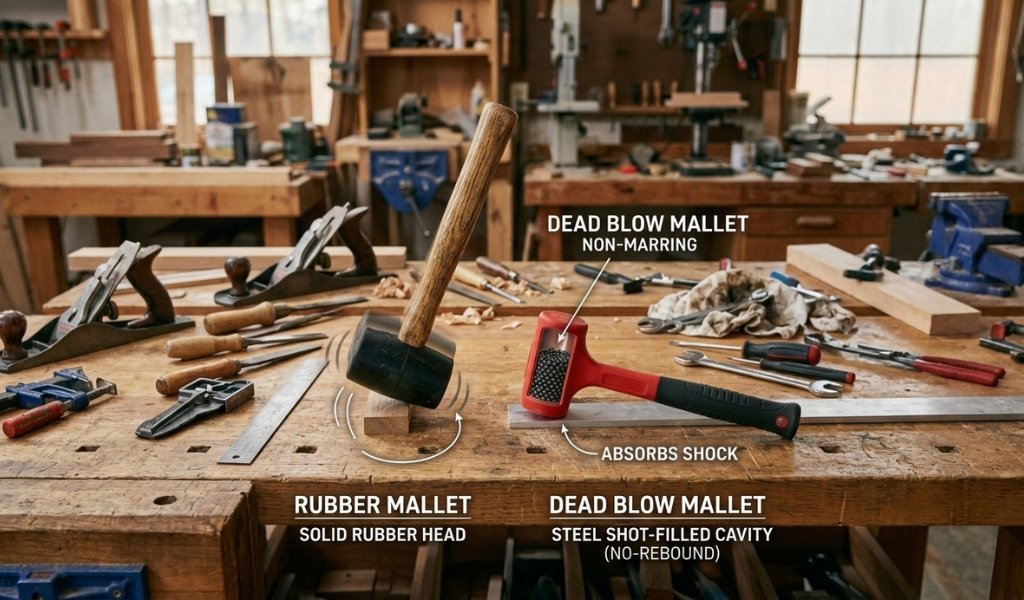
Both the rubber mallet and the dead blow hammer fall under the category of non-marring, soft-face striking tools. Their shared purpose is to deliver controlled force without damaging the surface being struck but how they achieve that goal differs significantly in construction, energy transfer, and rebound behavior.
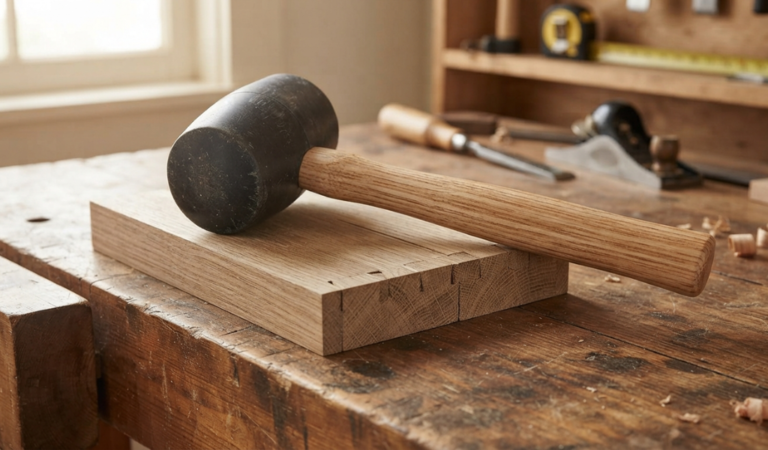
A rubber mallet has a head made entirely from solid rubber typically vulcanized or high-density molded rubber bonded to a wooden or fiberglass handle. When the head strikes a surface, the rubber compresses slightly on contact, then rapidly expands back to its original shape. That elastic rebound is the defining mechanical characteristic of the rubber mallet.
The solid construction is simple and effective. There are no moving parts, no internal cavities, and no filler materials. The head is non-marking, meaning it won’t mar, dent, or scratch most surfaces which is exactly why rubber mallets dominate tile installation, furniture assembly, and carpentry tasks where surface protection is non-negotiable.
Most rubber mallets range from 12 oz to 32 oz, with the 16 oz and 20 oz versions being the most common for general workshop and jobsite use. The black rubber mallet is the most widely recognized version, though white rubber heads are also available for tasks where the black pigment could stain light-colored materials like grout or stone.
The elastic bounce, however, is both a feature and a limitation. On soft or absorbent surfaces, the rebound is manageable. On hard surfaces concrete, steel, ceramic a rubber mallet will bounce back sharply after each strike, which reduces efficiency and can throw off your swing mechanics.
A dead blow hammer looks like a rubber mallet from the outside, but the internal anatomy is entirely different. The head is hollow, encased in polyurethane or a similar soft plastic, and filled with steel shot or sand. That internal shot is what makes the dead blow perform the way it does.
On impact, the steel shot shifts forward inside the cavity, delivering its mass into the strike just as the head makes contact. Instead of the rebound energy snapping back into your wrist as it does with a solid rubber head the shifting shot absorbs and dissipates that energy internally.
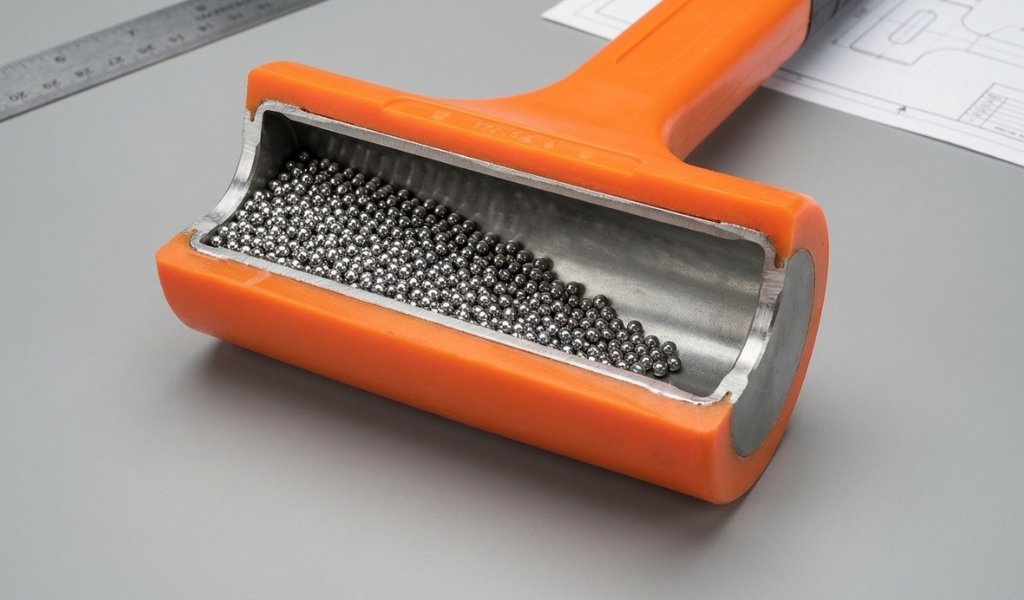
The result is minimal rebound, near-zero bounce-back, and a significantly higher percentage of kinetic energy transferred directly into the target.
Dead-blow hammers are designed to deliver maximum force without damaging sensitive surfaces or allowing energy to escape through recoil. That’s why they’re a standard tool in automotive workshops, manufacturing environments, and anywhere precision force without bounce is critical. The polyurethane casing protects surfaces from marring while the internal cavity mechanics do the real work.
This is one of the most misunderstood aspects of the rubber mallet vs. dead blow debate. The dead blow hammer doesn’t necessarily generate more raw force but it delivers force more efficiently.
With a solid rubber mallet, a portion of each swing’s energy is lost to the elastic rebound of the head. The rubber compresses, then springs back, and that spring-back carries energy away from the target. Depending on the surface hardness, you can lose a meaningful percentage of each strike’s impact this way.
A dead blow hammer eliminates most of that energy loss. The internal steel shot continues moving forward after the head makes contact, extending the duration of the impact and dumping nearly all of the swing’s kinetic energy into the workpiece. The net result: the dead blow doesn’t swing harder, but it works harder per swing. For tasks requiring precise, controlled force without marring like seating a tight mechanical component or driving a joint together that efficiency difference is significant.
Recoil from a rubber mallet isn’t just annoying, it’s a control issue. When the head bounces back unpredictably, particularly on hard or irregular surfaces, you lose the ability to strike with consistent accuracy. In woodworking, a bounce-back can cause the mallet to glance off a chisel handle, sending it sideways. In tile work, a sharp rebound can crack the tile on a follow-through.
Dead-blow hammers essentially eliminate this problem. The minimal rebound means each strike stays predictable and controlled. You can deliver blow after blow to the same target zone with consistent accuracy, which is exactly what’s needed when persuading a stuck mechanical part or driving a joint together without slipping.
For repetitive striking tasks especially in confined spaces or around fragile components that recoil prevention translates directly into safer, more precise work.
Both tools are designed to be non-marking, but they perform that function differently depending on the material.
A rubber mallet’s solid head distributes force across the face of the head, spreading impact over a wider area and reducing the risk of localized denting. On wood, soft metal, and tile, this works extremely well. The limitation appears on finished or painted surfaces, particularly metal: if a rubber mallet bounces back and the edge of the head catches the surface, it can leave a mark.
The polyurethane casing on a dead blow hammer is somewhat harder than rubber, but the zero-bounce mechanics mean there’s far less chance of accidental contact from rebound. On automotive bodywork, aluminum components, or finished furniture, dead-blow hammers typically offer better surface protection not because the face is softer, but because the controlled strike leaves no room for the tool to misbehave.
The most fundamental difference between these two tools is what’s inside the head.
A rubber mallet head is solid rubber from face to core. There are no cavities, no moving parts, and no internal fill material. The mass is fixed and uniform, which means the energy delivery and the rebound behavior are entirely dependent on the elastic properties of the rubber itself.
A dead blow hammer head is hollow, encased in a hard polyurethane or plastic shell, and partially filled with steel shot or sand. That shot occupies roughly 30–50% of the head’s internal cavity, leaving room to shift on impact. When the head strikes a target, the shot travels forward, amplifying the force delivery and absorbing the rebound. It’s a simple but highly effective internal mechanism that fundamentally changes how the tool performs.
This construction difference also affects sound. A rubber mallet produces a dull thud. A dead blow produces a heavier, flatter impact sound than the characteristic “dead” tone that gave the tool its name.
Rubber mallets are primarily available in natural rubber or synthetic rubber compounds. Some models feature a metal or steel core head with rubber pads bonded to each striking face, a design that provides more mass while retaining the non-marking surface protection. Certain specialty versions use interchangeable rubber heads, allowing you to swap face material based on task requirements.
Dead-blow hammers are most commonly encased in polyurethane, a harder and more abrasion-resistant material than natural rubber. Polyurethane holds up better under high-frequency striking and resists cracking in cold temperatures, an important factor in outdoor and garage environments. Some dead-blow designs also feature steel face inserts for applications requiring harder strikes, though these sacrifice some surface protection.
Brands like Estwing and Halder produce well-regarded dead-blow and rubber mallet options across a range of weights and face configurations, with Halder in particular being known for modular, replaceable-face designs.
Because the rubber mallet head is solid, its weight is evenly distributed throughout the head mass. This creates a consistent, predictable swing feel easy to control, easy to gauge force, and forgiving for extended use.
A dead blow hammer has a different weight dynamic. At rest, the shot settles to the bottom or rear of the cavity. During a swing, that mass shifts forward, which alters the perceived balance mid-swing. New users often describe the dead blow as feeling slightly unpredictable until they adjust. Experienced users learn to use that shifting mass to their advantage, timing their swings to maximize the forward momentum of the shot.
For all-day use, fiberglass handles on both tool types significantly reduce vibration transfer to the wrist and forearm compared to wooden handles. The ergonomic handle design matters on extended jobs a fiberglass handle on a 20 oz mallet makes a noticeable difference over several hours of assembly work.
Rubber mallets dominate in situations where surface protection is the primary concern and rebound is manageable.
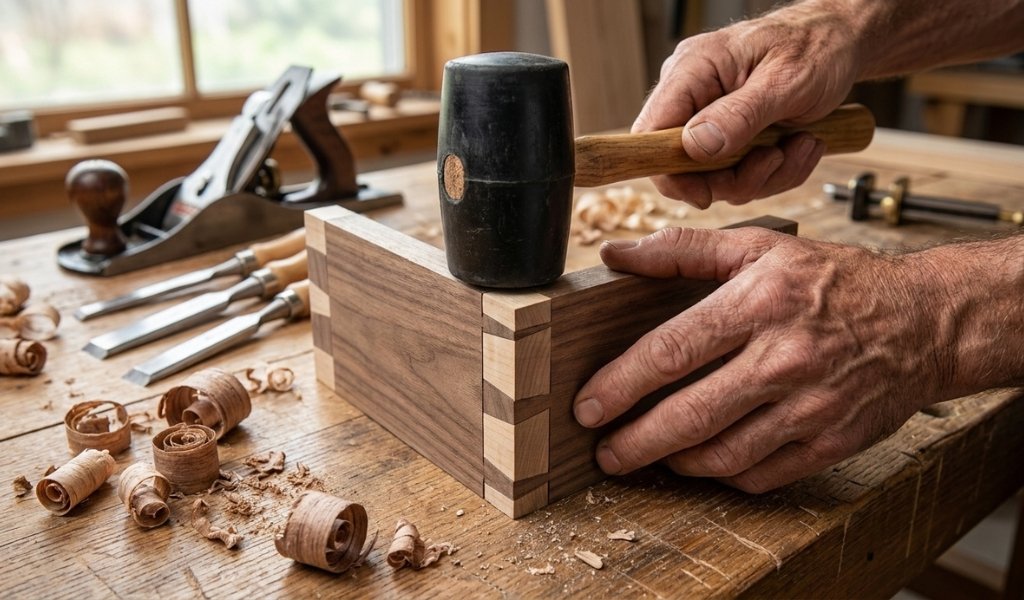
Woodworking joinery is perhaps the most classic rubber mallet application. Driving mortise and tenon joints together, tapping dovetails home, persuading stubborn dowels into bores all of these tasks require enough force to move wood against resistance, but not so much that you split the joint or crush the fibers. The solid rubber head delivers that controlled force cleanly.
Tile setting and paver installation is another core application. When pressing ceramic, stone, or porcelain tiles into a mortar bed, you need to seat the tile firmly without cracking it. A rubber mallet distributes the force evenly across the tile face. The same logic applies to brick and paver work: a rubber mallet knocks each unit into position in the sand bed without chipping edges or cracking faces.
Flat-pack furniture assembly is where most homeowners first encounter a rubber mallet. The cam locks, dowels, and panel joints used in flat-pack construction require the kind of persuasive tapping that a rubber mallet handles perfectly firm enough to fully seat components, gentle enough not to strip or crack the MDF or veneer.
Laminate and vinyl flooring installation rounds out the core use cases. Tapping flooring planks together, closing the joints without cracking the tongue-and-groove connection, a rubber mallet and a tapping block are the standard solution.
Dead-blow hammers come into their own anywhere that precision force delivery and minimal rebound are essential especially on hard, unyielding surfaces where a rubber mallet would simply bounce away.
Automotive work is the defining application. Removing stuck wheel hubs, loosening stubborn suspension components, knocking CV joints free, or tapping body panels back into rough alignment these tasks require force that a rubber mallet can’t efficiently deliver on hard metal surfaces. The dead blow delivers that force cleanly, without the chaotic rebound that a standard rubber mallet produces when striking steel.
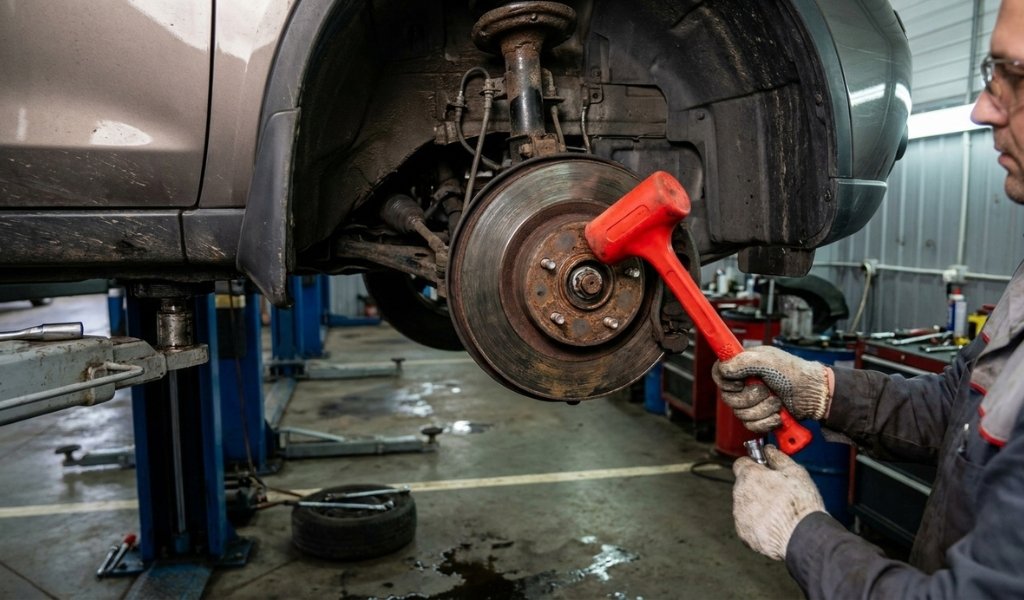
Machinery assembly and maintenance is another high-value application. Seating tight components, aligning machinery frames, driving pins and bushings into bores all of these require controlled, repeatable strikes where energy efficiency matters. Every ounce of swing energy needs to go into the workpiece, not back into the operator’s wrist.
Automotive and industrial disassembly tasks where parts are stuck by corrosion, heat bonding, or mechanical interference benefit significantly from the dead blow’s ability to impart sustained, direct force. The minimal recoil also makes it safer in tight engine bays or around adjacent components that could be damaged by a bouncing tool.
In garage and workshop environments where both tools are available, a common working rule is straightforward: reach for the rubber mallet when protecting the surface is the top priority, and reach for the dead blow when you need force to actually move something resistant.
Getting the weight right matters as much as choosing the correct mallet type. Too light, and you’ll strain your joints with excessive swings. Too heavy, and you’ll lose control and fatigue quickly.
For general woodworking, furniture assembly, and tile setting, a 16 oz to 20 oz rubber mallet covers most tasks without becoming tiring. Heavier joinery work large mortise and tenon joints, driving substantial dowels may benefit from a 24 oz head.
For dead-blow applications in automotive and machinery work, a 24 oz to 32 oz dead blow hammer is typically the practical range. Lighter versions work for precision fitting tasks. Heavier dead blows some models reach 40 oz or beyond, are reserved for seriously resistant components, though they’re rarely needed in standard workshop settings.
Head size also affects where you can work. A larger striking face distributes force over a wider area ideal for tile and panel work. A smaller face gives you more targeted force delivery better for driving pins, tapping bushings, or working in confined mechanical spaces.
Handle material directly affects shock absorption, durability, and in some environments safety. Wooden handles are traditional and offer good shock absorption, but they can crack under heavy use or in dry conditions. Fiberglass handles are more durable, resist cracking, and handle vibration better over long work sessions.
In chemical or fuel-rich environments automotive garages, refineries, or industrial maintenance settings spark-resistance becomes a critical safety consideration. Most polyurethane-encased dead blow hammers are non-sparking by nature, making them appropriate for use around flammable materials. Purpose-built spark-free dead blow hammers made from non-ferrous materials are available for the most sensitive environments, such as around fuel lines or compressed gas fittings.
For longevity, look for mallets with replaceable faces. Several manufacturers, including Halder, build modular dead blow and rubber mallet systems where the striking face can be swapped out when worn. This extends the tool’s effective lifespan significantly, especially in high-frequency production environments where face wear is a real maintenance concern.
Not necessarily but they hit more efficiently. A dead blow hammer transfers a higher percentage of swing energy into the target by using internal steel shot to absorb rebound. The result is more effective force per swing, even if the raw striking weight of the two tools is identical.
For many applications, yes but not all. The dead blow’s polyurethane face is slightly harder than rubber, which means it can leave faint marks on very soft or highly polished surfaces where a rubber mallet would be safer. For delicate woodworking joinery or fine tile work, a rubber mallet remains the better choice.
Standard polyurethane dead blow hammers are generally non-sparking due to their non-metallic construction, making them suitable for most garage and workshop environments. For high-risk settings involving fuel, gases, or explosive environments, verify that the specific tool is rated as spark-resistant and non-ferrous before use.
The bounce-back is a product of the rubber head’s elastic properties. When solid rubber strikes a hard surface, it compresses on impact and then rapidly returns to its original shape, releasing stored energy as rebound. On hard surfaces like concrete, tile, or steel, this elastic recoil is most pronounced.
Choose the rubber mallet when surface protection is the top priority and you’re working on softer or more delicate materials tile setting, furniture assembly, installing laminate flooring, or carpentry. The solid rubber head distributes force gently and predictably, and the lower cost makes it the practical everyday choice for general workshop use.