Physical Address
304 North Cardinal St.
Dorchester Center, MA 02124
Physical Address
304 North Cardinal St.
Dorchester Center, MA 02124

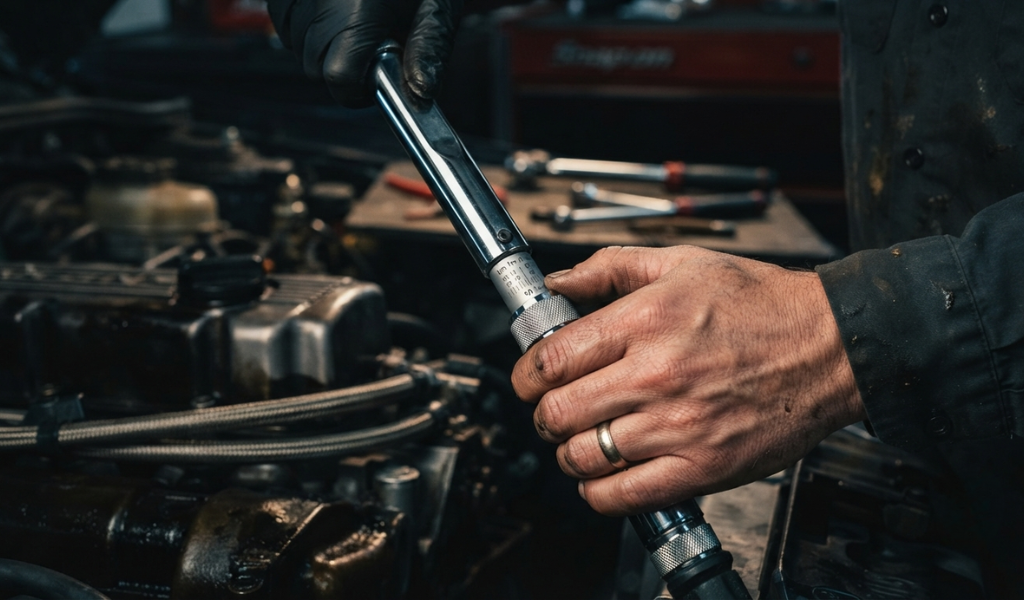
If you have ever stripped a bolt or watched a fastener snap because you tightened it too much, you already know why torque matters. Learning how to use a click-type torque wrench properly can save you money, protect your equipment, and keep every repair job safe and accurate. Whether you are working on a car engine, a motorcycle chain, or a piece of home machinery, this tool takes the guesswork out of tightening.
A click-type torque wrench is one of the most trusted tools in any garage or workshop. It looks like a regular wrench but works with precision, giving you an audible click the moment a fastener reaches the exact torque you set. In this guide, you will learn everything from the basic parts of the tool to how to read a torque wrench, set it correctly, use it safely, and store it so it lasts for years.
By the end of this article, you will understand not just how the tool works but also how to avoid the common mistakes that ruin fasteners and shorten the wrench’s lifespan.
A click-type torque wrench is a hand tool built to apply a specific amount of rotational force, known as torque, to a nut or bolt. Unlike a standard wrench that relies purely on feel, this tool gives you a physical and audible signal once the fastener has reached the target tightness. That signal is a distinct click, and it is the reason mechanics and technicians trust this design so much.
The tool is widely used because it removes human guesswork from the tightening process. Manufacturers of cars, bikes, and machines list exact torque values for their fasteners, and a click-type wrench lets you match those numbers precisely. This matters because both under-tightening and over-tightening can cause serious damage, from loose parts that vibrate free to cracked housings and stripped threads.
Compared to other types, such as beam or digital torque wrenches, the click-type model strikes a balance between affordability, accuracy, and ease of use. It does not require batteries or constant visual monitoring, which makes it a favorite for both professionals and weekend mechanics.
Inside the wrench sits a spring-loaded mechanism connected to the handle. When you rotate the handle, you adjust the tension on that internal spring, which corresponds to a specific torque setting shown on the scale. As you tighten a fastener with the wrench, the internal mechanism resists your applied force until it reaches the preset value.
Once that value is hit, a small lever inside releases suddenly, causing the head of the wrench to move slightly and produce a clicking sound along with a subtle jolt you can feel in your hand. This click is your cue to stop applying pressure immediately. If you keep turning after the click, you risk over-tightening, since the mechanism only signals the target torque rather than physically stopping your movement.
Understanding this mechanical process helps explain why timing matters so much when using the tool. The moment you feel or hear that click, your job is done for that fastener.
Every click-type torque wrench shares a few essential components, and knowing them makes the tool much easier to use correctly.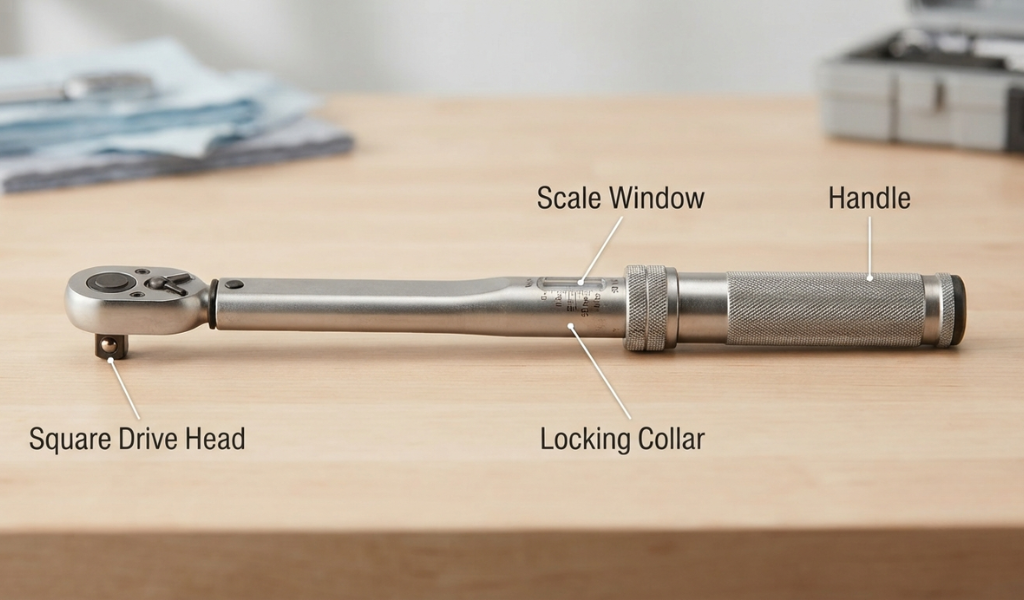
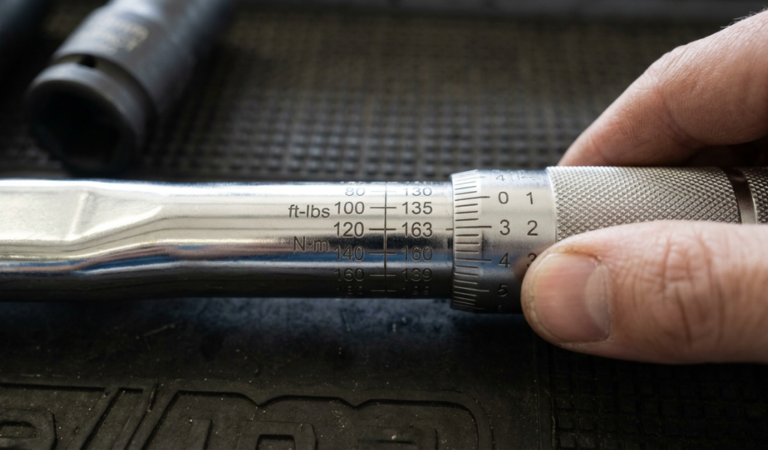
The handle houses the adjustment mechanism and often includes a locking collar or knob near the base. Turning this handle changes the torque setting displayed on the scale. The scale itself, usually located along the handle, shows measurement markings in units like Newton-meters or foot-pounds, allowing you to dial in the exact value needed for your task.
The drive head is where you attach sockets or extensions, and it is typically a square drive available in common sizes such as 1/4 inch, 3/8 inch, or 1/2 inch. Some models include a reversible ratchet head, letting you use the wrench for both tightening and loosening.
Near the handle, you will also find a locking mechanism that keeps your torque setting from shifting accidentally during use. This small part plays a big role in maintaining accuracy, especially in busy workshop environments where the tool gets picked up and moved around often.
Getting the torque setting right is the single most important step in the entire process. Even a well-made wrench will not help you if the value you dial in is wrong for the job.
The torque scale on most click-type wrenches is printed along the length of the handle, near the adjustment knob. It typically shows two rows of numbers, major markings for whole units and minor markings for smaller increments in between. Learning how to read a torque wrench scale correctly means paying attention to both rows, since a small misread can lead to a noticeably wrong setting.
Most wrenches display measurements in Newton-meters (Nm), foot-pounds (ft-lb), or sometimes inch-pounds (in-lb) for smaller fasteners. Before setting anything, check your vehicle or equipment manual for the exact torque specification required, since guessing is never a safe option.
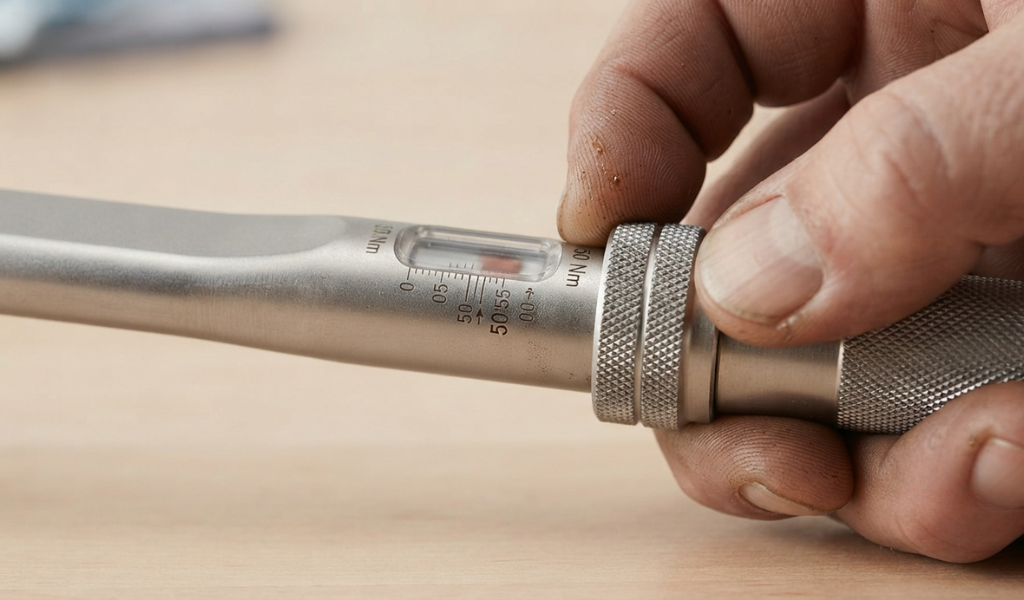
To set the torque, first unlock the adjustment collar at the base of the handle, usually by twisting or pulling it slightly outward. Rotate the handle clockwise to increase the value or counterclockwise to decrease it, watching the scale carefully as the numbers align with the reference line or window.
Once you reach the exact figure specified for your fastener, lock the collar back into place. This locking step is easy to forget but critical, since an unlocked handle can drift out of position while you are working, throwing off your entire setting without you realizing it.
Now that the tool is set up correctly, using it in practice comes down to three simple stages.
Choose a socket that matches the size of the fastener you are working on and fit it securely onto the drive head. A loose or mismatched socket can slip during use, damaging the fastener head or throwing off your torque reading. Always double check that the socket clicks firmly into place before applying any force.

Grip the handle at the center marking, since most wrenches are calibrated assuming force is applied at that exact point. Holding the tool too close to the head or too far out on the handle can slightly change the actual torque being applied, even if the scale shows the correct number.
Position your body so you can pull or push in a smooth, controlled motion rather than at an awkward angle. Standing directly behind the wrench, with your shoulder aligned to the direction of force, gives you better control and a more accurate result.
Begin turning the wrench steadily, applying even pressure without jerking or rushing the motion. As the fastener tightens, you will feel resistance build gradually. When the wrench reaches your preset torque, you will hear a clear click and often feel a small give in the handle.
The moment that click happens, stop turning immediately. Continuing to apply pressure after the click, even briefly, can push the fastener past its intended torque and undo the accuracy the tool was designed to provide.
A torque wrench is not just for professional mechanics. Anyone working with fasteners that carry safety or performance requirements should have one on hand.
Car engines, wheel lug nuts, cylinder heads, and suspension components all rely on precise torque specifications. Overtightened lug nuts, for example, can warp brake rotors, while undertightened ones risk a wheel coming loose while driving. Mechanics use torque wrenches constantly during engine rebuilds, brake jobs, and general maintenance to make sure every bolt matches the manufacturer’s requirements.
Modern bikes, especially those with carbon fiber frames and components, are particularly sensitive to over-tightening. A torque wrench helps cyclists and motorcycle owners tighten stems, handlebars, and seat posts without cracking delicate materials. Motorcycle chains, brake calipers, and engine covers also require accurate torque to perform safely at high speeds.
Beyond vehicles, torque wrenches are useful for assembling furniture with metal fittings, home appliances, workshop equipment, and even some plumbing fixtures. Any project involving bolted connections that need to hold steady under stress or vibration benefits from correct torque application.
Even experienced users sometimes fall into habits that reduce the accuracy and lifespan of their torque wrench.
One of the most frequent errors is continuing to turn the wrench after the click, especially when a fastener feels like it needs “just a little more.” This habit defeats the entire purpose of the tool and can lead to stripped threads, cracked components, or fasteners that are dangerously overstressed.
Another common mistake is relying on memory or rough estimates instead of checking the manufacturer’s specifications. Torque values vary widely depending on the material, size, and application of the fastener, so a setting that works for one bolt may be completely wrong for another. Always confirm the correct number before you begin.
Using the tool safely protects both you and the quality of your work.
Before every job, check the wrench for visible damage, rust, or a loose drive head. A worn or damaged tool can give inaccurate readings, which defeats the purpose of using it in the first place. If the click feels inconsistent or the scale looks hard to read, it may be time for calibration or replacement.
Always pull or push the wrench in a smooth, controlled motion rather than jerking it suddenly. Sudden force can cause the wrench to click prematurely or inaccurately, and it increases the risk of your hand slipping off the handle. Keep your footing steady and avoid using extensions or cheater bars unless the manufacturer specifically allows it, since these can apply more torque than the tool is rated for.
Good storage habits keep your torque wrench accurate for years, while poor habits can wear out the internal spring mechanism much faster than expected.
After every use, turn the adjustment handle back down to the lowest torque setting on the scale. Leaving the spring compressed at a high setting for long periods causes it to weaken over time, which throws off future accuracy. This simple habit takes only a few seconds but significantly extends the tool’s working life.
Store your torque wrench in its case, away from extreme heat, moisture, or direct sunlight. Avoid dropping it or stacking heavy tools on top of it, since physical shocks can knock the internal mechanism out of alignment. Most manufacturers recommend professional calibration once a year or after a set number of uses, particularly if the wrench sees regular heavy duty work in a shop setting.
A click-type torque wrench is a simple tool with a big impact on the safety and durability of anything you build or repair. Once you understand its parts, know how to set it accurately, and get comfortable with the tightening process, you will find that most tightening mistakes disappear from your work entirely. Take the time to check manufacturer specs, apply steady pressure, and store the tool properly, and it will reward you with years of reliable service.
If you are new to this tool, start with a low-stakes project like tightening a bike stem or a small appliance bracket to build confidence before moving on to more critical automotive work.
What does the click on a torque wrench actually mean?
The click signals that the wrench has reached the exact torque value you set. It is your cue to stop turning immediately to avoid over-tightening the fastener.
How do I read a torque wrench scale correctly?
Look at the markings along the handle, paying attention to both the major and minor increments. Align your target value with the reference line or window, then lock the setting in place.
Can a click-type torque wrench be used to loosen bolts?
Some models with a reversible ratchet head can loosen fasteners, but many manufacturers recommend using a separate breaker bar for loosening to protect the internal mechanism from unnecessary wear.
How often should a torque wrench be calibrated?
Most experts suggest calibration once a year for regular use, or more frequently if the tool is used daily in a professional shop.
What happens if I keep turning after the click?
Continuing past the click applies more torque than intended, which can strip threads, damage fasteners, or overstress the component you are working on.
Why should I return the wrench to its lowest setting after use?
Leaving the internal spring compressed at a high setting for extended periods weakens it faster, reducing the tool’s accuracy and lifespan over time.
Is a click-type torque wrench better than a digital one?
Both have their strengths. Click-type wrenches are generally more affordable, do not need batteries, and are easier to maintain, while digital models often offer more precise readings and data logging features for specialized work.