Physical Address
304 North Cardinal St.
Dorchester Center, MA 02124
Physical Address
304 North Cardinal St.
Dorchester Center, MA 02124

Your power drill can do far more than bore holes. With the right sanding drill bit or drill sander attachment, that same tool becomes a capable sander for shaping, smoothing, and surface prep. From knocking down rough edges on a walnut board to removing rust from a metal bracket, the humble electric drill turns into a surprisingly versatile grinder and sander.
This guide breaks down every type of sanding attachment you can chuck into a drill: sanding drums, flap wheels, rotary grinding stones, and sanding discs with backer plates. You’ll learn how each accessory works, which grit to choose, and how to sand wood with a drill without leaving burn marks or gouges behind. Whether you’re a working pro or a weekend DIY tinkerer, you’ll walk away knowing exactly which tool to reach for.
Before we dive in, it helps to understand where drill-mounted abrasives sit in the bigger picture. If you want a full overview of dedicated sanders and abrasives, our guide to wood sanding tools covers the machines and accessories that complement everything below.
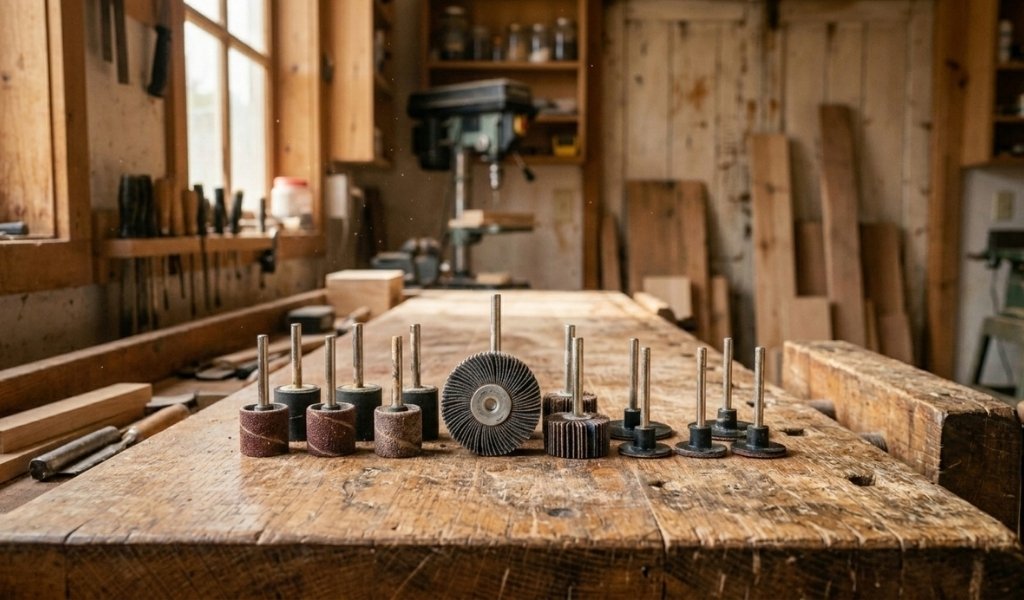
A sanding drill bit isn’t a drill bit in the traditional sense. Instead of cutting into material, it holds abrasive material, sandpaper, sanding bands, or bonded grit, and spins it against a surface to sand, grind, or polish. The abrasive is mounted on a shank that fits into your drill’s chuck, just like a standard bit.
These attachments span a huge range. Some are tiny mandrel bits used in nail sanding and manicure work. Others are heavy 2-inch drill sander attachments built for woodworking and rust removal. What they share is a common principle: the drill supplies the rotation, and the attachment supplies the cutting action.
Yes, a power drill works well as a sander for many jobs, though it has limits. Corded and cordless power drills spin between roughly 1,500 and 3,000 RPM, which is plenty for driving sanding drums, discs, and flap wheels. This makes a handheld drill a practical stand-in for a dedicated sander when you need to shape curves, smooth edges, or handle spot work.
Where a drill falls short is flat, large-surface finishing. A random orbit sander will always leave a smoother, swirl-free result on a tabletop. But for contoured shapes, tight spots, and quick material removal, a drill with the right sanding accessory is hard to beat. It’s compact, you probably already own one, and swapping attachments takes seconds.
Drill sanding relies on the abrasive’s grit doing the work as the drill rotates it. Coarse grit (like 80 grit) strips material fast and shapes rough stock. Finer grit (like 180 grit) smooths the surface for finishing. The attachment’s shape determines what it’s good for: a drum reaches into concave curves, a flap wheel wraps around contours, and a disc flattens broad faces.
Most woodworking attachments use a threaded or friction-fit shank, typically an inch shank or a smaller 3mm shank for compact accessories. Speed control matters too. Wood scorches easily, so a lower drill speed and steady movement keep the surface cool. Let the grit cut; don’t force the tool. Pushing too hard clogs the abrasive and burns the wood.
No single attachment does everything. Building a small kit of sanding drill bits gives you the flexibility to tackle wood, metal, acrylic, and plastic without swapping tools. Here are the three categories every workshop should stock.
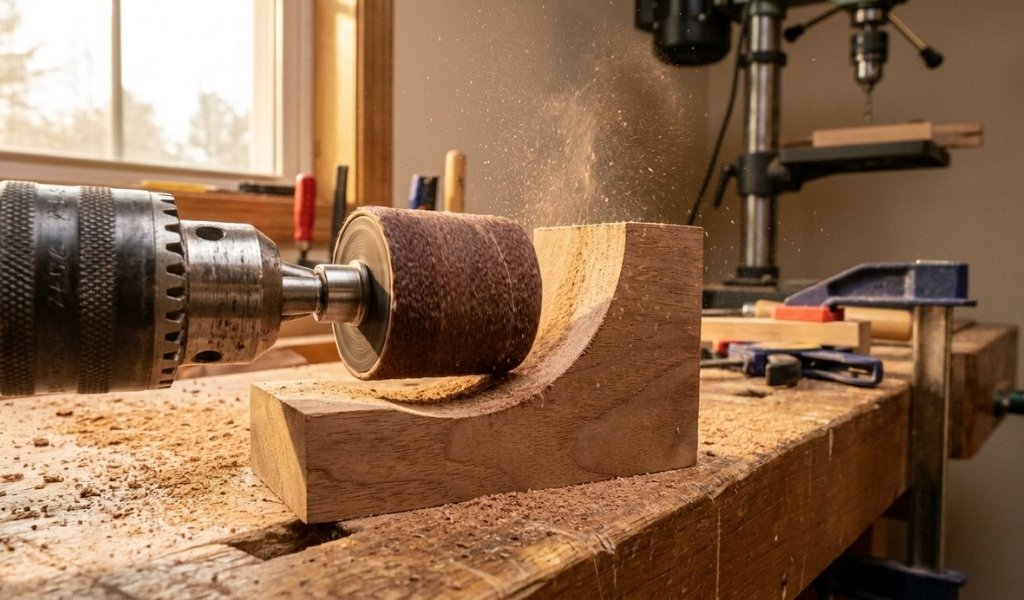
A sanding drum is a rubber or foam cylinder that grips a replaceable abrasive sleeve. Slide a worn sleeve off, push a fresh one on, and you’re back to work. Drums turn your drill into a mini spindle sander, which is ideal for sanding the inside of curves, smoothing cut-outs, and shaping convex and concave edges.
A typical sanding drum kit includes several drum mandrels in different diameters plus a stack of sleeves in assorted grits. The mandrel expands slightly as you tighten it, locking the sleeve in place so it doesn’t spin free under load. Drum sanders shine on chair legs, jigsaw-cut shapes, and any curved surface where a flat pad can’t conform.
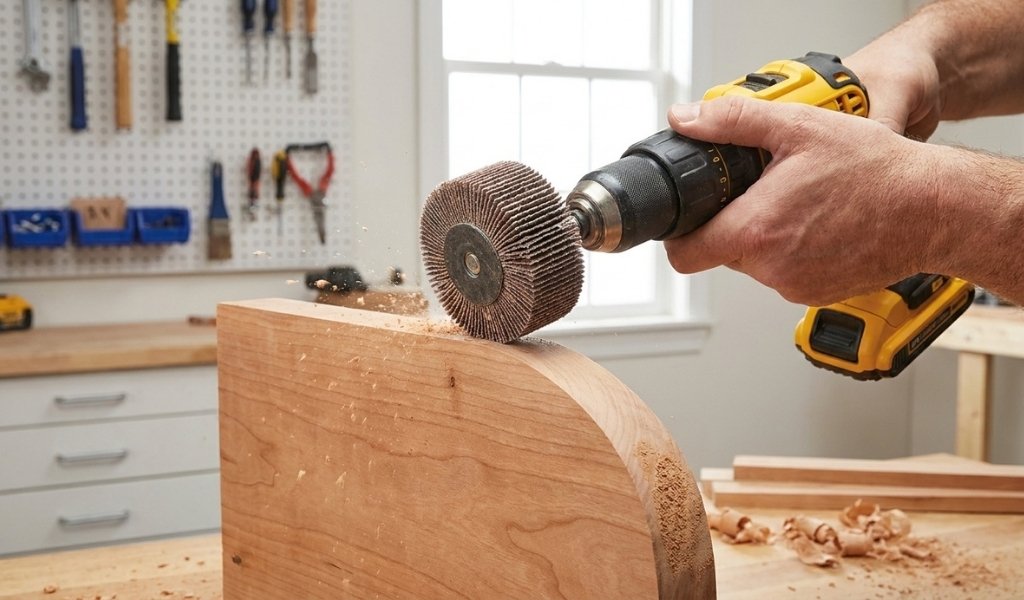
Flap wheels are made from overlapping strips of sandpaper radiating from a central hub. As the outer flaps wear down, fresh abrasive is exposed underneath, so the wheel keeps cutting consistently. They conform to contours beautifully, which makes them excellent for shaping wood, blending welds, and rust removal on metal.
Rotary grinding stones and diamond or carbide burrs take things further. A diamond point grinds hard materials like ceramic and tile, while carbide burrs carve wood and soft metal aggressively. For rust removal and paint stripping, a wire brush wheel or coarse flap wheel clears surfaces fast. These accessories overlap with what a Dremel rotary tool does, but a standard drill handles the larger versions with ease.
A sanding disc drill setup uses a backing plate, essentially a rubber pad on a shank, that holds sandpaper discs via hook and loop or an adhesive bond. This is the go-to for flatter surfaces and broad sanding work. The most popular option is the 2 inch drill sander attachment, often sold as a 100pcs 2 inch drill sander set that bundles a backer plate with a big assortment of hook and loop discs.
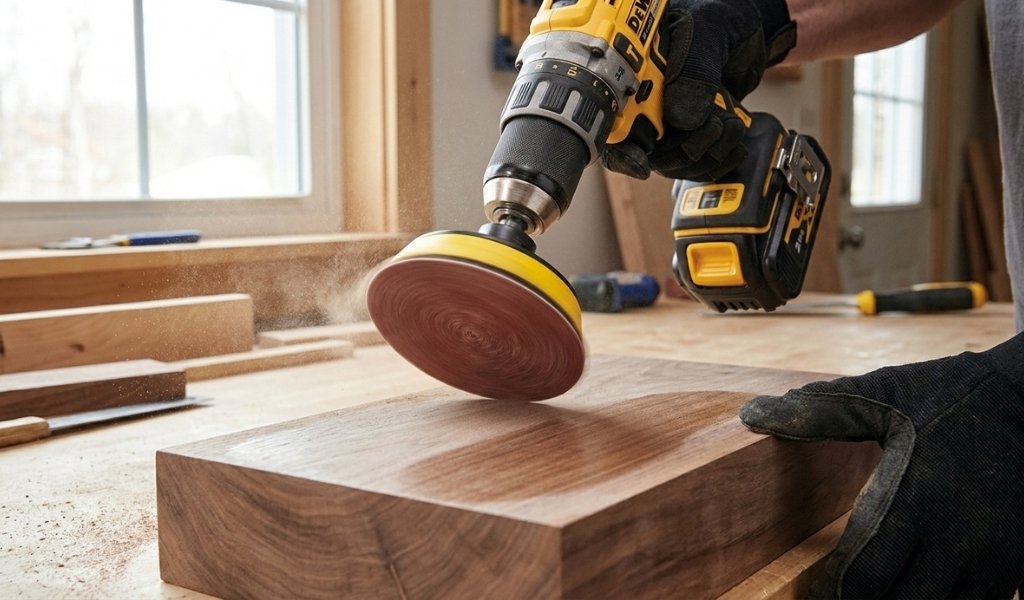
These kits are cheap, versatile, and cover a lot of ground. The drill sander attachment with backer supports wet dry sanding, buffing pads, and polishing pads too, so the same shank handles headlight restoration, acrylic polishing, and metal finishing. Look for a set with a sander attachment with a backer plate that uses hook and loop, since swapping sandpaper discs takes only a second and you can reuse the discs many times.
| Attachment | Best material | Typical use |
| Sanding drum | Wood, plastic | Curves, cut-outs |
| Flap wheel | Wood, metal | Shaping, blending |
| Grinding stone | Ceramic, metal | Grinding, deburring |
| Sanding disc + backer | Wood, acrylic, metal | Flat surfaces, polishing |
| Wire brush | Metal | Rust removal |
Sanding wood with a drill is straightforward once you match the attachment to the job and control your speed. Follow these steps for clean results without burn marks or gouges.
Start by matching the accessory to the surface. Use a sanding drum for interior curves, a flap wheel for rounded edges, and a disc with a backer for flat faces. Size matters too: a 2-inch attachment covers ground quickly, while smaller drums fit tight spaces.
Then work through grits in sequence. Begin with a coarse 80 grit to remove tool marks and shape the wood, then step up to 120 grit, and finish with a smooth 180 grit for a finish-ready surface. Skipping grits leaves scratches that show up under stain or finish. As a rule, don’t jump more than about 60 to 80 grit points between passes.
Insert the shank fully into the chuck and tighten firmly. A loose shank wobbles, which causes uneven sanding and can damage the accessory or your work-piece. Give the attachment a gentle tug to confirm it’s seated before you power up.
Run the drill at a low to medium speed. High RPM generates heat, and heat scorches wood and clogs the sandpaper with burned residue. Keep the tool moving in smooth, overlapping passes; never dwell in one spot. Let the grit do the cutting rather than pressing hard. If you see fine dust turning dark, ease off the pressure and slow down. And always wear eye protection and a dust mask, since drill sanding throws off plenty of fine dust.
Yes. A power drill fitted with a sanding attachment sands, shapes, and polishes wood, metal, plastic, and acrylic. It won’t match a random orbit sander for flat finishing, but for curves, edges, and spot work, a drill is a genuinely capable sander.
There are several. The main types are sanding drums with replaceable sleeves, flap wheels, rotary grinding stones, and sanding discs mounted on a backer plate. Each attaches to your drill’s chuck via a shank and suits different surfaces and materials.
Yes, through a backing plate. A backer pad with a shank holds sandpaper discs using hook and loop backing or adhesive. The common 2-inch drill sander attachment, often sold in a 100pcs kit, is the easiest way to run standard sandpaper discs from your drill.
Fit the right attachment, secure the shank tightly in the chuck, and work through grits from coarse (80 grit) to smooth (180 grit). Run the drill at low to medium speed, keep it moving in overlapping passes, and avoid heavy pressure to prevent burn marks.
Most sanding attachments use a standard shank, commonly a 1/4-inch or 3mm shank, that fits the chuck on virtually any corded or cordless electric drill. Always check the accessory’s shank size against your drill’s chuck capacity before buying, especially for larger flap wheels and drum mandrels.
A drill and a modest set of sanding attachments cover an impressive amount of ground, curves, contours, rust removal, polishing, and flat sanding all from one tool you likely already own. Start with a versatile 2-inch disc kit and a small sanding drum set, keep 80, 120, and 180 grit on hand, and control your speed to protect your work.
For projects that demand a flawless flat finish, pair your drill with a dedicated sander when the job calls for it. But for shaping, prep, and detail work, the right sanding drill bit earns its place in every toolkit.