Physical Address
304 North Cardinal St.
Dorchester Center, MA 02124
Physical Address
304 North Cardinal St.
Dorchester Center, MA 02124

A truly smooth wood surface rarely happens by accident. It’s the result of the right abrasives, the right grit progression, and the right tools working together. That’s exactly what a well-built wood sanding kit gives you: everything you need to move from rough lumber to a finish-ready surface, all in one package.
For DIY restorers, carpenters, and professional woodworkers alike, buying a complete sanding kit beats hunting down individual discs, pads, and holders one at a time. You get matched components, a sensible range of grit, and accessories designed to work as a system. Whether you’re refinishing a heirloom dresser or prepping a run of cabinet doors, the kit approach saves time and reduces guesswork.
This guide breaks down what belongs in a professional sanding kit, the different types available for various woodworking projects, and how to pair your abrasives with power tools for maximum workshop efficiency. If you want a broader look at the machines behind these accessories, our complete guide to wood sanding tools is a great companion read. Let’s get into what makes a sanding kit worth owning.
A pro-grade sanding kit is more than a stack of sandpaper. It’s a coordinated set of parts that let you attach, swap, and control your abrasives across different surfaces and stages of work. Understanding each component helps you buy smarter and use what you have more effectively.
The best kits balance power tool attachments with hand sanding accessories. That combination covers both the fast, flat work a sander handles and the detail sanding that only a careful hand can finish properly. Here’s a closer look at the parts you’ll find inside a quality package.
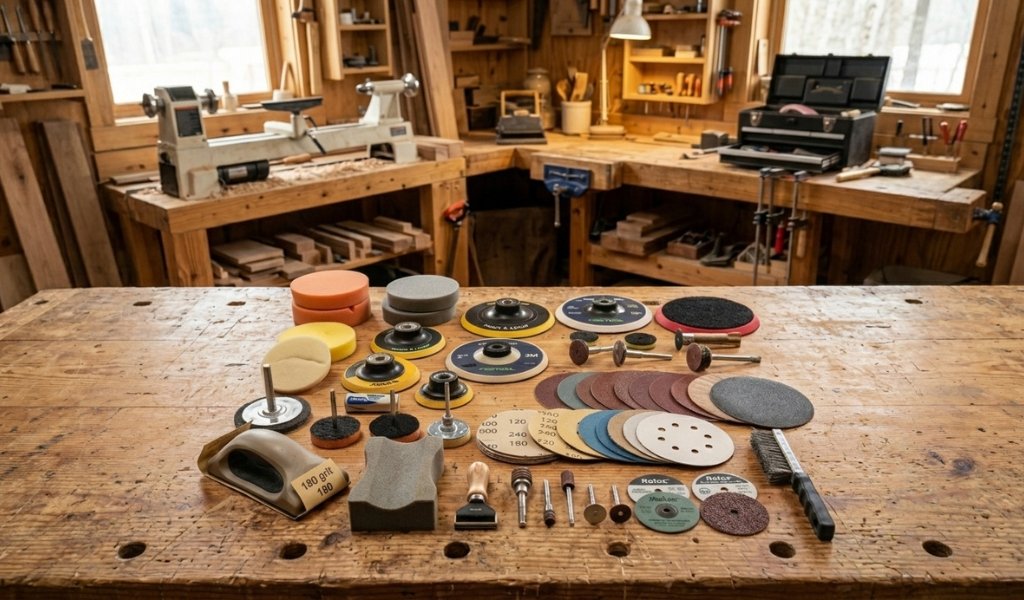
The backbone of any power-driven sanding system is the hardware that connects your abrasive to the tool. Disc holders grip your sanding discs and mount into a drill or rotary tool, keeping the abrasive flat and stable against the wood surface.
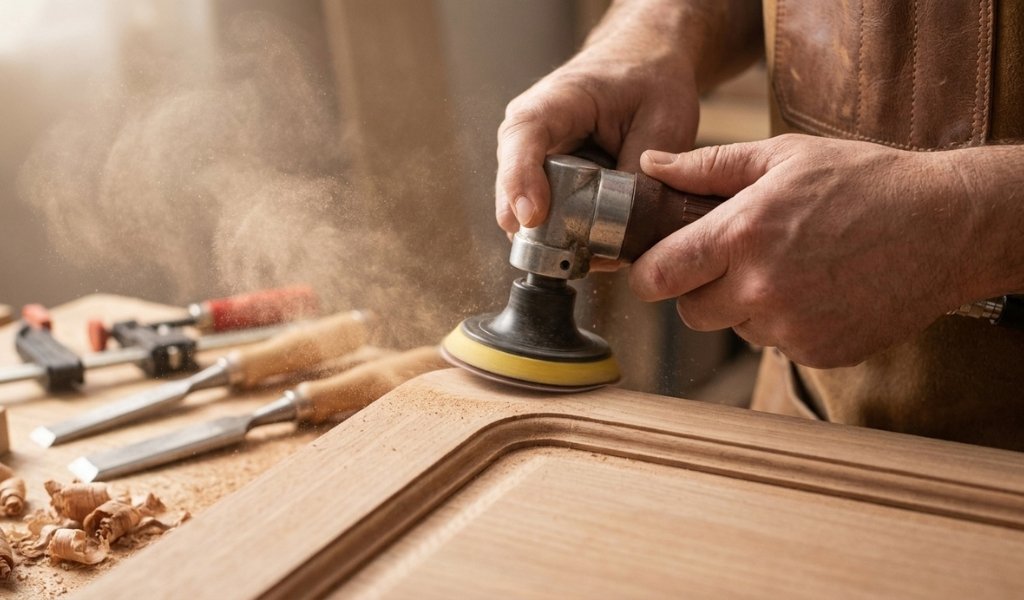
Most use a hook and loop face so you can change discs in seconds.
Foam pads sit between the holder and the disc, adding a layer of cushioned give. This soft backing lets the abrasive flex slightly over contours and curved edges, which is why foam interface pads are prized for fine finishing and shaping work. A firm pad keeps things flat; a soft pad follows the surface.
Roloc mandrel stems are the quick-change heroes of the kit. These threaded steel stems lock into a rotary tool chuck and accept twist-on Roloc discs. Swap a worn disc for a fresh one with a quarter turn, no wrenches required. For repair work, rust removal on metal fittings, or knocking back tough finishes in tight areas, the Roloc system is fast and reliable.
Hook and loop pads turn any compatible sander or holder into a rapid disc-changing machine. The Velcro-style grip holds sanding discs firmly during use, yet peels away cleanly when it’s time to step up a grit. This hook and loop sanding system is the standard across random orbital sanders and most drill-mounted holders because it’s simply faster than adhesive-backed alternatives.
On the manual side, hand sanding accessories give you precision where machines fall short. A good hand sanding kit typically includes:
Hand sanding gives you the control that power tools can’t always match. For final passes and delicate repair work, nothing beats a comfortable block and a fresh sheet of abrasive.
No single sanding kit suits every task. A jeweler restoring a small wooden box needs something very different from a carpenter smoothing a tabletop. Matching the kit to the project is the key to efficient, clean results.
Below are the most popular types of sanding kits, grouped by the kind of work they handle best. Choose based on your project scale, the detail involved, and how much material you need to remove.
A mini sanding kit is built for precision. These compact sets pack small discs, narrow foam pads, and slim mandrels designed for rotary tools and detail sanders. They shine on intricate carvings, tight inside corners, model-making, and small repair jobs where a full-size sander would be clumsy or damaging.

Because the pads and discs are small, you gain fine control over exactly where the abrasive touches. That precision makes mini kits a favorite for craft work, furniture restoration, and any project with delicate detail. Many include multiple pad shapes so you can reach flat faces, curved edges, and narrow slots without switching tools.
For general woodworking, a comprehensive multi-grit kit is the workhorse. These packages include sanding sheets spanning a full range of grit, typically starting around 80 grit for aggressive material removal and climbing through 120, 240, and 320 up to 600 for fine finishing. This progression is what produces a truly smooth surface.
Here’s how the grit range breaks down in practice:
Working through every grit in order, without skipping steps, is the single most important habit in producing a professional finish. A complete hand sanding kit with this full spread means you never stall mid-project waiting on the right sheet.

Some kits target the fine finishing stage specifically. Detail finishing sets bundle high-grit abrasives, soft foam pads, and small profile tools aimed at the last steps before a topcoat goes on. These are ideal when the heavy lifting is done and all that remains is refining the surface to perfection.
Reusable mesh systems are a newer, smarter option worth knowing about. Instead of solid-backed sandpaper, mesh abrasives have an open weave that lets dust pass through rather than clogging the surface. That design keeps the abrasive cutting faster and longer, and many mesh discs can be rinsed clean and reused. For wet sanding and dusty repeat jobs, mesh systems reduce waste and hold their bite well past the point where standard paper would quit.
When your projects grow in size or you’re working through material every day, a power tool bundle earns its place fast. These heavy-duty combinations pair a sander or drill attachment with a full set of matched abrasives, giving you a ready-to-work system out of the box.
The right bundle depends on your tools and your typical workload. A rotary tool bundle suits detail and repair specialists, while a palm sander package serves anyone tackling broad flat surfaces regularly. Here’s what to look for in each.
Angle drill sanding bundles solve a common problem: reaching awkward spots where a standard drill won’t fit. The right-angle head lets you drive sanding discs flat against surfaces inside cabinets, under overhangs, and along tight vertical faces. Paired with foam-backed disc holders, these bundles handle both flat and gently curved work in confined areas.
Rotary tool bundles center on versatility. A rotary tool spins at high speed and accepts a huge variety of small abrasives through mandrel stems, from Roloc discs to sanding drums. These kits are the go-to for detail sanding, metal cleanup on hardware, and precision work where control matters more than raw power. Many include aluminum and brass accessories alongside the abrasives, making them useful for mixed-material repair jobs.
For flat surface finishing, an ergonomic palm sander is hard to beat. These lightweight tools fit comfortably in one hand, use a hook and loop pad for fast disc changes, and move in a tight orbital pattern that smooths without aggressive gouging. Modern designs feature a soft, comfortable grip and reduced vibration, which matters a great deal during long sanding sessions. Your hands stay fresher and your control stays sharper.
Palm sander bundles often ship with useful accessory add-ons that boost workshop efficiency:
Some premium kits also step up to variable-speed control, letting you slow the sander for delicate finishing or speed it up for faster material removal. Pairing a quality palm sander with a well-stocked accessory set builds an efficient, flexible station that handles the bulk of everyday woodworking projects.
A wood sanding kit is only as good as its fit for the job in front of you. Detail restorers thrive with a mini kit and a rotary tool bundle. General woodworkers get the most mileage from a comprehensive 80-to-600-grit set paired with an ergonomic palm sander. High-volume shops lean on heavy-duty combinations with plenty of spare pads and reusable mesh discs to keep production moving.
Whatever you build, remember the fundamentals that no kit can do for you: sand with the grain, work through your grit range in order, let the tool do the work, and keep your surface and abrasives clean. Master those habits with quality tools in hand, and a smooth, professional finish stops being luck and starts being routine.
Ready to upgrade your setup? Start with the grit range you use most, add the pads and holders that match your tools, and build out from there. For a deeper look at the sanders themselves, revisit our complete guide to wood sanding tools and match the right machine to your new kit.
The best all-around tool is a random orbital sander. Its dual spinning-and-orbiting motion smooths flat surfaces and gentle curves while minimizing visible swirl marks. For tight corners and fine detail, pair it with a detail sander or a hand sanding block. There’s no single best tool for every job, so most woodworkers keep a few on hand.
The easiest approach is a power sander with a hook and loop pad, which lets you swap grits in seconds and covers ground quickly. Start with a coarser grit to remove material, then step up through finer grits. Let the tool’s weight do the work rather than pressing hard, and always move with the grain for the cleanest result.
Aluminum oxide sandpaper is the most popular choice for wood because it’s durable and cuts cleanly across a wide grit range. Choose your grit based on the stage of work: 80 grit for heavy removal, 120 to 240 for smoothing, and 320 to 600 for fine finishing. For dusty or wet sanding jobs, reusable mesh abrasives resist clogging and last longer.
Yes. A sheet of sandpaper wrapped around a flat block will smooth wood perfectly well, especially on smaller projects and final finish passes. Hand sanding gives you excellent control, though it takes more time and effort than a power tool. For large surfaces or heavy material removal, a sander saves considerable work.
While designed for wood, most sanding kits also handle plastic, metal, and softer stone with the right abrasive. Roloc and rotary accessories in particular excel at cleaning steel, aluminum, and brass hardware during repair work. Always match the abrasive type to the material, and check the disc rating before sanding anything other than wood.
A typical kit includes an assortment of sanding discs and sheets across multiple grits, hook and loop pads, foam interface pads, disc holders, and often Roloc mandrel stems for rotary tools. Hand sanding kits add blocks, sponges, and sanding sticks. Premium bundles may also include dust collection attachments and a carrying case.
Absolutely. Foam pads flex to follow curved surfaces, while sanding sponges conform to rounded edges and moldings. For tight inside corners, a detail sander’s triangular pad or a folded sanding sheet reaches where larger tools can’t. Mini kits with small mandrels and narrow pads are purpose-built for confined, detailed work.