Physical Address
304 North Cardinal St.
Dorchester Center, MA 02124
Physical Address
304 North Cardinal St.
Dorchester Center, MA 02124

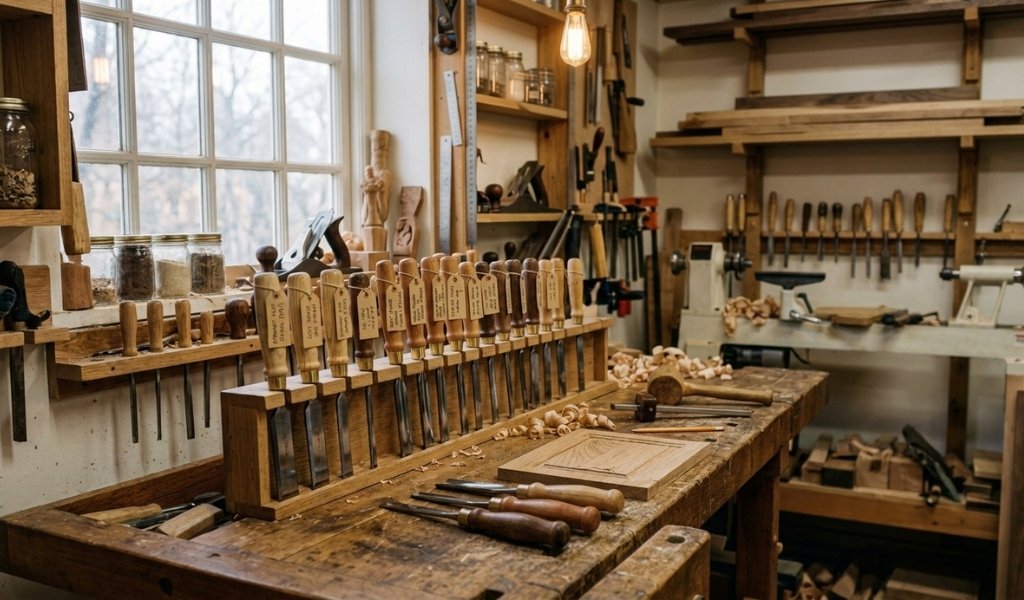
Wood carving is one of the most hands-on crafts in the workshop and the right chisel makes all the difference between a clean, confident cut and a frustrating split. Whether you’re roughing out a spoon blank or refining the details of a relief carving, your carving chisels are the foundation of everything you produce.
This guide covers every essential aspect of choosing and using wood carving chisels: the types of tools available, how to select the right carving set for your skill level, which steel quality to look for, and how to keep your edges razor sharp. If you already have a handle on what a chisel is and are ready to go deeper, this is your complete reference.
It’s also worth noting that woodcarving doesn’t end at the chisel. Once your carved surface is ready for finishing, knowing how to approach sanding properly will elevate the final result significantly.
A wood carving chisel is a cutting tool designed to remove material from a wooden workpiece with precision and control. Unlike power tools, carving chisels let the craftsman feel every cut adjusting pressure, angle, and direction in real time. That tactile feedback is exactly why carvers, from hobbyists to professionals, rely on hand tools even when power equipment is available.
The blade of a carving chisel is engineered specifically for wood. It holds a fine edge, resists rolling under pressure, and when properly sharpened glides cleanly through oak, basswood, and everything in between. The handle transfers force from hand or mallet directly to the blade, giving the carver full control over depth and direction.
Carving chisels serve a wide range of purposes: roughing out the initial shape of a piece, creating grooves and channels, detailing fine features, hollowing recessed areas, and cleaning up flat surfaces. The specific tool you reach for depends entirely on the cut you’re trying to make.
General woodworking chisels and carving chisels are both cutting tools, but they’re built for different tasks and using one where the other belongs produces noticeably worse results.
General woodworking chisels (bench chisels, mortise chisels, bevel edge chisels) are designed for carpentry and joinery. They’re built to handle mallet blows, chop mortises, and pare joints clean. The blade profile is typically flat and straight, optimized for trimming and fitting rather than shaping.
Carving chisels, by contrast, are purpose-built for woodcarving and detail work. They come in a much wider range of blade profiles curved, angled, V-shaped, and spoon-shaped because carving requires cuts that flat blades simply can’t produce. Carving tools also tend to have thinner blades and more refined bevels, which allows for the precision and finesse that woodcarving demands. They’re lighter, better balanced for extended hand use, and often designed to be pushed by hand rather than struck with a mallet (though mallet-compatible versions exist for tougher work).
The bottom line: general woodworking chisels are for general woodworking. Carving chisels are for carving. Knowing the difference before you build your kit saves time, money, and frustration.
The straight flat chisel (also called a straight chisel or firmer chisel) is the foundation of any carving set. Its flat blade removes material efficiently and excels at smoothing flat surfaces, trimming edges, and creating clean, straight lines across a workpiece. Most beginners start here it’s intuitive to use and versatile enough for a broad range of woodcarving tasks.
The skew chisel takes the straight chisel concept and angles the cutting edge, typically at 45 degrees or so. This skew profile lets the carver access tight corners, cut crisp V-shaped grooves at an angle, and clean up areas where a flat blade would struggle to make contact. Skew chisels are particularly useful in relief carving, where precise, controlled cuts along edges and intersections define the quality of the finished piece.
Together, these two tool types give carvers the ability to produce accurate, flat, and angled cuts essential building blocks for almost any woodcarving project.
Gouges are curved carving tools, and they’re arguably the most important category of wood carving chisels. The curve of a gouge’s blade is called its sweep, rated on a scale (typically 1–12) from nearly flat to deeply curved. A shallow-sweep gouge removes material gently and is ideal for broad, flowing cuts. A deep-sweep gouge (sometimes called a veiner) cuts narrow, pronounced curves and is used for fine detail work and intricate textures.
Gouges allow carvers to hollow out curves, shape rounded surfaces, and produce the flowing lines that give relief carving its organic quality. A wood carving gouge in the mid-sweep range say, a #5 or #7is often the workhorse of a carving kit, useful across a wide range of projects and carving styles.
When selecting gouges, pay attention to both sweep and blade width. Narrow gouges provide precision for detail work; wider profiles cover ground faster during roughing stages.
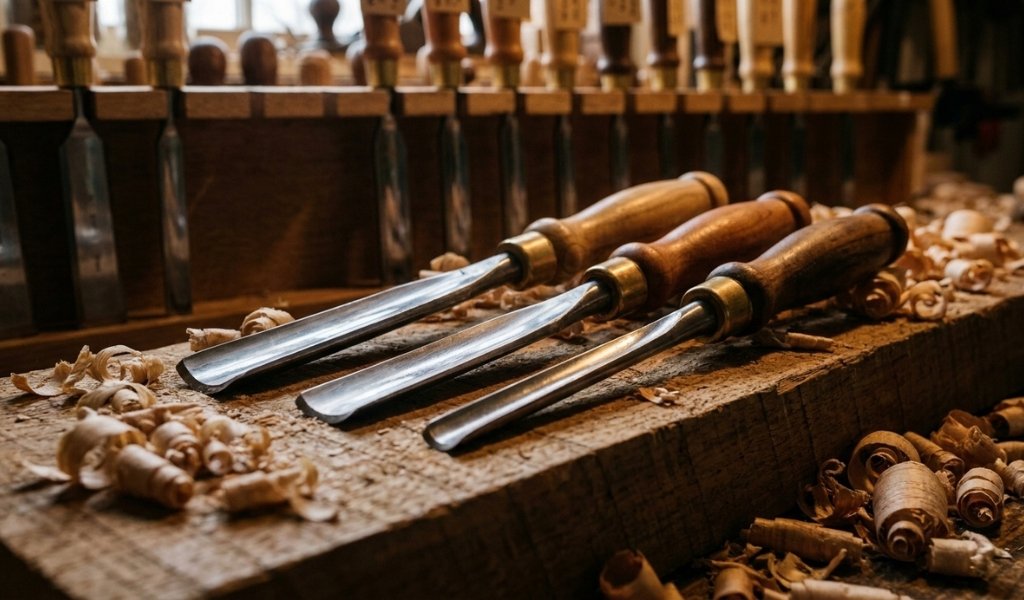
The V-tool (also called a parting tool or triangular chisel) cuts a clean V-shaped groove in a single pass. It’s one of the most distinctive tools in woodcarving and one of the hardest to keep properly sharp.
V-tools are used for outlining designs before deeper carving begins, separating sections in relief carving, carving lettering and text into wood, and adding fine detail lines to hair, fur, feathers, and other textured surfaces. The angle of the V varies between tools; shallower V angles produce wide, open grooves, while sharper angles cut narrow, deep channels.
The V-tool requires careful sharpening attention because both inner faces of the V must be honed evenly to avoid a lopsided cut. When maintained correctly, though, it’s an incredibly expressive and precise carving tool.
Standard straight gouges work well for surface carving, but they can’t reach into deep recesses or hollowed areas without the handle fouling against the workpiece. Bent gouges and spoon gouges solve this problem.
A bent gouge has a gradual curve along the blade’s length, allowing the carver to reach into moderately deep recesses while maintaining visibility and control. Spoon carving gouges take this further the blade curves sharply near the tip, like the bowl of a spoon, making them ideal for hollowing spoon bowls, creating deep concave shapes, and accessing the deepest recessed areas of a carving.
Spoon carving specifically relies on these tools almost entirely, and any carver interested in functional woodcarving (bowls, vessels, utensils) will use bent and spoon gouges constantly. For sculptural work and woodcarving projects with deep relief, these tools are not optional; they’re essential.
Palm chisels are compact carving tools designed to fit in the palm of the hand, driven purely by hand pressure. They’re well-suited for small-scale work, miniature carvings, and detail-heavy woodcarving where precise control matters more than raw material removal. Kids and adults new to carving often find palm chisels approachable and easy to control.
Full-size carving tools have longer handles designed to be gripped like traditional hand tools and driven either by hand or with a mallet. They remove material faster, handle larger workpieces more effectively, and are the standard choice in most professional workshops.
The choice between palm chisels and full-size tools comes down to the scale of the work. For small, intricate pieces, palm chisels give excellent precision. For larger relief carvings or roughing out substantial blocks, full-size carving tools offer the leverage and power you need.
A beginner doesn’t need every tool available. A well-chosen starter kit of 5–8 pieces covers the vast majority of woodcarving projects without overwhelming the new carver with choices.
A solid beginner carving set typically includes:
For hobbyists focused on spoon carving or small functional pieces, adding a spoon gouge early makes sense. BeaverCraft Tools produces well-regarded beginner kits that offer a good balance of quality and value, and their carving sets are purpose-designed for new carvers rather than repurposed general woodworking tools.
When starting out, prioritize tools that arrive sharp (or can be sharpened easily) over sheer quantity. A carving set of five razor-sharp tools will teach more than a 20-piece kit of dull blades.
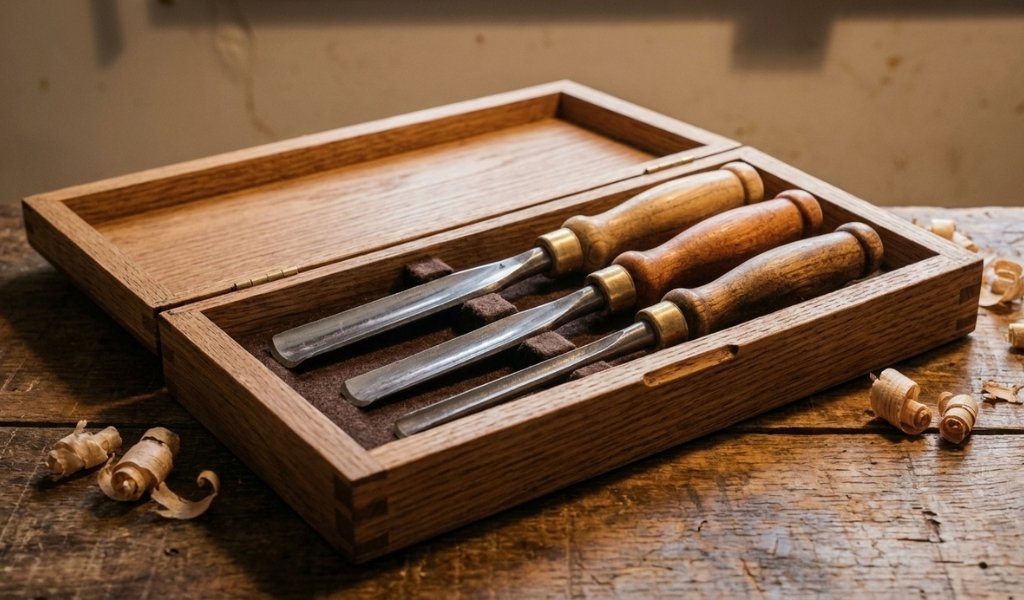
Experienced carvers and professionals typically invest in individual tools from specialist manufacturers rather than purchasing sets. This allows precise selection of sweeps, widths, and handle styles.
Narex is one of the most respected names in professional carving chisels. Narex carving tools are produced in the Czech Republic and are known for their consistent geometry, quality steel, and excellent value at the professional level. They’re a benchmark brand among serious woodcarvers.
Other professional-grade options worth considering include Pfeil (Swiss Made), Two Cherries (German), and Ashley Iles (UK). These brands command premium prices, but their tools hold edges longer, have better handle fits, and are manufactured to tighter tolerances than budget alternatives.
At the professional level, carvers often build their kit over years adding specific profiles as particular woodcarving projects demand them. A pro set is less of a purchase and more of an accumulation.
The steel used in a carving chisel’s blade directly determines how well it holds an edge and how easy it is to sharpen. Two types dominate the market: CR-V steel (chrome-vanadium) and high-carbon steel.
CR-V steel is an alloy that balances hardness with toughness. It resists chipping, handles lateral stress reasonably well, and is relatively forgiving to sharpen. CR-V carving chisels are durable, practical, and a sound choice for general carving work particularly for beginners and intermediate carvers.
High-carbon steel achieves higher hardness levels than CR-V, which means it can hold a sharper edge for longer when properly heat-treated. The trade-off is brittleness; high-carbon steel is more prone to chipping if misused or dropped. For carvers who prioritize an edge that stays truly razor sharp through extended use, high-carbon steel is the professional standard.
For most woodcarving projects, a quality CR-V steel chisel will perform very well. Those doing fine detail work or demanding relief carving projects should consider high-carbon steel tools from established manufacturers like Narex, where the heat treatment process is carefully controlled.
Splitting is almost always a technique problem rather than a tool problem. Wood splits when force is applied too quickly, too deeply, or against the grain without adequate control.
A few principles prevent most splitting:
For softer woods like basswood or butternut common choices for beginners these rules are somewhat more forgiving. Hardwoods like oak demand more precision and care.
A dull carving chisel requires more force, produces rougher cuts, and increases the risk of the blade slipping unpredictably. Keeping carving tools razor sharp is not optional it’s the single most important maintenance habit a woodcarver can develop.
Sharpening removes metal to reform the bevel and cutting edge. For most carving chisels, a combination of a coarse sharpening stone (to reshape a damaged edge) and a fine stone (to refine it) covers the basics. Gouges require a slip stone, a shaped stone that matches the curve of the blade’s inner profile to sharpen the inside of the sweep properly.
Honing maintains the edge between full sharpenings. A leather strop charged with honing compound removes the microscopic wire edge left by sharpening and polishes the bevel to a mirror-like finish. Most carvers strop their tools every 10–15 minutes of active carving, keeping the edge at peak sharpness without a full resharpening session.
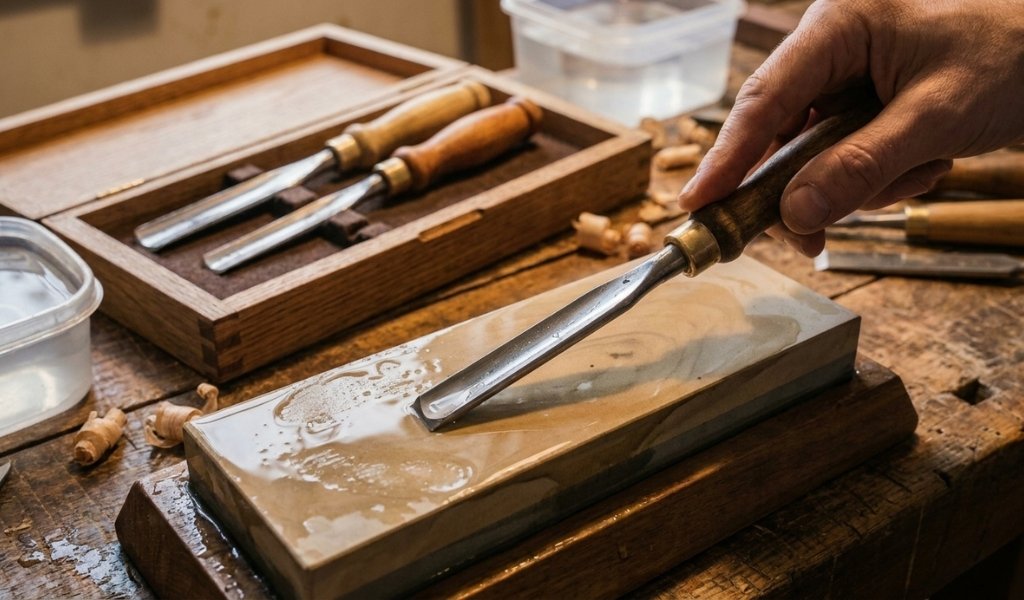
V-tools require extra attention because both interior faces must be honed to equal sharpness to produce a clean, centered groove. Neglecting one face results in a cut that drifts to one side.
Carving chisels are sharp tools, and careless habits lead to injuries. A few consistent practices keep the risk low:
The best wood carving chisels depend on skill level and budget. For beginners, BeaverCraft Tools offers quality starter kits that arrive ready to use. For intermediate and professional carvers, Narex carving chisels represent excellent value and consistent quality. Premium options from Pfeil or Ashley Iles suit experienced carvers who want the finest available tools.
A functional beginner carving set needs a straight flat chisel, a skew chisel, two or three gouges in varying sweeps, and a V-tool. That combination of five to seven tools handles most carving projects. As your woodcarving develops, you can add bent gouges, spoon gouges, and additional sweep profiles for more specialized work.
For most woodcarving projects, a mid-sweep gouge (such as a #5 or #7) is the most versatile single tool. It removes material efficiently, shapes curves naturally, and handles a wide range of carving styles. For very fine detail work, a narrow V-tool or veiner is the better choice. The “best” tool is always the one matched to the specific cut being made.
The essential types are: straight flat chisels (for flat surfaces), skew chisels (for corners and angles), gouges in multiple sweeps (for curved cuts), V-tools (for outlining and detail lines), and for recessed work bent gouges and spoon carving gouges. Palm chisels extend this toolkit for small-scale and miniature work.
High-quality carving chisels are available from specialist woodworking retailers, both online and in-store. BeaverCraft Tools sells direct online and is widely available through Amazon. Narex carving tools are stocked by most dedicated woodworking suppliers. For premium European brands like Pfeil or Ashley Iles, specialist hand tool retailers and craft supply stores are the best source.