Physical Address
304 North Cardinal St.
Dorchester Center, MA 02124
Physical Address
304 North Cardinal St.
Dorchester Center, MA 02124

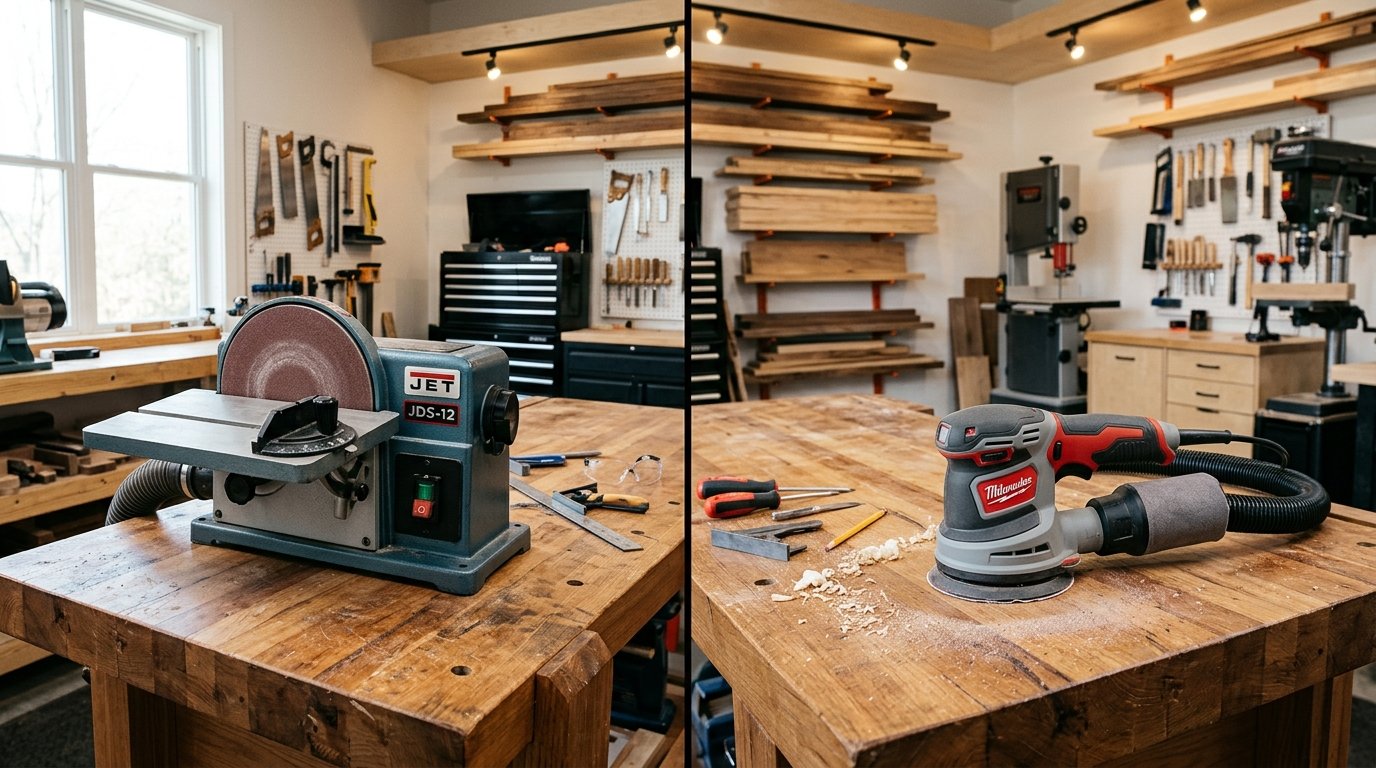
Walk into any hardware store and you will find a wall of sanders, all promising a smooth finish with less work. It is easy to get stuck in front of that wall, especially when two tools look so alike. The disc sander vs orbital sander question comes up for almost every new woodworker, and the wrong pick can leave you with burn marks, ugly scratches, or a tool that sits unused in the corner.
The truth is that these two tools do very different jobs. One is built to shape and trim, and the other is built to smooth and finish. This guide explains the difference between an orbital sander and a disc sander in plain words, compares them side by side, and helps you decide which one deserves your money first.
Before we compare features, it helps to know what each tool actually is. Many people lump every type of sander together, but they work in very different ways. Once you see how each one moves and where it shines, the choice gets much easier.
A disc sander is a power tool with a flat round plate that spins in one direction, much like a record player. You stick a sanding disc to the plate and it turns at high speed. Most models sit on a bench and have a small table in front of the disc. You do not move the tool. You push the wood against the spinning disc.
This setup is great for shaping. Because the table can tilt, you can sand a clean angle on the end of a board, round a corner, or true up an edge so two pieces meet with no gap. Woodworkers love it for cutting a perfect miter, fitting a joint, and shaping small curved parts. 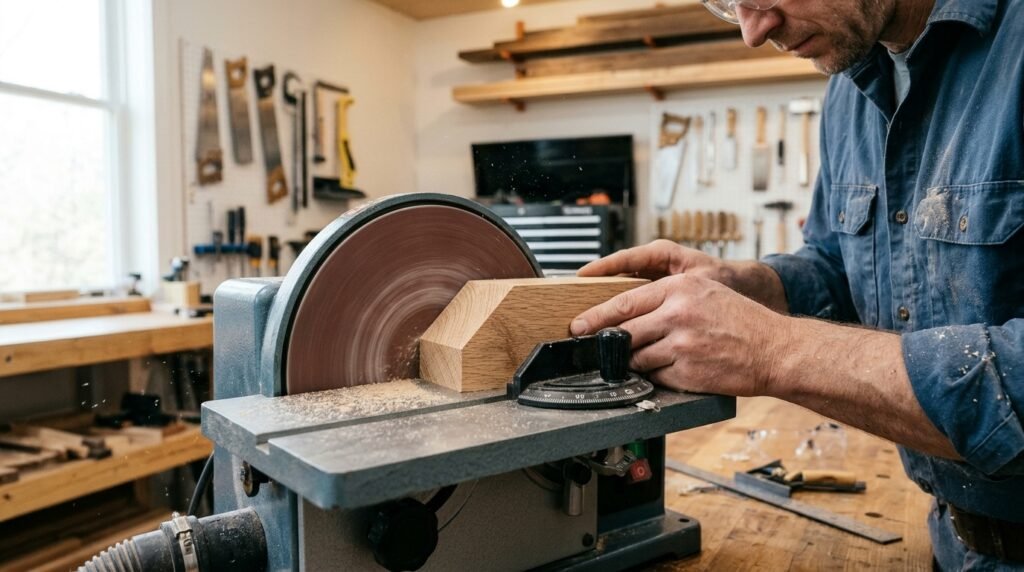 It removes wood fast, and it gives you a lot of control when you want a precise edge.
There is one thing to learn early. Only half of the disc is safe to use. The side that spins down toward the table presses the wood against the support, while the other side tries to lift and throw it. Always sand on the down side. You also need a light touch, because a disc can burn the wood quickly if you hold it in one spot. Common sizes run from six to twelve inches, and larger discs give you more surface to work with.
An orbital sander is a small handheld power sander you move across the wood. The pad vibrates in tiny circles, which smooths the surface and leaves a fine finish. It is a type of sander that beginners find easy to use, since it is light and does not grab the wood the way a heavy tool can.
There are a few versions to know. A basic one uses a square pad and a regular sheet of sandpaper, which is why people also call it a sheet sander. A small one-hand model is called a palm sander, and it often uses a quarter sheet of paper. These work fine for flat boards but the square pad can leave small scratch marks that show up under stain.
The random orbital sander fixes that problem. Its round pad spins and also moves in a random orbit at the same time. Since no point on the paper travels the same path twice, the sanding marks are tiny and hard to see. This is why most people choose a random orbit sander as a general finishing sander. It handles tabletops, doors, cabinets, and furniture parts with ease, and it works on a wide range of woods without much risk of damage.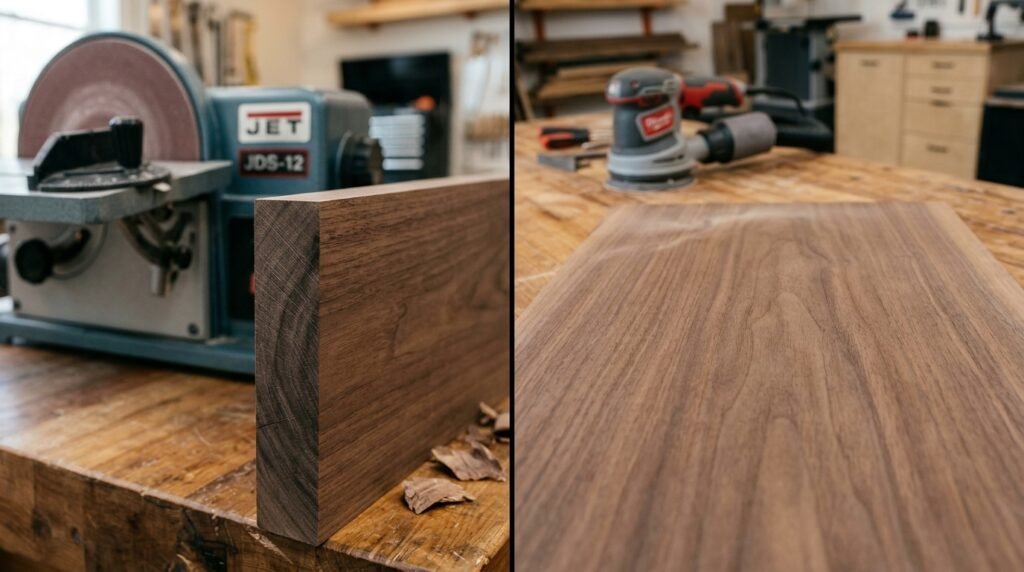
Now that you know what each one does, let us put them head to head. The best way to compare them is to look at what happens in real use, since the spec sheet only tells part of the story. Three areas matter most for most buyers: how fast they cut, what kind of surface they leave, and how well they fit the size of your project.
A disc sander is the more aggressive tool. The disc spins fast and the wood is held firmly against it, so it takes off material quickly. With a coarse grit you can remove a quarter inch from an edge in seconds. That power is handy when you need to bring a board down to a line or fix a cut that came out a little off.
A random orbital sander is gentler. It removes wood at a steady and controlled pace, which is exactly what you want when you are smoothing a surface and not reshaping it. You can speed it up by using a coarse sandpaper like 60 or 80 grit, but it will never match the bite of a disc sander or a belt sander. For heavy stock removal across a big board, a belt sander works better than either of these tools. A belt sander works by running a looped sanding belt over two drums, and its long flat strip can strip paint or level a rough plank fast.
So if your main goal is speed on small parts, the disc wins. If you want safe and even progress across a large area, the orbital is the better partner. Think of the disc as a sharp chisel and the orbital as a soft brush.
Here the two tools split in opposite directions. The disc sander gives you precise, square, and angled edges that no handheld tool can match. The table acts as a guide, so a cut at 45 degrees stays at 45 degrees. If you build picture frames, boxes, or any project with tight joints, a disc sander helps a great deal.
But a disc sander is not made for big flat surfaces. The disc leaves curved scratches, and a long panel is simply too large to hold against it. If you try to flatten a tabletop on a disc, you will end up with dips and swirl marks that are hard to remove.
The random orbital is the opposite. It shines on wide, flat boards and leaves a smooth, even surface. The random orbital motion keeps swirl marks to a minimum, so the wood looks clean once the stain goes on. It cannot make a crisp angle or a sharp square corner though, as the round pad tends to soften edges. A small detail sander with a pointed pad can reach tight corners if you need them, but it is not a replacement for either of these two tools.
This is where the shape of the tool really matters. A disc sander usually stays on your bench, and the piece comes to the tool. That works well for small and medium parts like table legs, drawer fronts, and boards you can easily hold. It does not work for a huge workpiece such as a full door or a long countertop. You simply cannot push those onto a bench disc.
An orbital sander goes to the work. You can carry it to a ladder, a deck, or the side of a cabinet that is already installed. It handles large pieces just as well as small ones, and it runs on a normal outlet or a battery. Most weigh only three or four pounds and fit in a single bag, so you can store them anywhere.
A real life example makes the difference clear. A hobbyist who builds small wooden toy boxes bought a random orbital first and found it great for the tops and sides. But the box corners never fit perfectly, and he spent hours with a hand plane. After adding a small disc sander to his bench, he could trim every corner square in a few seconds, and his boxes finally looked professional. Each tool did a job the other could not.
Sanding makes a lot of dust, and the way each tool handles it is worth knowing. Fine dust is bad for your lungs and it also clogs your sandpaper, so good dust collection makes the work cleaner and your abrasive last longer.
Most random orbital sanders come with a small dust bag and a pad with many tiny holes. The holes pull dust through the sandpaper and into the bag. You can also hook the tool to a shop vacuum with a hose for much better results. A good dust collection system on an orbital sander can catch most of the mess, and it keeps the paper cutting longer since dust does not build up between the grit.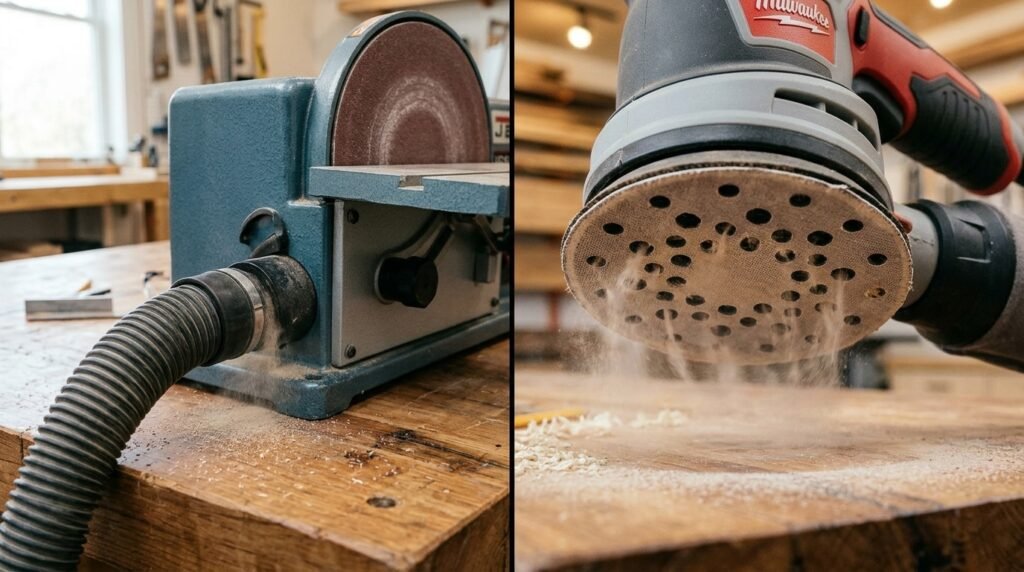
A disc sander is harder to keep clean. Dust flies off the spinning disc in all directions, and the open design makes it tough to catch every bit. Many benchtop models include a dust port under the table or behind the disc where you can connect a vacuum. This helps a lot, but you will still need to wear a mask and clean the bench after use. If you plan to use a disc sander inside your home, think about a good shop vacuum or an air filter.
Changing the abrasive is also different. A random orbital sander usually uses hook and loop discs, which means you press a new one on and peel it off when worn. It takes a few seconds. A disc sander often uses sticky backed sanding disc sheets that peel from a liner and stick to the plate. These hold well but need more care when you change them. You must scrape off the old glue and keep the plate clean, or the new disc will wrinkle or come loose at high speed. Both types of paper are cheap, but you will use more of them on an orbital sander, because the smaller paper wears out faster on big surfaces.
Pick the right grit for the job. Start with 80 grit for rough work, move to 120, and finish at 180 or 220 for a smooth feel. Skipping steps leaves deep scratches that no fine paper can remove.
Budget is a big factor for most people, so let us look at what you can expect to pay. These numbers are rough and vary by brand and store, but they give you an idea.
A good random orbital sander costs about 50 to 100 dollars for a solid mid-range model. Professional grade ones go higher, up to 200 dollars or more, and you get smoother vibration control and better dust pickup. A cheap palm sander can be found for 25 to 40 dollars, though the finish is less refined. For most home projects a mid-priced random orbit sander gives the best value, since it does so many jobs.
A benchtop disc sander usually costs 100 to 300 dollars. Combination machines that pair a disc with a belt sander are popular for small shops and often cost 150 to 400 dollars. They take up more space and need a solid bench, so you should count that in your plan. There are also small disc attachments for drills that cost very little, but they are not accurate or safe enough for serious work.
In terms of value, the orbital sander gives more uses per dollar. You can use it on almost any project, from refinishing an old chair to prepping a deck for paint. The disc sander is more of a specialist. It costs more and does fewer things, but it does them very well, and it can save hours if you do a lot of precise shaping. Remember to count the ongoing cost of paper too. Hook and loop discs for an orbital are cheap in bulk packs, which keeps long term spending low.
For most people the answer is simple. Buy a random orbital sander first. It is affordable, easy to use, safe for beginners, and good for almost every surface. It gives a smooth fine finish, avoids swirl marks, and works on projects of any size. If you can own only one power sander, this is the one.
Add a disc sander later if your work calls for it. If you make furniture, boxes, frames, or anything with tight angles and curved parts, a disc sander will quickly become one of your favorite tools. It saves time, makes joints neat, and handles edge work that is nearly impossible by hand. If you refinish large surfaces like floors or old decks, you may want a belt sander before either of these.
To sum it up, the disc is for shaping and the orbital is for finishing. Neither is better in every case, and many shops end up owning both. Think about the type of projects you do most, and match the tool to the job. Then go to your local store, hold a few models in your hands, and choose the one that feels right. Your next project will thank you for it.
A disc sander is a stationary tool that spins a round disc in one direction and is used to shape edges and angles. An orbital sander is a handheld tool that moves in small circles and is used to smooth flat surfaces. One shapes the wood and the other finishes it.
For most work, yes. The random orbit motion leaves fewer visible scratches than a standard orbital with a square pad. It also sands faster and works well on wood grain from any direction.
It is not a good idea. The disc is too aggressive for large flat panels and tends to leave dips and curved marks. Use a random orbital sander or a belt sander for tabletops.
A random orbital sander is the easiest choice. It is light, forgiving, and hard to damage the wood with. A disc sander needs more skill and care, especially with feed direction and burn marks.
A palm sander is a small type of orbital sander that fits in one hand and uses a quarter sheet of sandpaper. It is cheaper and lighter but is less powerful and often leaves more marks than a random orbital model.
Only if you need to remove a lot of material fast, such as leveling rough boards or stripping old finish. For regular smoothing, an orbital sander is enough.
Use a sharp, fresh disc and keep the wood moving. Apply light pressure and never hold it still against the disc. A coarser grit also creates less heat than a worn fine one.