Physical Address
304 North Cardinal St.
Dorchester Center, MA 02124
Physical Address
304 North Cardinal St.
Dorchester Center, MA 02124

Suspension work can go wrong fast. Coil springs store a massive amount of energy, and without the right spring compressor tool, that energy has nowhere safe to go. Springs have been known to fly across garages, crack components, and cause serious injuries—all because someone tried to remove them without the proper equipment.
If you’re planning to replace struts, swap out worn coil springs, or install a lowering kit, knowing how to choose the right spring compressor tool is just as important as knowing how to use one. The wrong tool for the job doesn’t just slow you down—it puts you at risk.
This guide covers everything you need to make a confident decision: what a compressor is and how it works, the main types available, and a practical checklist to match the right tool to your vehicle and workload.
A spring compressor tool is a device used to safely compress coil springs during suspension repairs and replacements. It controls the stored energy inside the spring, allowing mechanics to remove or install struts, shocks, and coil springs without the risk of sudden spring release.
At its core, a compressor is any device that applies controlled force to reduce the size of an object or to increase the pressure within a system. In the world of suspension work, that “object” is a coil spring, and the goal is to shorten it safely so you can work on the parts around it.
The principle is simple, but the physics behind it deserves respect. A coil spring resists being shortened, pushing back with a force that grows the more you compress it. A compressor counters that resistance with a mechanism—usually a threaded rod, a hydraulic ram, or a pneumatic cylinder—that converts your effort into steady, controlled pressure. As you turn a handle, pull a trigger, or step on a pedal, that mechanism draws the coils closer together a little at a time.
Here’s the key idea: a good compressor doesn’t just squeeze the spring, it holds the spring under tension and lets you release that tension on your terms. That controlled give-and-take is what makes the difference between a safe repair and a flying piece of metal. The mechanical advantage built into the tool—gears, threads, or fluid pressure—means a person can hold back hundreds of pounds of stored energy with a fraction of that effort and so that you must learn about What Is a Compressor and How Does It Work
Once you understand that a compressor’s whole job is managing stored energy in a predictable way, the differences between spring compressor types start to make a lot more sense.
A spring compressor is a mechanical device designed to squeeze a coil spring down so you can safely separate it from the surrounding suspension components. That usually means removing it from a strut assembly or a control arm.
Coil springs are under constant tension. Even when a vehicle is lifted off the ground, the spring doesn’t simply relax—it stays under load until it’s physically compressed and the tension is released in a controlled way. A spring compressor tool does exactly that: it brings the spring down to a manageable length, relieves pressure on the upper and lower seats, and lets you disassemble the whole assembly without incident.
Here are the most common situations where you’ll need one:
There are four main types of spring compressor tools on the market. Each one suits a different vehicle type, workspace setup, and level of use. Understanding the differences is the first step toward picking the right one.
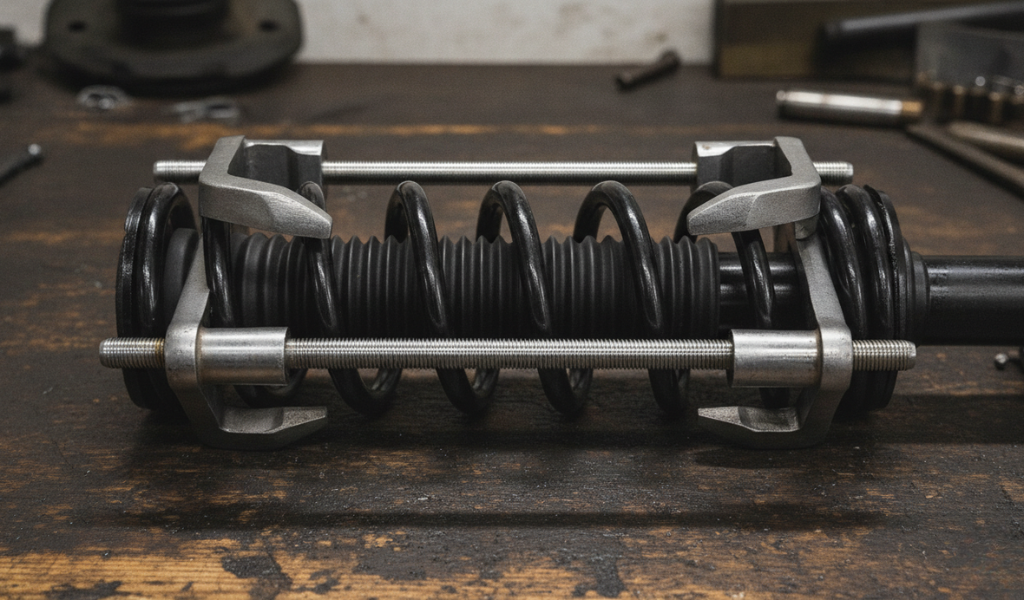
These are the most common type and probably what most people picture when they think of a spring compressor tool. Two threaded rods run along the outside of the coil, each carrying a set of jaws that hook onto the spring coils. You tighten the rods with a ratchet or impact gun, drawing the jaws toward each other and compressing the spring.
Best for: MacPherson strut setups, which are standard on most sedans, compact cars, and smaller SUVs.
Pros: Affordable and portable. They fit in a drawer, work while the strut is still in the car, and are widely available.
Cons: Jaw travel is limited, so they struggle with very tight or heavy-duty springs. Rushing the setup or placing the jaws incorrectly can cause slippage—which is exactly what you don’t want.
This design works differently. A long threaded rod threads down through the center of the strut shaft, with specially shaped plates sitting on the top and bottom coils. Turning the rod draws those plates together from the inside out.
Best for: Narrow or recessed spring pockets where external jaws simply can’t get a proper grip.
Pros: The centered load path keeps compression straight and even. These tools are also compact when stored.
Cons: The plates need to match your spring’s diameter, setup takes longer than external jaw models, and the rod can bind if it’s not perfectly aligned going in.
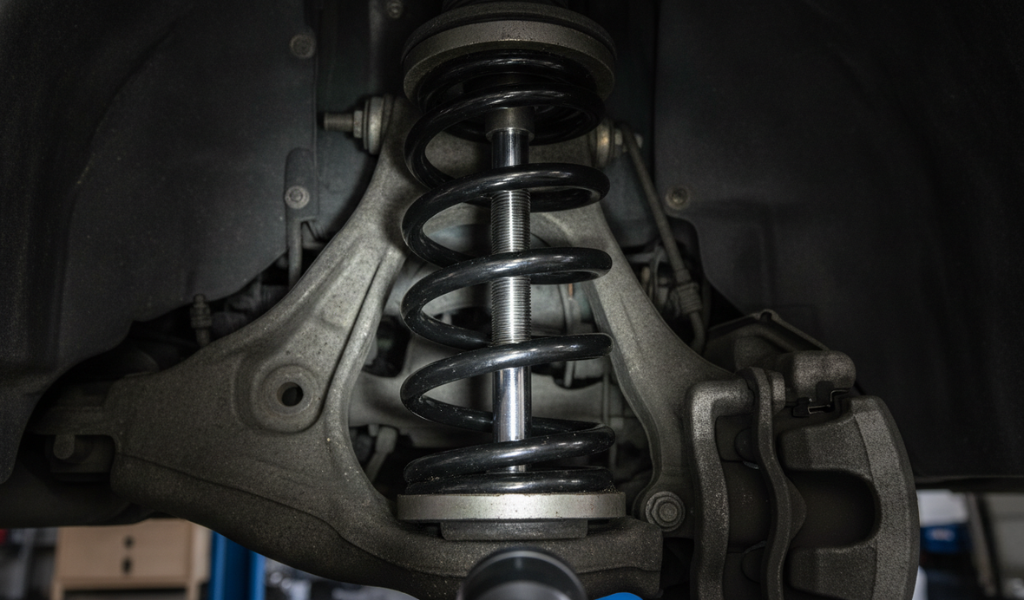
These units are built for stability. A heavy steel frame bolts permanently to a workbench or wall, and a large screw or hydraulic cylinder drives a plate downward to compress the spring. Many include quick-adjust pins and rotating adapters to handle different spring sizes.
Best for: Home shops where suspension work happens regularly, small professional repair shops, and enthusiasts who want a proper dedicated setup.
Pros: Rock-solid stability, faster workflow once the unit is set up, and capable of handling the thick springs found on trucks and full-size SUVs without straining the hardware.
Cons: The strut must be removed from the vehicle before use. These units also take up permanent wall or bench space, and they cost more than handheld options.
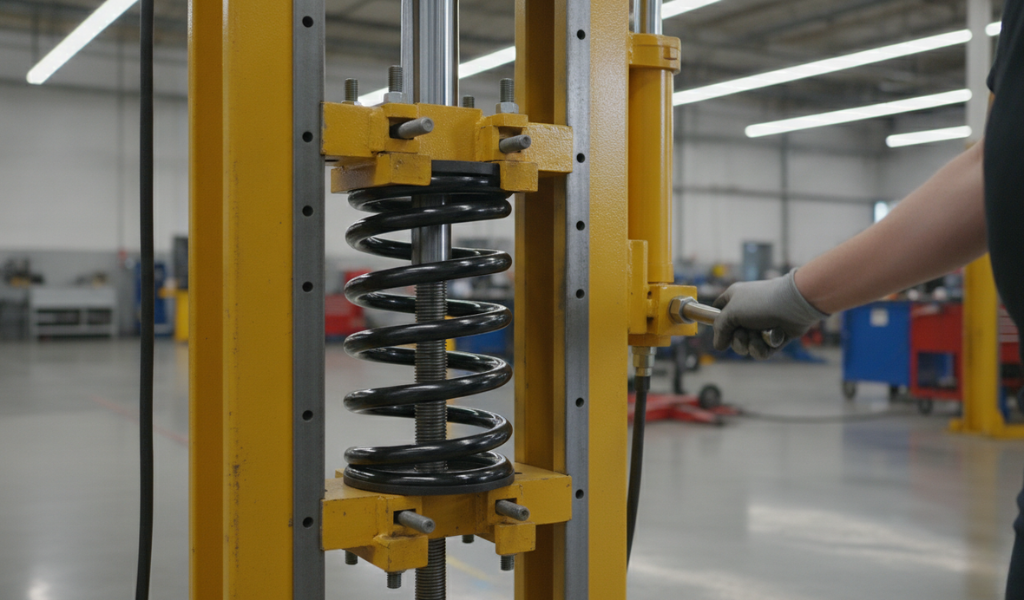
Think of these as the heavy-duty version of bench units. A free-standing steel frame houses a hydraulic ram, bottle jack, or air-over-hydraulic cylinder that generates compression force with minimal physical effort. Large V-blocks and adjustable clamps handle even complex or irregular spring shapes.
Best for: Professional shops doing multiple spring jobs per week, and serious enthusiasts working on high-performance or heavy-duty vehicles.
Pros: Fast, consistent, and nearly effortless. Foot-pedal versions free up both hands during the process. These tools handle the heaviest springs without breaking a sweat.
Cons: The highest upfront cost of any spring compressor type. They require dedicated floor space and are the most difficult to move around.
External spring compressors attach to the outside of the coil spring using hooks or jaws and are commonly used on passenger vehicles with MacPherson struts. Internal spring compressors work through the center of the spring and are better suited for tight suspension assemblies where external jaws cannot fit. External models are generally more affordable and easier to use, while internal models provide better access and control in confined spaces.
With the four main types covered, here’s a practical checklist to help narrow things down and find how to use a spring compressor before you spend any money.
This single factor eliminates a lot of guesswork. Compact cars and front-wheel-drive sedans work well with a quality pair of external two-jaw compressors. Half-ton trucks, large SUVs, and off-road vehicles have thicker coil wire and longer spring travel—those applications are better suited to a bench-mount or hydraulic floor unit. Performance coil-overs sometimes need specialized adapters that only come with premium compressor kits.
Before buying anything, take a look at the spring while it’s still on the vehicle. Measure the diameter and check how much clearance exists around the coil. Tight wheel wells, deep spring pockets, or recessed upper mounts can block external jaws entirely. If clearance is an issue, an internal rod compressor or removing the assembly for a bench tool is the smarter path.
Every spring compressor tool has a rated load capacity, usually expressed in pounds or tons. Compare that number to the stiffest spring you’ll compress. Buying a tool rated well above your actual requirement gives you a safety margin and helps the tool last longer. Entry-level DIY models typically handle around 1,000 lbs. Heavy-duty hydraulic units can top 2 tons of compression force.
Manual threaded rods cost less and work in any garage, but they put all the physical effort on you. Air-over-hydraulic models connect to a shop air compressor and speed up repetitive jobs while reducing arm fatigue. Full electric or foot-pedal hydraulic units are overkill for a weekend hobbyist, but in a busy shop doing several spring jobs a day, they pay for themselves quickly.
This is one area where it’s worth spending a little extra. Look for wide locking jaws that grip securely and reduce the risk of slipping. Built-in cage shields contain the spring if anything goes wrong mid-compression. Self-centering plates remove the guesswork from alignment. Over-travel stops prevent you from compressing the spring beyond its safe limit. These features aren’t just conveniences—they’re what stand between a smooth job and a dangerous one.
A pair of handheld jaw compressors stores on a pegboard hook. A floor-standing hydraulic frame needs several square feet of clear floor space and enough ceiling height to accommodate tall strut assemblies. Measure your available space before committing to a larger unit.
Some compressor kits ship with multiple jaw sets, V-blocks, and yoke adapters included. Others sell those pieces separately. If you regularly work on different makes and models—say, a Japanese compact one weekend and a domestic pickup the next—investing in a kit with interchangeable adapters from the start saves money and headaches down the line.
No matter which spring compressor tool you choose, a few habits make every job safer.
Always wear safety glasses. A spring that slips during compression sends hardware in unpredictable directions. Eye protection is non-negotiable.
Compress both sides evenly. When using external two-jaw compressors, tighten each rod in small, alternating increments. Compressing one side fully before the other puts uneven stress on the spring and increases the risk of the jaws jumping off.
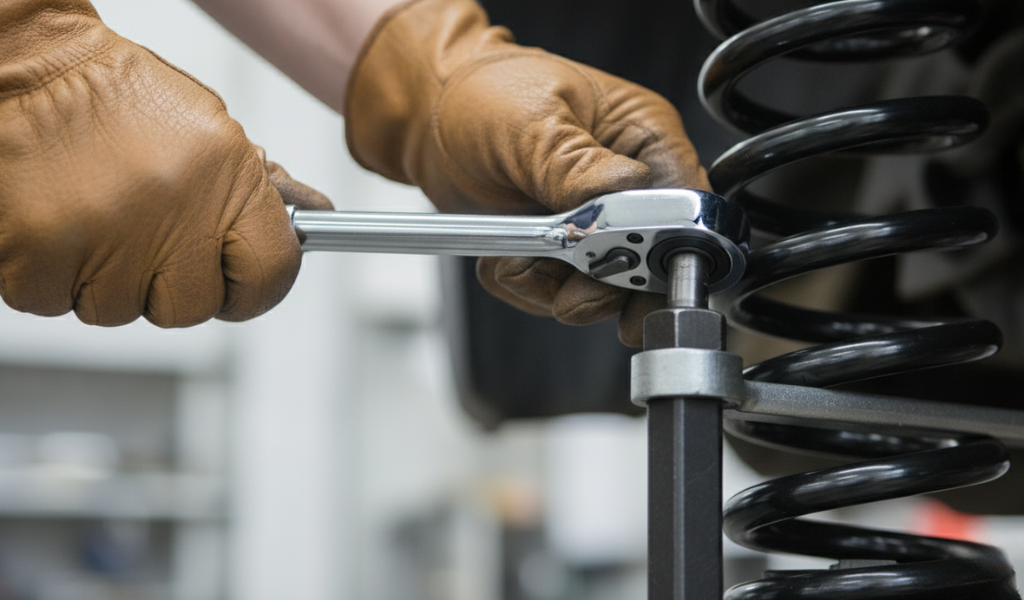
Never use a damaged compressor. Inspect threaded rods, jaws, and locking hardware before every use. Worn threads or cracked components can fail under load.
Release tension slowly. When you’re done with the repair and reinstalling the spring, release pressure gradually. A slow, controlled release prevents the spring from shifting or the tool from binding.
Choosing the right spring compressor tool comes down to three things: what you’re working on, how often you’re doing it, and how much space you have to work with. An occasional DIYer replacing front struts on a family sedan has very different needs than a shop mechanic servicing truck suspensions every day.
Take a few minutes to think through your vehicle mix, measure your spring clearance, and compare load capacity before buying. A well-matched tool makes suspension work faster, cleaner, and—most importantly—safe. If you’re still not sure which type suits your setup, reading through detailed product specs and customer reviews for any models you’re considering is a smart final step before placing an order.
What is a compressor and how does it work?
A compressor is a device that applies controlled force to shorten a coil spring and hold it under tension. It uses a mechanism—such as a threaded rod, hydraulic ram, or pneumatic cylinder—to convert your effort into steady pressure, drawing the coils together a little at a time. The built-in mechanical advantage lets one person safely manage hundreds of pounds of stored energy and release it in a controlled way.
What is a spring compressor tool used for?
A spring compressor tool is used to compress coil springs so they can be safely removed from or reinstalled in a suspension assembly. It controls the stored energy in the spring, allowing you to disassemble struts and shocks without the spring releasing suddenly.
Can I use a spring compressor tool on any car?
Most spring compressor tools work across a wide range of vehicles, but the right type depends on your car’s suspension design. External two-jaw compressors suit most passenger cars with MacPherson struts. Trucks, large SUVs, and performance vehicles may need a bench-mount or hydraulic unit with higher load capacity.
Is it safe to use a spring compressor tool at home?
Yes, with the right tool and proper technique, spring compression is manageable in a home garage. Choose a tool rated for your spring’s load, wear safety glasses, compress evenly, and inspect the tool before each use. A bench-mounted unit offers extra stability for home use compared to handheld jaw compressors.
What’s the difference between external and internal spring compressors?
External (two-jaw) compressors clamp onto the outside of the coil with hooks or jaws. Internal rod compressors thread through the center of the strut shaft and compress from the inside. Internal designs work better in tight spaces where external jaws can’t get a solid grip.