Physical Address
304 North Cardinal St.
Dorchester Center, MA 02124
Physical Address
304 North Cardinal St.
Dorchester Center, MA 02124

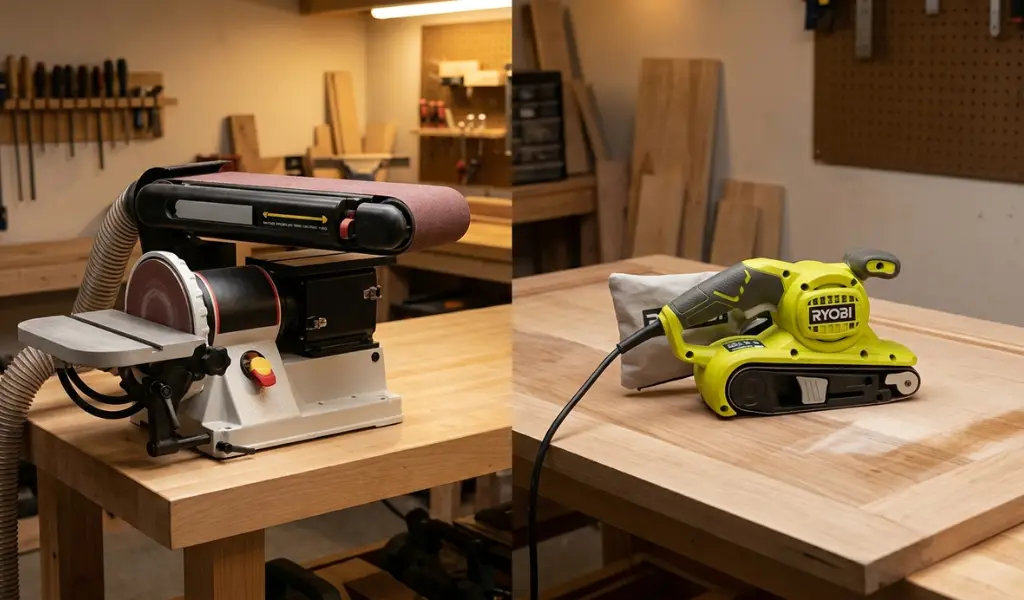
Every woodworker hits the same wall at some point. You have a rough board or a stubborn paint layer and a pile of sandpaper that is going nowhere. You know you need a power tool but the shop has two very different options. The debate of benchtop belt sander vs hand belt sander is one of the most common questions in any hardware store aisle.
Both tools use a loop of sanding paper that spins around two rollers. Both remove material fast. But they do the job in opposite ways. With a benchtop model the tool stays still and you move the wood. With a hand model you hold the tool and move it across the wood. That one simple difference changes almost everything about how they feel and what they do best.
If you are new to this tool family it helps to read our primer first, Belt Sander: Types, Benefits, and Safety Tips. It covers the basics so this guide can focus on the real question. Which one belongs in your workshop? By the end of this article you will know exactly what to buy and why.
A benchtop belt sander is a stationary machine that sits on a workbench or a stand. The motor and belt are fixed in place and the sanding belt runs past a flat surface where you press your workpiece. Think of it as a tool that comes to a stop so your hands can do the steering.
Most hobby models use a belt that is about 4 inches wide and 36 inches long. Bigger shop versions run a 6 by 48 inch belt. A few special models use a long and narrow 2 by 72 inch belt which knife makers love. You can also find a small belt sander with a 1 by 30 inch belt for tight jobs.
The biggest perk of this type is stability. Most benchtop units have a heavy cast iron base that soaks up shaking. That weight prevents vibrations and keeps the belt running smooth. Less vibration means cleaner results and less hand fatigue.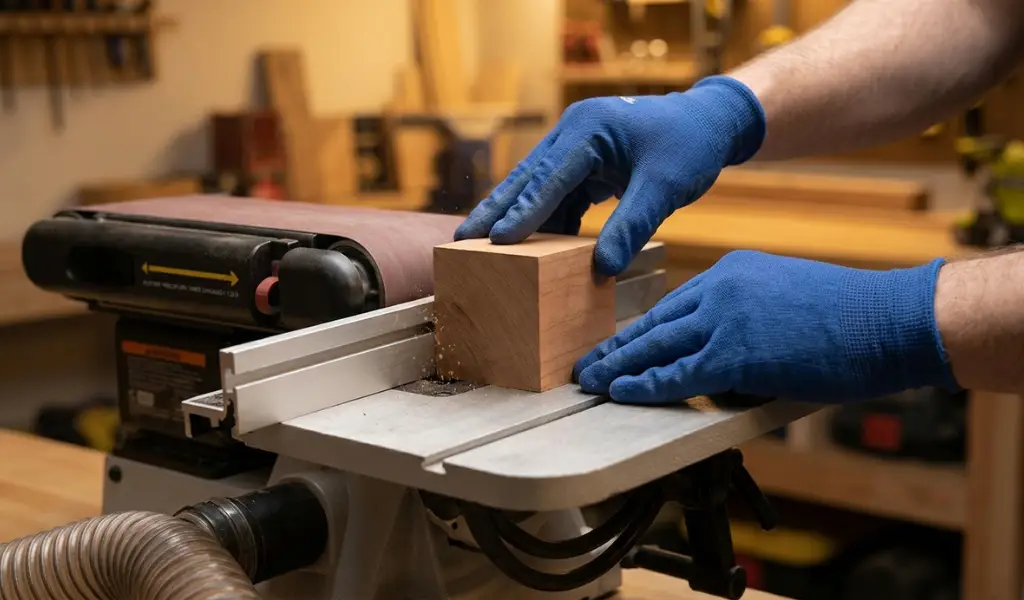
The belt rides over a flat plate called a platen. This plate keeps the belt flat so you get an even sanding surface. Many machines include a tilting work table. You can set it to 45 degrees or 90 degrees for bevels and square edges. A fence or miter slot helps you hold a steady angle every time.
One popular option is the belt and disc sander. This is a single machine with a belt on one side and a round disc on the other. The disc lets you sand curves and perfect ends. It also helps with miters. Some versions of this machine offer variable speed so you can slow it down for delicate stock. Others have a quick release lever so you can swap belts in seconds.
Dust control is another plus. Many models have built-in dust ports that connect to a shop vacuum. Good dust collection keeps your lungs safe and your bench clean.
A benchtop belt sander shines on small work. Think of wooden toys and box corners and picture frames. Because the belt is fixed you can hold a small piece with both hands and feed it into the belt with fine control.
Sharpening is another strong use. You can put a fine grit belt on the machine and sharpen chisels and plane blades and even lawn mower blades. The key is to keep the metal moving and cool so it does not burn. This is where the old bench grinder vs belt sander question comes up. A bench grinder uses a spinning stone wheel and tends to leave a hollow grind. A belt gives you a flat edge and runs cooler.
Knife makers use belt grinders to shape blades and use zirconia belts for steel. A hobby machine can handle mild metal work with the right belt but a dedicated 2 by 72 inch grinder is a better fit for heavy knife making.
Finally a benchtop unit helps with precise edges. You can square an edge or bevel a corner or fit a joint tight. Cabinet makers and model builders use them to fine tune parts that must line up well.
A hand belt sander is a portable power tool you hold with one or two hands. You set it down on the wood and let the moving belt do the work as you glide it forward. It is also called a handheld belt sander and it looks a bit like a small tank with a handle on top.
The most common belt size is 3 by 21 inches or 3 by 24 inches. Bigger models take a 4 by 24 inch belt. Well known brands such as Porter-Cable and Makita and Bosch all make good ones. Most plug into a wall outlet because the motor needs real power.
The main strength here is power. A handheld model often has a motor rated at 6 to 8 amps. That is a powerful motor in a tool you can lift with one hand. The belt can reach high speeds of 1,000 to 1,500 feet per minute and some run faster. With a coarse belt such as 80-grit it can remove large amounts of wood in seconds.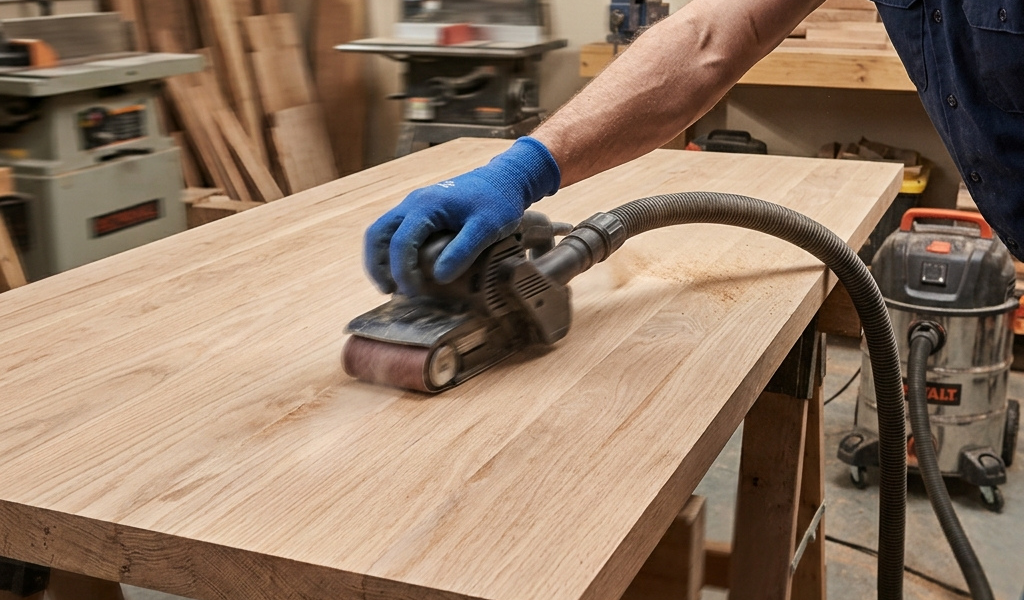
Portability is the other win. You can carry it to a job site or into a garage or across a lawn. You can take it to the wood rather than moving heavy wood to the tool. That is a huge help when the piece weighs more than you do.
Many hand models include a dust bag that clips onto a port. It catches much of the sawdust but not all. For best results attach a shop vacuum if the port allows it. Some have toolless belt change levers and a belt tracking knob so the belt stays centered. A few include speed control but most run at a single fast pace.
The flip side of all this power is that the tool is difficult to control if you are not careful. Hold it still for a moment and it digs a groove. Tilt it and you leave a ramp in the wood. It takes practice to keep it flat and moving.
Big flat surfaces are where this tool earns its keep. Think of a rough tabletop made of glued boards. You need to level the seams and take off the high spots. A handheld belt sander does that job fast. Follow it with a random orbital sander to remove scratches.
It also works on large panels such as doors and plywood sheets and wide boards. You can carry the tool across the work without needing any outfeed support. Removing old finish like paint or varnish from a deck or a fence or a cabinet door is another common use. The belt eats through the coating quickly.
Floor refinishing needs a note. Some DIYers use a handheld belt sander on a small hardwood floor or a patch. It can work for a closet or a hallway. But for a full room a rented drum sander is the better tool since it is wider and easier to keep level. Keep the hand model for corners and edges where the big machine cannot reach.
A friend of mine once rebuilt an old workbench top that was cupped and covered in stains. He spent a full afternoon with hand planes and sandpaper and got nowhere. Then he borrowed a belt sander with a 60-grit belt. In 40 minutes the top was flat and clean and ready for oil. That is the sort of job the hand model was born for.
Now let us put them side by side. Each tool wins in some areas and loses in others. The right pick depends on the work you do most.
For raw speed on big surfaces the hand model usually wins. Its belt is wide and sits flat on the wood while its motor pushes hard. It can remove material from a wide board far faster than a small benchtop machine can.
Benchtop units are not weak though. A 6 by 48 inch machine with a one horsepower motor can hog off wood very quickly. The catch is that the work is small enough to hold against the belt. For large parts you simply cannot feed them in safely.
Belt speed also plays a part. Many benchtop machines run at around 1,500 to 3,000 feet per minute. This is fast enough to sand hard wood and some metals. A tool with variable speed gives you more room to work. Slow it down for plastics and soft metals. Speed it up for hardwood.
It helps to know that a belt sander is not a thickness planer. A planer makes a board even in thickness by cutting thin layers. A belt sander removes wood by grinding and gives less exact thickness. Drum sanders sit somewhere between the two. They sand boards to a set thickness and work well for wide panels but they cost much more.
This is where the benchtop model takes the crown. The belt sits still and the table stays flat. You can use the fence to sand at exact sanding angles and repeat the same cut again and again. 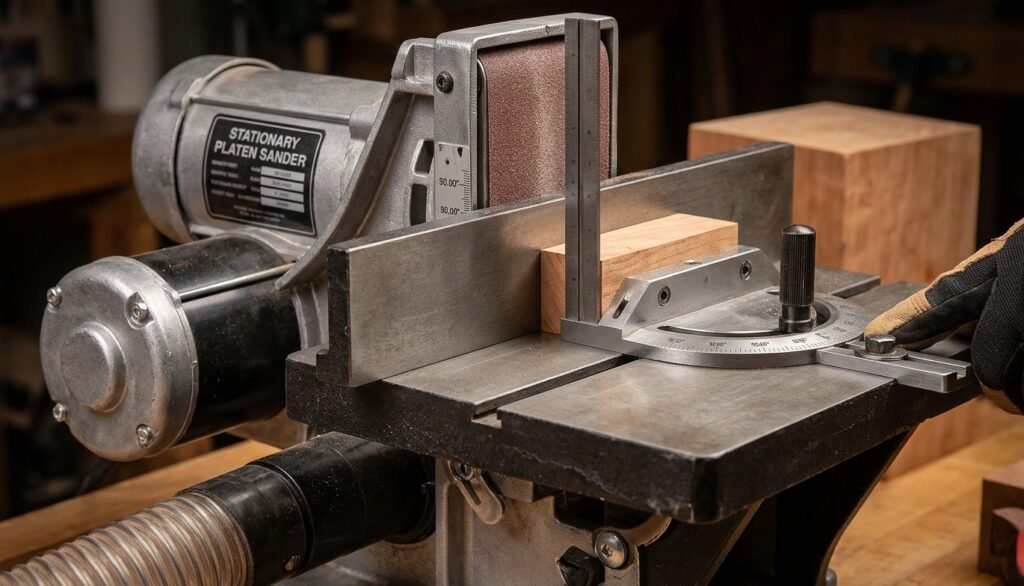 Your hands only need to guide the piece and not carry the weight of the tool.
A handheld sander asks more of the user. You need steady hands and a plan. Let the weight of the tool do the work and keep it moving along the grain. Never press down hard. Move in long smooth passes and overlap each one a bit. If you stop or tilt the tool you will carve a dip.
For a beginner a hand model can feel scary. A tip from the shop floor. Practice on scrap wood first and use a finer belt than you think you need. Then work up to coarser grits only if you must. Always finish with an orbital sander for a fine surface. A belt sander is a shaping tool and not a polishing tool.
If accuracy matters more than speed such as when you make drawers or small boxes pick the benchtop model. If speed matters more such as when you flatten a big slab pick the hand model.
A hand belt sander weighs 6 to 10 pounds and fits on a shelf. You can toss it in a truck bed. It needs almost no space. That makes it a great fit for a small garage or an apartment storage closet.
A benchtop machine needs a permanent spot. A small one can weigh 20 to 30 pounds and a cast iron model may weigh more than 50. You need a sturdy bench or a stand. Bolt it down if you can so it does not walk across the table during use. In a tiny shop that can be a problem.
Power access matters too. Both types need an outlet but the handheld cord can reach farther. If you work outdoors or at a client home the portable one is the only real choice.
A good middle path for crowded shops is a clamp-on small belt sander or a benchtop model that folds to a vertical position. Some machines can tilt the belt up so it stands on its end which saves bench space.
Use the chart below as a quick cheat sheet. It sums up the main points from this guide.
| Feature | Benchtop Belt Sander | Hand Belt Sander |
|---|---|---|
| Best for | Small parts and precise shaping | Large flat surfaces and rough stock |
| Mobility | Fixed in one spot | Easy to carry anywhere |
| Control | High with a table and fence | Needs steady hands and practice |
| Stock removal | Fast on small pieces | Fast on large panels |
| Sharpening | Good with fine belts | Not suited |
| Dust collection | Dust port or built-in system | Dust bag or shop vacuum |
| Footprint | Needs bench space | Stores on a shelf |
| Typical price | About $100 to $400 for home use | About $80 to $250 |
| Skill level | Beginner friendly | Takes some practice |
In simple terms. Choose a benchtop model if you build small projects and want clean edges and a tool that stays put. Choose a hand model if you work on big wood or refinish furniture and need a tool you can carry. If your budget allows it many serious woodworkers own both.
When you read a belt sanders review online look past the star rating. Check the belt size and the motor power and the dust port. Also check how easy it is to change and track the belt. Those details decide how well a tool serves you year after year. The best belt sander is the one that suits your own projects and not the one with the longest feature list.
The benchtop belt sander vs hand belt sander debate has no single winner. A benchtop model gives you control and accuracy and sharpening skills. A hand model gives you raw power and the freedom to move around. One tool brings the wood to the belt. The other brings the belt to the wood.
Before you buy think about the jobs you do most. List your next five projects. If most of them are small pick the benchtop machine. If most are big flat surfaces pick the hand model. Whichever you buy use a dust mask and eye protection. Clamp your work. Keep your fingers clear of the belt.
Ready to get started? Pick your tool and a pack of 80-grit and 120-grit belts and test them on scrap wood this weekend. Share this guide with a fellow maker who is stuck on the same choice.
Which is better for a beginner, a benchtop or a hand belt sander?
Most beginners find a benchtop model easier because it stays still and the table holds the angle. A hand model takes more practice since it can dig into the wood if you hold it wrong.
Can a hand belt sander replace a planer?
No. A planer cuts boards to an even thickness. A hand belt sander removes wood by grinding and cannot match that accuracy. It can smooth and level a surface but not make it perfectly uniform in thickness.
Can I use a belt sander to sharpen tools?
Yes with a benchtop model and a fine grit belt. Move the blade often so it does not overheat. A bench grinder is another choice but a belt gives a flat edge and runs cooler.
What grit should I start with?
Start with 80-grit for rough stock and old finish. Move to 120-grit and then 150-grit to smooth the surface. Finish with a random orbital sander before you stain or oil the wood.
Is a belt sander good for sanding hardwood floors?
It can work on a small area or a patch. For a full room rent a drum sander. It is wider and easier to keep level. A belt sander is better for edges and corners.
Do I need dust collection with a belt sander?
Yes. Belt sanders create a lot of fine dust. Use the dust bag or hook up a shop vacuum. Wear a dust mask too since the dust can harm your lungs over time.
Which belt sander lasts longer?
A benchtop model with a cast iron base and a strong motor can last for decades. A good hand model can last many years too if you clean it often and replace worn belts on time.