Physical Address
304 North Cardinal St.
Dorchester Center, MA 02124
Physical Address
304 North Cardinal St.
Dorchester Center, MA 02124

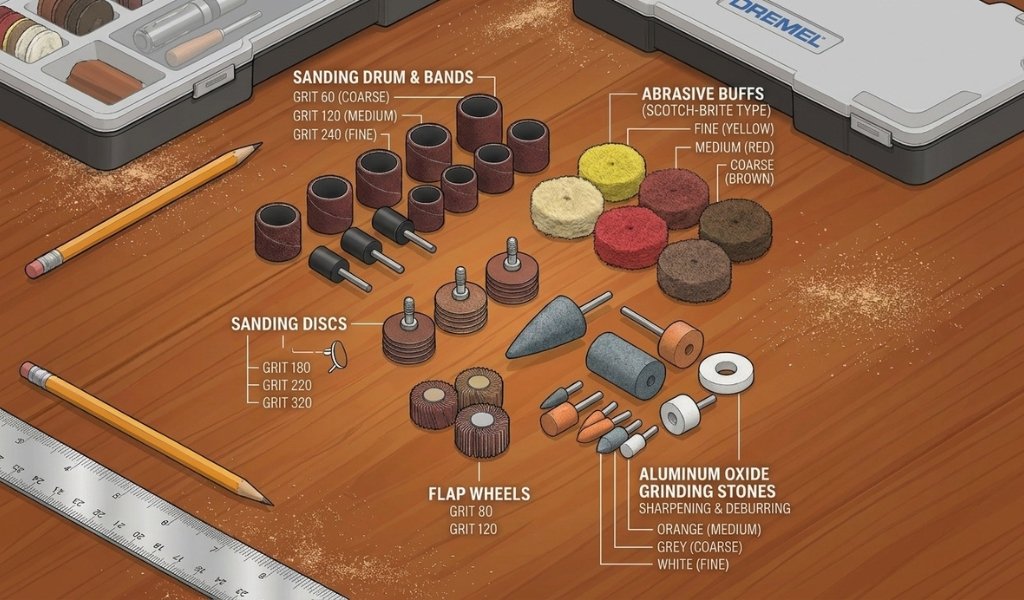
Most rotary tool users know Dremel makes excellent bits but walk into any hardware store, and the sheer volume of sanding accessories on the shelf can stop you cold. Bands, drums, discs, flap wheels, abrasive buffs: each one is built for a different task, and choosing the wrong one costs you time, material, and finish quality.
This guide cuts through the confusion. Whether you’re shaping a wooden furniture joint, smoothing fiberglass bodywork, or cleaning up a weld on metal, the right Dremel sanding bit makes the difference between a professional result and one you’re not proud of. You’ll learn how each accessory type works, which grit range to reach for at each stage of a project, and how to match the right bit to your material. If you want to go deeper on sanding fundamentals before diving into rotary tool specifics, that foundational knowledge will serve you well here.
Let’s break it all down, accessory by accessory, grit by grit.
Dremel sanding bits are small abrasive accessories designed to mount on a Dremel rotary tool and perform precision material removal, shaping, and finishing at high speed. Unlike full-size sanders that cover broad flat surfaces, Dremel sanding accessories excel in tight spaces, curved profiles, intricate carvings, and detail work where conventional power tools simply can’t reach.
The working principle is straightforward: abrasive particles bonded to a foam, rubber, fabric, or stone substrate spin at high RPM and cut away small amounts of material through friction. Depending on the accessory type, that abrasive action can be aggressive (for shaping and rough stock removal) or extremely fine (for polishing and finishing passes).
Dremel sanding bits are versatile sanding machines in miniature form. They handle wood, metal, plastic, and fiberglass, making them indispensable across woodworking, metalworking, model-making, jewelry crafting, and automotive detailing. The key is understanding which accessory to reach for at each stage of a project.
Nearly all Dremel sanding accessories are built around a standard 1/8-inch (3.2 mm) shank diameter. This isn’t arbitrary it’s what makes the entire Dremel ecosystem work. A 1/8-inch shank fits the collet on every standard Dremel rotary tool, meaning you can swap between sanding bands, discs, flap wheels, and abrasive buffs without changing chucks or adapters.
This universal compatibility extends to third-party accessories as well. Many aftermarket sanding bits sold under different brands but designed for rotary tools also use the 1/8-inch shank standard, which gives you a wide range of compatible options beyond the Dremel product line itself.
For drum sanders specifically, the shank is part of a sanding drum mandrel, a rubber or steel spindle that the replaceable sanding band slips over. The mandrel mounts via its 1/8-inch shank into the tool’s collet, while the band wraps around the outside drum surface and is held in place by a screw at the tip. When the band wears out, you swap only the band, not the mandrel. That replaceable design keeps running costs low, especially for high-volume sanding work.
Some larger Dremel accessories use a 1/4-inch shank or require the Dremel MultiPro collet, but for sanding tasks, 1/8-inch (or in some metric-market products, 6.4 mm equivalent) is the standard to know.
Sanding bands are among the most frequently used Dremel sanding accessories, and for good reason. A sanding band is a small abrasive sleeve typically 1/2 inch in diameter and 1/2 inch long that mounts over a rubber sanding drum mandrel. When the mandrel spins, the band’s outer abrasive surface makes contact with your workpiece.
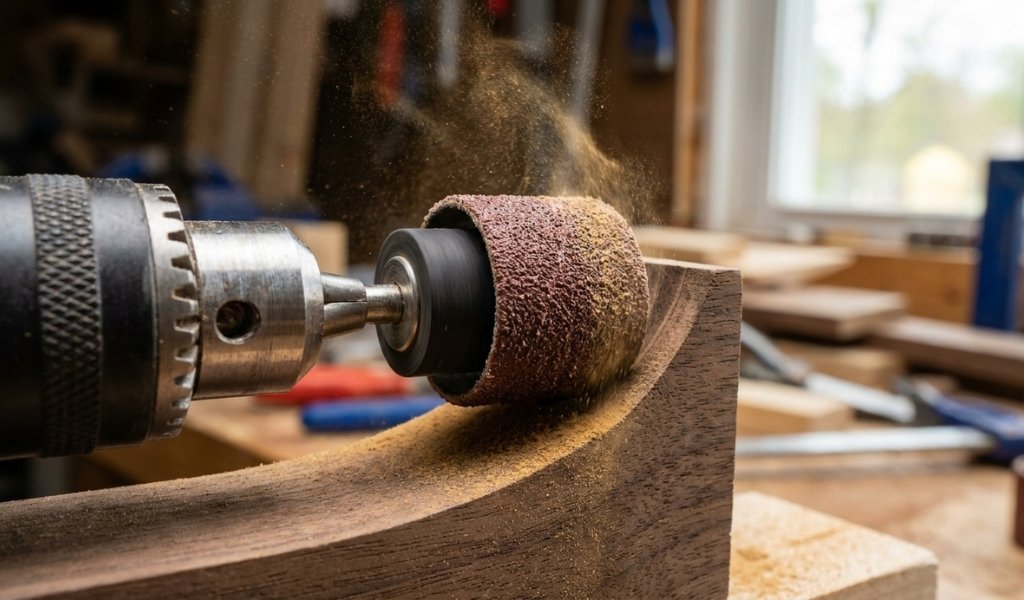
The drum sander configuration makes these bands exceptionally effective for:
Dremel sanding bands are available in a range of grits, from coarse 60-grit for aggressive stock removal down to finer options for smoothing rough spots before a finish pass. The replaceable nature of the bands means you can progress through grits on the same mandrel swap the band, not the whole accessory. For work on soft materials like balsa wood or foam, lower-speed settings and finer grit bands prevent tearing and ensure a clean surface.
Sanding discs for Dremel rotary tools are small circular abrasive discs typically 3/4 inch in diameter that mount on a disc mandrel and spin to sand flat surfaces, edges, and end-grain. They’re fast-cutting and well-suited for smoothing flat panels, deburring cut metal edges, and cleaning up joints before assembly.
Flap wheels take a different approach. Rather than one solid abrasive surface, a flap wheel consists of multiple overlapping abrasive fabric strips arranged radially around a central hub. As the wheel spins, the flaps contact the workpiece progressively conforming slightly to curved or irregular surfaces in a way that a rigid disc cannot. This makes the Dremel flap wheel particularly effective for:
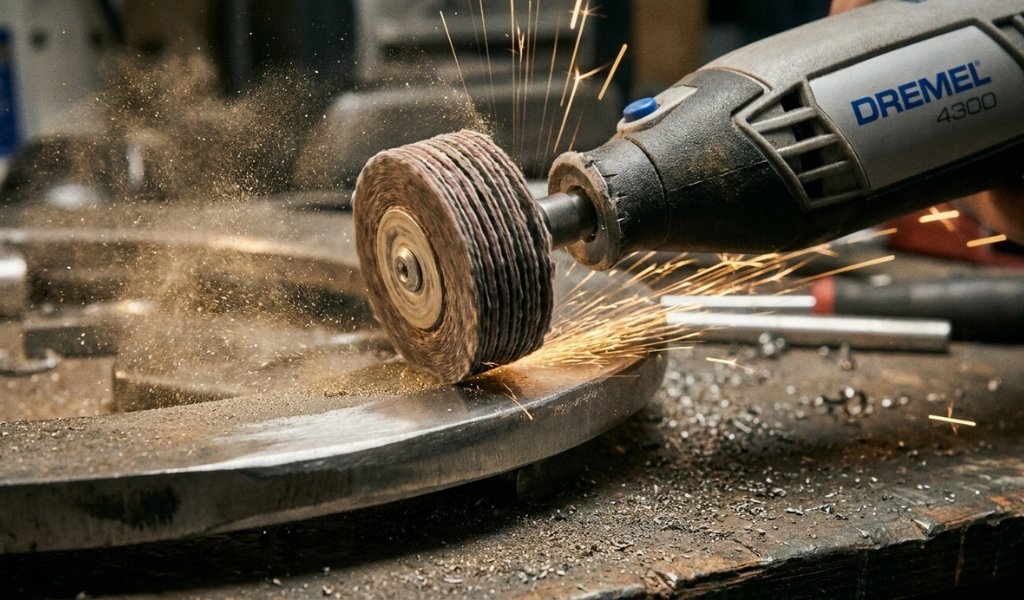
Both disc and wheel accessories use the standard 1/8-inch shank mounting system and are available in multiple grit options. Sanding discs cut more aggressively and are better for flat work; flap wheels are gentler and more versatile across complex geometry.
As you move toward the final stages of a project, two accessory categories become particularly important: abrasive buffs and grinding stones.
Abrasive buffs are small felt or rubber-bonded abrasive accessories designed for fine finishing and polishing passes. They cut very gently, making them ideal for the last stage of surface preparation before applying a finish, or for polishing metal to a bright sheen. On wood, abrasive buffs smooth down any remaining surface texture left by finer sanding bands.
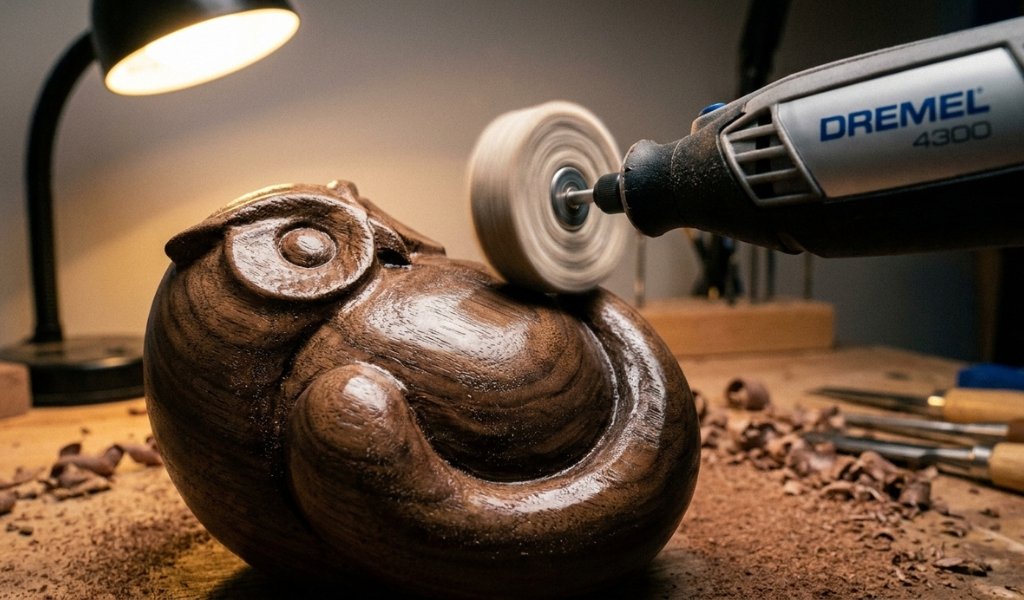
On soft metals like aluminum or copper, they can bring the surface to a near-mirror finish.
Grinding stones also called mounted stones or abrasive stones are cylindrical, conical, or ball-shaped accessories made from aluminum oxide or silicon carbide bonded in a vitrified ceramic matrix. While they’re technically classified as grinding accessories rather than sanding bits, grinding stones perform fine material removal and shaping tasks that overlap with sanding, particularly on hard materials like hardened steel, glass, or ceramic.
For woodworkers, grinding stones handle tasks like cleaning up glue squeeze-out in tight joints or shaping end grain in recessed areas. For metal workers, they’re essential for deburring, sharpening, and weld cleanup. The Dremel rotary tool’s variable speed control is especially useful with these accessories; hard materials require lower RPMs to avoid cracking the stone or overheating the workpiece.
Grit selection is the detail most beginners get wrong and fixing a surface damaged by the wrong grit takes far longer than choosing correctly in the first place. The same logic that governs full-size sanders applies directly to Dremel sanding bits: lower numbers cut more aggressively, higher numbers cut more finely.
Coarse grit Dremel sanding accessories ranging from 36 to 80 grit are built for one purpose: removing material fast. A 60-grit sanding band, for example, is aggressive enough to reshape a wooden edge, open up a tight hole, or strip a corroded surface on metal without excessive time or effort.
This grit range is most appropriate when:
On harder materials like metal or fiberglass, lower grits do the bulk of the structural work. On softer materials like balsa or foam, even 80-grit can be aggressive and apply lighter pressure and lower tool speed to maintain control.
One important rule: don’t skip grits on the way up. Starting with a 60-grit sanding band leaves scratches in the surface that a 240-grit accessory isn’t designed to remove efficiently. You’ll work through each grit stage, letting each one erase the marks left by the one before it.
Medium grit accessories spanning 120 to 220 grit are where most of the practical surface preparation work happens. After a coarse-grit shaping pass, this range refines the surface, removing the deep scratches left by lower grits and preparing the workpiece for its final finishing stage.
The Dremel 446 sanding band (a 240-grit accessory, bridging the upper edge of medium and lower edge of fine) is a popular choice for exactly this kind of work. Medium grits are appropriate for:
At this grit range, you’re not removing significant amounts of material, you’re refining what’s already there. Pressure should be light to moderate, and tool speed can be dialed back from the aggressive settings used during coarse-grit work. The result, after a thorough medium-grit pass, should be a surface that feels uniformly smooth to the touch with no obvious ridges or deep marks.
High-grit Dremel sanding accessories 240 grit and above handle the final stage of surface preparation. At this range, you’re not removing material in any meaningful quantity. The abrasive action is gentle, designed to close the surface, eliminate the fine scratches left by medium-grit passes, and leave a surface that’s ready for finish, paint, or polish.
For wood, a final pass with a 320-grit accessory before applying a stain produces noticeably more even color penetration than stopping at 120 or 150. For metal, high-grit sanding transitions naturally into buffing and polishing work. For plastic and fiberglass, fine-grit passes eliminate the micro-scratches that cause haziness in clear-coated surfaces.
Abrasive buffs and fine grinding stones live in this zone as well. At 240 to 320+ grit, compatible Dremel accessories can achieve results that look professional with clean edges, smooth curves, and surfaces that accept coatings cleanly.
At this stage, tool control matters as much as grit selection. Light, consistent contact with the workpiece is essential. Pressing too hard at fine grit doesn’t speed up the work; it creates uneven pressure points and can round edges you intended to keep crisp. Let the accessory do the cutting at low-to-medium RPM, and move slowly across the surface.
For most wood sanding tasks, a Dremel sanding band mounted on a rubber drum mandrel is the best starting point. Sanding bands are available in a range of grits, handle both shaping and smoothing tasks, and work well across hardwoods and soft materials alike. For detail finishing on wood, a fine abrasive buff or high-grit sanding disc will refine the surface before applying a stain or finish.
Yes, Dremel rotary tools are well-suited to sanding tasks, particularly in areas where full-size sanders can’t reach. With the right sanding accessory (bands, discs, flap wheels, or abrasive buffs), a Dremel rotary tool handles detailed sanding on wood, metal, plastic, and fiberglass effectively. It’s not a replacement for a belt sander or random orbital sander on large flat surfaces, but for precision and detail work, it’s the better tool.
For fine finishing passes, the Dremel 240-grit sanding band (446) is a reliable choice on wood and soft metals. Abrasive buffs are ideal for polishing metal or achieving a smooth pre-finish surface on wood. Flap wheels in higher grits blend surfaces smoothly without creating flat spots, making them a good option for curved or contoured workpieces requiring fine surface refinement.
Dremel sanding and accessory kits typically include a selection of sanding bands in multiple grits, one or more rubber drum mandrels, sanding discs with a disc mandrel, and sometimes a flap wheel or abrasive buffs. The exact contents vary by kit, but most starter sets cover both coarse and medium grit options enough to handle shaping and surface preparation tasks. For fine finishing work, individual high-grit accessories are usually purchased separately.