Physical Address
304 North Cardinal St.
Dorchester Center, MA 02124
Physical Address
304 North Cardinal St.
Dorchester Center, MA 02124

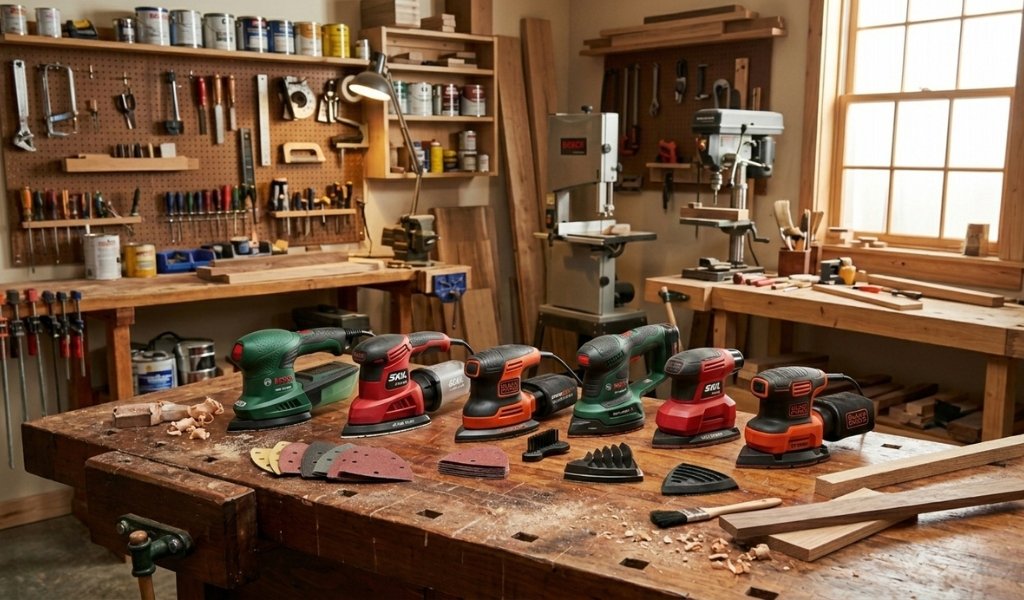
Most woodworking projects hit a wall at the same point: a tight inside corner, a recessed panel, a carved molding detail that a full-size sander simply cannot reach. That’s exactly where a detail sander earns its place on the workbench.
If you’ve spent any time doing sanding work on fine furniture, trim carpentry, or intricate DIY builds, you already know that larger sanders belt sanders, random orbital sanders, even palm sanders can only take you so far. They’re built for open surfaces. The moment you hit a tight spot, a dovetail joint, or a narrow groove, they become useless at best and destructive at worst. A detail sander is purpose-built to handle exactly those situations.
This guide covers everything you need to make a smart purchase decision. You’ll learn what a detail sander actually does, which types and models are worth considering, and exactly what specs to evaluate before spending your money.
A detail sander also called a mouse sander or corner sander is a compact, electric detail sander designed around a triangular sanding pad. That pointed tip is the defining feature.
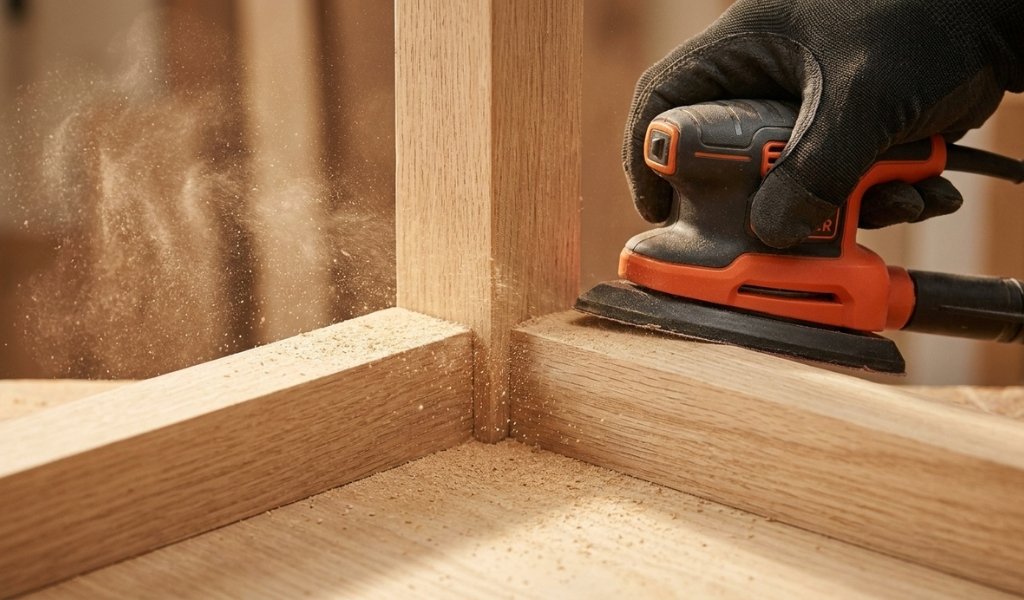
It lets the tool fit into 90-degree corners, reach narrow grooves, and navigate intricate profiles that no rectangular or circular sanding pad can access.
The sanding head on most detail sanders operates using a rapid oscillating motion, typically measured in orbits per minute (OPM). The pad vibrates back and forth at high speed, allowing the sandpaper to abrade the surface without the tool needing to travel across a wide area. This makes it highly effective for precision sanding on small sections of a workpiece, where control matters more than coverage.
The triangular pad attaches to hook-and-loop sanding discs or custom-cut sanding paper, and many models include interchangeable attachments for different profiles. The compact sander body is typically pistol-grip or barrel-grip shaped, keeping the operator’s hand close to the work surface for maximum feedback and accuracy.
Detail sanders operate at speeds generally ranging from 10,000 to 22,000 OPM, with higher-end models offering variable speed control to dial in the right aggressiveness for different materials and grit levels. The combination of a pointed sanding pad and high-frequency oscillation is what separates this sander tool from every other power sander in the shop.
The case for owning a mouse sander comes down to one practical reality: hand sanding tight spaces is slow, inconsistent, and hard on the hands. Folding sandpaper into a corner and scrubbing by hand works, but it rarely produces a flat, even surface especially in tight corners where pressure distribution is nearly impossible to control manually.
A detailed sander solves this. The pointed tip reaches into tight spots where larger sanders cannot go. For fine furniture with recessed panels, stair balusters, window casing profiles, or painted cabinetry with inside corners, a mouse sander cuts sanding time significantly while delivering a more consistent result than hand sanding alone.
Beyond just corners, a detail sander handles sanding tasks like preparing narrow door edges, smoothing curved cabinet frames, and cleaning up tight spaces sanding between drawer box components. For home improvement projects involving trim, molding, and built-in cabinetry, it’s one of the most-used tools in the shop. Marks on the wood from previous tools, old finishes in recessed areas, and rough grain in tight corners all of these yield efficiently to a properly chosen detail sander.
The corded vs. cordless debate applies squarely to detail sanders, and the right choice depends on how and where you work.
Corded detail sanders deliver consistent, uninterrupted power throughout the session. A corded sander typically draws 1.0 to 2.0 amps and maintains its OPM without variation, which matters when you’re working through multiple grits on a large furniture piece or doing extended sanding and finish work. The power cord does restrict movement, but for bench work and shop-based projects, that’s rarely a problem. Corded models are also generally less expensive and lighter than their cordless counterparts since there’s no battery pack adding weight.
Cordless detail sanders trade sustained power for mobility. A cordless detail sander runs on a lithium-ion battery and charger system, giving you the freedom to move around the workshop or take the tool to a job site without hunting for outlets.
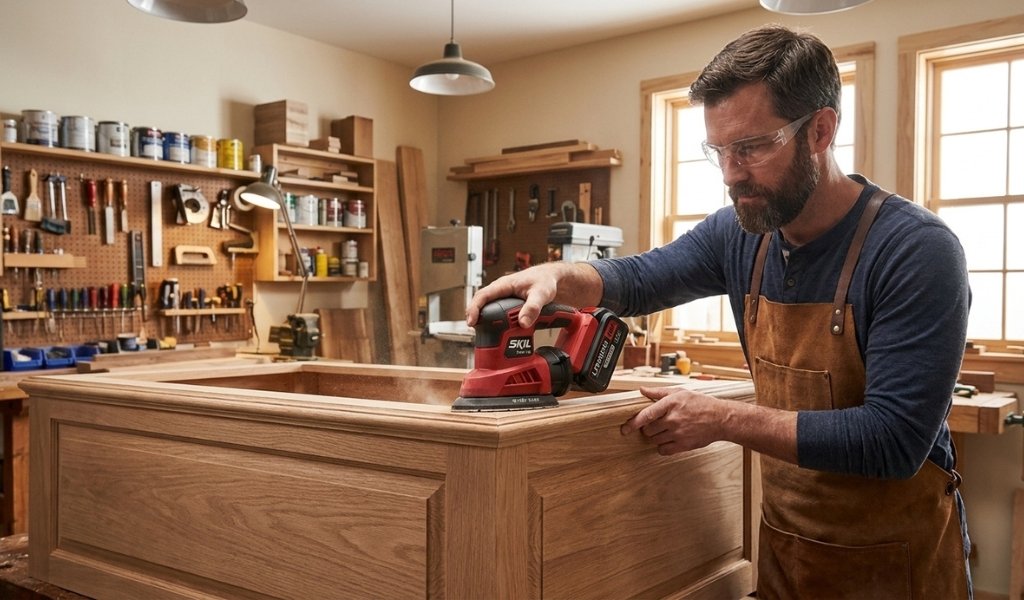
Battery and charger platforms from brands like Ryobi, Milwaukee, and Bosch mean you can share power sources across multiple tools a real advantage if you’re already invested in one of those ecosystems.
The tradeoff: cordless sanders add weight from the battery pack and may show power drop-off as the battery drains. For short sanding sessions and site work, a cordless sander is excellent. For long production runs, a corded sander is more reliable.
Choose a corded detail sander if: you work primarily in a stationary shop environment and need consistent power over extended sessions.
Choose a cordless detail sander if: portability, site work, or battery platform integration matters more than sustained runtime.
Some detail sanders go beyond the standard triangular pad configuration to offer multiple attachment options in a single tool. These multi-function or 5-in-1 versatile detail sanders come with a set of interchangeable sanding heads typically a standard triangular pad, a finger sanding attachment, a larger rectangular pad, and sometimes a pointed contour attachment.
The appeal is obvious: one tool handles a wide range of detail sanding scenarios without requiring separate purchases. A versatile detail sander with a full attachment kit can cover inside corners, narrow profiles, curved surfaces, and flat areas all in one package.
The delta sander configuration named for its triangular shape is the most common, but some models extend the range with an orbital detail sander mode that increases the pad’s motion pattern for faster material removal on flat surfaces. Multi-function tools are particularly well-suited for home improvement work where the variety of surfaces and situations makes a single-purpose tool limiting.
The tradeoff with multi-function sanders is that attachment changes add time, and some attachments don’t perform quite as well as a purpose-built tool for the same task. But for versatility across a range of woodworking projects, the 5-in-1 format is genuinely useful.
Several brands have established strong reputations in the detail sander category, each with distinct strengths.
Bosch Tools produces some of the most refined detail sanders on the market. Bosch detail sanders are well-regarded for their low vibration design, which significantly reduces hand fatigue during extended use. The Bosch multi-sander lineup includes both corded and cordless configurations, with high OPM ranges, effective dust collection systems, and robust interchangeable attachment systems. For professional woodworkers and serious DIYers, Bosch tools represent a premium investment that pays off in longevity and performance.
SKIL offers reliable, budget-friendly detail sanders that perform well for home improvement work and less intensive woodworking projects. SKIL detail sanders typically feature straightforward variable speed controls, hook-and-loop sanding pad attachment, and included sanding discs. The brand’s approachability makes it a strong pick for those building out a first workshop.
Black+Decker is widely known for its MOUSE sander line the brand essentially popularized the mouse sander form factor for consumer use. The Black+Decker MOUSE is compact, lightweight, and simple to operate, with a finger detail attachment included in most kits. The MAXXT mouse sander variant adds more power and improved dust collection over the original. Black+Decker mouse sanders are consistently well-reviewed for light to medium sanding tasks, particularly in home renovation contexts.
Ryobi rounds out the accessible end of the market with cordless detail sanders compatible with its ONE+ battery platform. Ryobi detail sanders are a practical choice for users already committed to the ONE+ ecosystem, offering decent performance at a competitive price point.
For heavy-duty professional applications, Milwaukee’s M12 FUEL orbital detail sander is worth noting. The M12 FUEL orbital detail sander delivers professional-grade performance in a cordless format, with low vibration, high OPM, and compatibility with Milwaukee’s M12 battery system.
Motor specs determine how aggressively a detail sander removes material and how consistently it performs under load.
Amperage indicates the power draw of a corded detail sander. Most detail sanders fall in the 1.0–2.0 amp range. Higher amperage doesn’t always mean better performance for detail work since detail sanders are precision tools, not material-removal workhorses but it does ensure the motor maintains speed when the pad is pressed against a surface.
OPM (orbits per minute) measures how fast the sanding pad oscillates. Detail sanders typically range from 10,000 to 22,000 OPM. Higher OPM produces faster material removal but also more heat and vibration. Lower OPM offers more control for fine finishing work. The best detail sander for professional use often operates in the 14,000–22,000 OPM range with variable speed.
RPM (RPM) is less commonly cited for detail sanders than for rotary tools, but some multi-function models include a rotary mode where RPM becomes relevant.
Variable speed is one of the most valuable features on a detail sander. The ability to dial down the speed when using fine-grit sandpaper on delicate surfaces or push it up when cutting through a painted finish gives you meaningful control over the result. Always prioritize variable speed on a detail sander intended for mixed woodworking and finishing work.
The sanding pad configuration defines what a detail sander can actually reach.
The standard triangular sanding pad is the core of the tool. Pad size varies slightly between models, but the pointed tip geometry is consistent; it’s what allows the sander to get into 90-degree corners and tight spaces. Sanding discs for triangular pads are available in a wide grit range, from 60-grit aggressive stock removal down to 220-grit finish sanding.
Interchangeable attachments expand the tool’s range considerably. The most useful additions include:
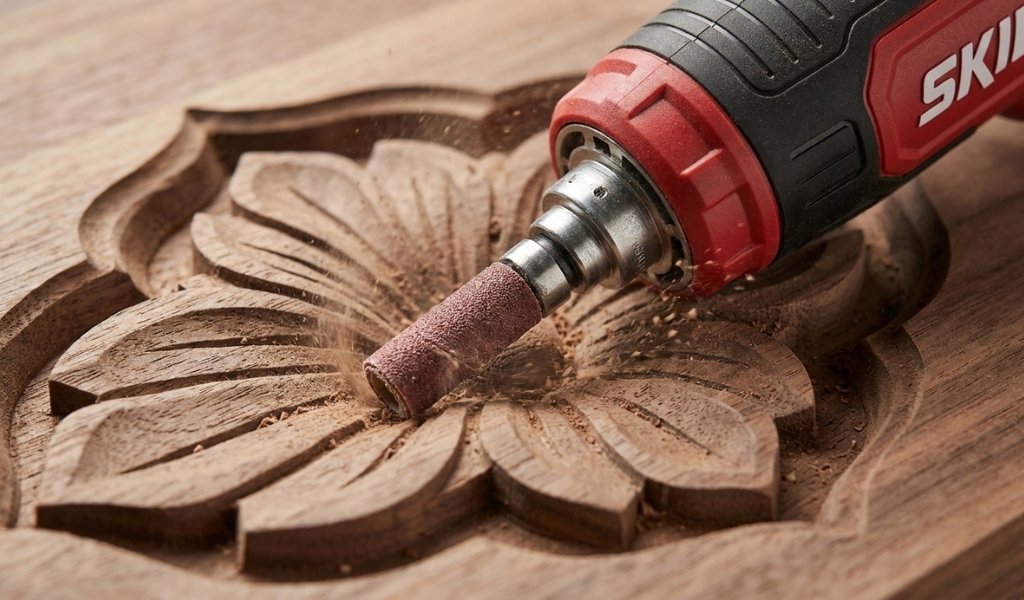
When evaluating a detail sander, check whether the sanding head accepts standard hook-and-loop sanding discs that can be purchased readily, or whether it requires proprietary sanding paper. Proprietary systems increase long-term cost and limit your grit options.
Dust collection separates a professional sanding setup from an amateur one. Fine wood dust created during detail sanding accumulates fast and becomes airborne quickly in tight corners exactly where a detail sander operates. Always mask when sanding, regardless of dust collection quality.
Most detail sanders include one of two dust collection approaches: an integrated dust box that captures dust directly at the pad, or a port that connects to a shop vacuum hose. The dust box is convenient for quick jobs but fills quickly and is less efficient than vacuum extraction. For extended sanding sessions, a vacuum-connected dust collection system is far superior.
Ergonomics directly affect how long you can work comfortably. A well-designed detail sander fits naturally in one hand, with the grip positioned low and close to the sanding pad. Low vibration design particularly in models from Bosch reduces hand and wrist fatigue over long sessions. Heavier tools with poorly balanced weight distribution become tiring quickly, especially in overhead or awkward-angle applications.
Look for a compact sander with a rubberized grip, a well-placed power switch you can operate without repositioning your hand, and an overall balance that keeps the sanding pad flat against the surface without excessive downward pressure from you. The goal is a tool that feels like an extension of your hand, not one you’re fighting to control.
A detail sander is specifically designed for precision sanding in tight corners, recessed areas, narrow profiles, and intricate surfaces where larger sanders cannot reach. It excels at preparing fine furniture for finishing, cleaning up trim and molding details, smoothing inside cabinet corners, and removing old paint or finish from detailed woodwork. For any woodworking project with complex geometry, a detail sander is the right sanding tool for the job.
The best detail sander depends on your use case, but for professional woodworking, Bosch’s multi-sander lineup and Milwaukee’s M12 FUEL orbital detail sander consistently rank at the top for low vibration, power, and attachment versatility. For DIY home improvement work, the Black+Decker MOUSE and MAXXT mouse sander offer reliable performance at an accessible price. Prioritize variable speed, quality dust collection, and a comprehensive interchangeable attachment system when comparing models.
These tools serve different purposes. A random orbital sander covers large, flat surfaces faster and removes material more aggressively; it’s the right choice for wide panels, tabletops, and floors. A detail sander reaches tight spaces and corners that an orbital sander cannot access. Most woodworkers benefit from owning both: a random orbital sander for open surfaces and a detail sander for intricate work. If you need to choose one for a project with lots of corner and trim sanding, the detail sander wins every time.
Common uses include sanding inside corners on furniture frames, smoothing window and door casing profiles, preparing stair components and balusters, stripping paint or finish from recessed panel doors, cleaning up tight spots on built-in cabinetry, and finish-sanding carved decorative details. Beyond woodworking, detail sanders are also used in home improvement projects for sanding grout lines, painted surfaces in tight areas, and composite trim materials.