Physical Address
304 North Cardinal St.
Dorchester Center, MA 02124
Physical Address
304 North Cardinal St.
Dorchester Center, MA 02124

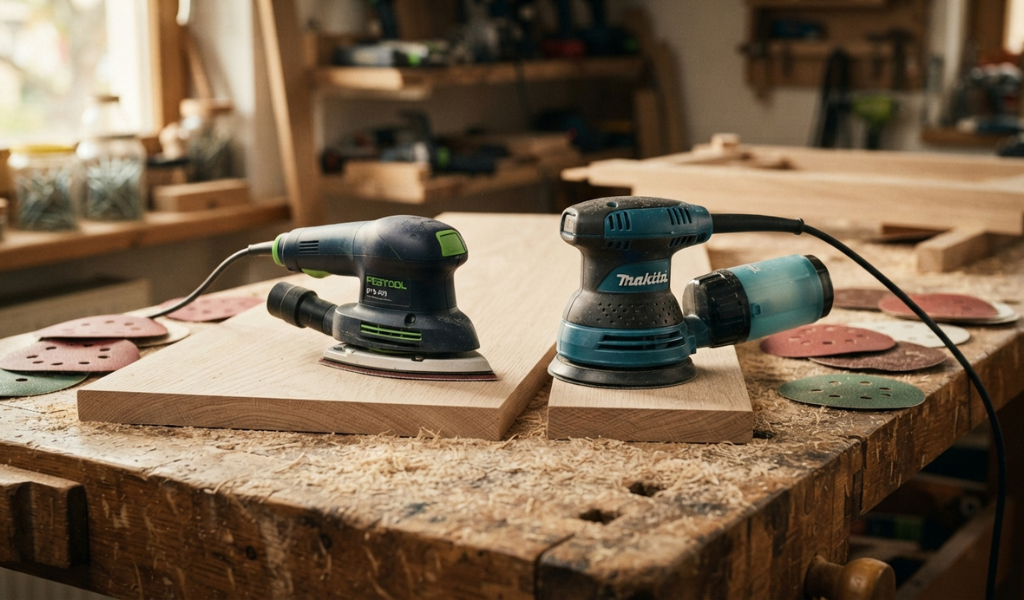
Walk into any hardware store and ask which sander you need, and you’ll probably get a confused shrug. That’s because the answer depends entirely on your project. Choosing the right tool between a detail sander and an orbital sander can save you hours of frustration, protect your workpiece, and give you a finish you’re actually proud of.
Both tools remove material and smooth surfaces, but they’re built for different jobs. A detail sander is designed for precision, tight corners, and hard-to-reach spots. A random orbital sander is the go-to choice for smoothing large surfaces quickly and evenly. Picking the wrong one for the job often leads to swirl marks, uneven finishes, or wasted time.
This guide breaks down everything you need to know about detail sander vs orbital sander comparisons, including performance, grit selection, common mistakes, and which one fits your work best. By the end, you’ll know exactly which sander belongs in your toolbox, or whether you need both.
A detail sander, sometimes called a mouse sander because of its small, pointed shape, is built for precision work. It uses a triangular sanding pad that vibrates in small, quick motions rather than spinning in circles. This design lets the sander reach corners, edges, and tight spaces that larger tools simply can’t access.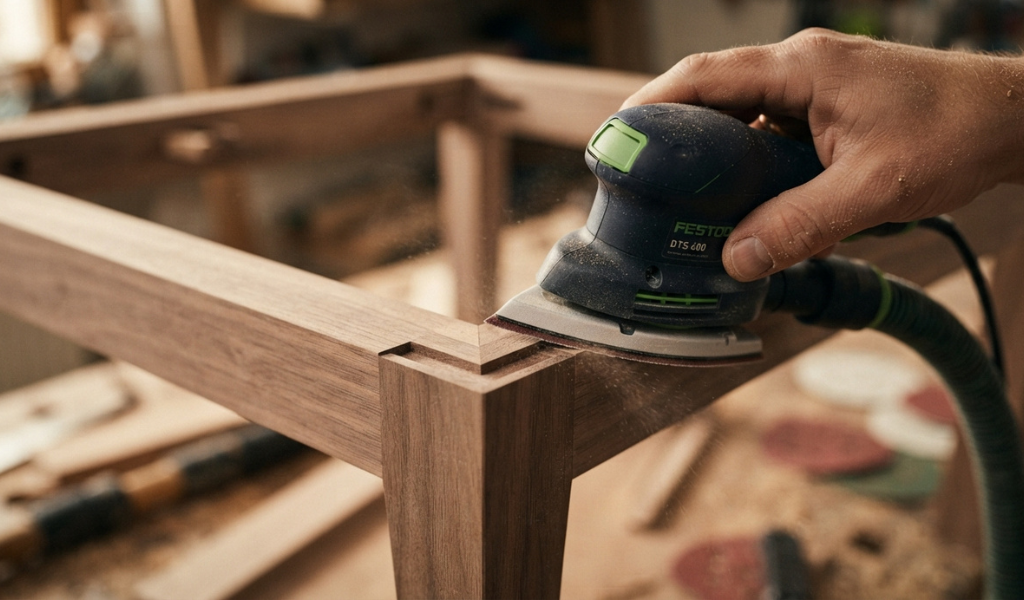
Woodworkers often reach for a detail sander when refinishing furniture with carved details, sanding window frames, or working on stair spindles. The pointed tip fits into hard-to-reach corners, while the flat sides handle small flat surfaces. Because it removes material slowly and carefully, a detail sander gives you more control over fine finishing work.
Most detail sanders are lightweight and easy to hold with one hand, which matters when you’re working in tight spaces for extended periods. Many models also include built-in dust collection, helping keep your workspace cleaner while you sand.
An orbital sander, more specifically a random orbital sander, uses a round sanding pad that moves in two directions at once. The pad spins while also moving in tiny circles, which is why it’s called “random.” This dual motion prevents the sander from leaving repetitive swirl marks in the wood grain, something older sheet sanders and disc sanders were notorious for.
This tool is the workhorse for smoothing large surfaces like tabletops, doors, cabinet panels, and floors. Because the round pad covers more area with each pass, an orbital sander can save time compared to sanding by hand or using a detail sander on a big surface.
Random orbital sanders are usually available in corded and cordless versions, and many models use hook-and-loop sanding discs for quick paper changes. If you’re preparing wood for finishing or removing an old coat of paint or varnish, this is often the better choice.
The clearest way to understand the difference between an orbital sander and a detail sander is to look at pad shape and movement. A detail sander has a triangular pad that vibrates in small, tight motions, ideal for corners and edges. An orbital sander has a round pad that moves in a random orbit pattern, ideal for flat, open surfaces.
Material removal is another key difference. Orbital sanders remove material faster because of their broader pad and more aggressive motion, making them a better fit for large surface prep. Detail sanders remove material more slowly, which actually works in your favor when you’re doing precision work and don’t want to accidentally sand through a thin veneer or delicate edge.
Size and reach also set these tools apart. A detail sander’s pointed shape lets it get into corners a round pad can never reach. An orbital sander’s round shape makes it awkward for tight spaces, but efficient for open, square or rectangular surfaces.
Deciding between these two tools comes down to three factors: the sanding performance you need, how quickly you want to finish the job, and the surface finish you’re after.
If your project involves detailed work like furniture trim, moldings, or intricate carvings, a detail sander performs better because it’s designed for precision, not speed. If you’re working on flat, open areas like a tabletop or a large panel, an orbital sander performs better because it covers more ground with less effort.
An orbital sander is generally faster for big jobs. Its round sanding pad and stronger motor let it remove material and smooth large surfaces in a fraction of the time a detail sander would need. A detail sander is slower by design, but that slower pace gives you more control when precision matters more than speed.
Both tools can produce a smooth, professional finish when used properly. An orbital sander tends to produce a more even finish across large areas because of its random motion, which helps avoid visible patterns in the wood grain. A detail sander produces excellent results in small areas but isn’t practical for finishing an entire tabletop or door.
Woodworkers often need both tools, since most projects include a mix of large flat surfaces and small detailed areas.
For woodworking projects involving furniture restoration, carved details, or trim work, a detail sander is ideal. It handles corners and edges that a round pad can’t reach, making it perfect for finishing chair legs, spindles, and decorative molding. If you’re refinishing an antique piece with lots of small details, this tool will save you from hours of hand sanding.
When it comes to smoothing large surfaces like tabletops, cabinet doors, or wide boards, an orbital sander is the better choice. It removes material evenly across flat surfaces and helps you avoid the uneven, streaky look that comes from sanding by hand. For woodworkers building furniture from scratch, this tool becomes a go-to for prepping wood before staining or sealing.
Advantages:
Disadvantages:
Advantages:
Disadvantages:
When comparing overall performance, it helps to think about what each tool was designed to do. A detail sander is designed for precision, not power. It excels in areas where control matters more than speed, like sanding between coats of finish on a decorative piece or smoothing a small repair patch.
An orbital sander, on the other hand, is designed for consistency across larger areas. Its round sanding pad and random movement pattern help produce a uniform finish without visible patterns, which is especially important when staining wood, since uneven sanding shows up clearly under stain.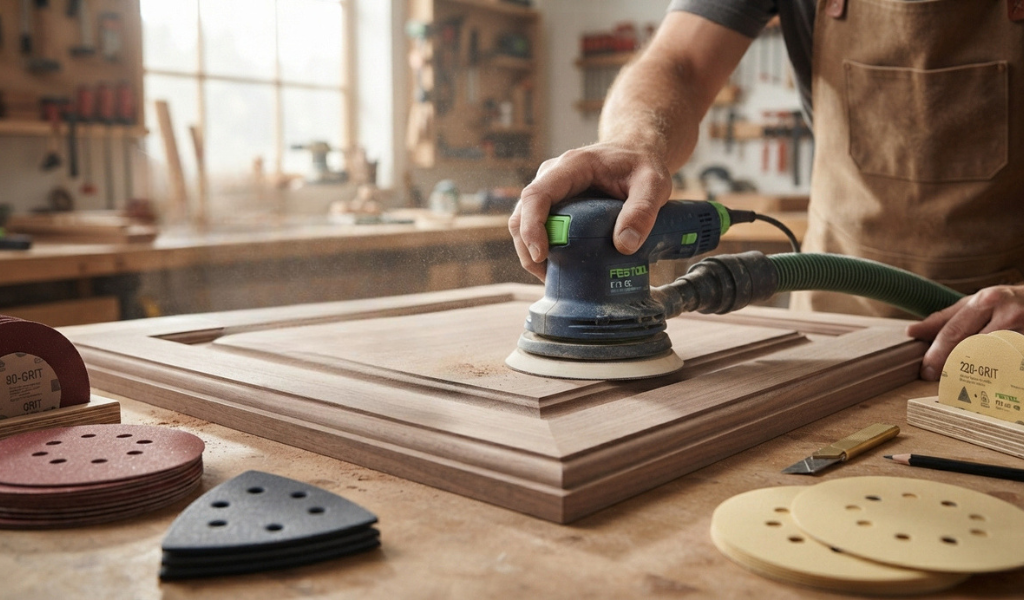
If you’re chasing a fine finishing result on a large project, many professionals actually use both tools in sequence. They’ll start with an orbital sander to handle the bulk of the surface, then switch to a detail sander to clean up corners and edges the round pad missed.
Furniture projects usually combine flat surfaces with detailed elements, so the honest answer is that both tools have a place. For flat surfaces like tabletops, seats, and cabinet doors, an orbital sander is the better choice because it saves time and produces an even finish across a large surface.
For legs, spindles, carved trim, or any tight corners and edges, a detail sander is the better choice. Trying to use a round sanding pad in these areas usually means you’ll either miss spots entirely or accidentally round over edges you wanted to keep sharp.
If you only have room in your budget for one tool right now, think about the type of furniture work you do most. If you mostly build or refinish simple, flat pieces, an orbital sander is likely the better first investment. If you specialize in antique restoration or detailed woodworking, a detail sander might get more use.
Picking the right grit matters just as much as picking the right sander. Coarse grits, around 60 to 80, work well for removing old paint or varnish and leveling rough surfaces. Medium grits, around 100 to 150, handle general smoothing and prep work. Fine grits, 180 and above, are best for final smoothing before staining or sealing.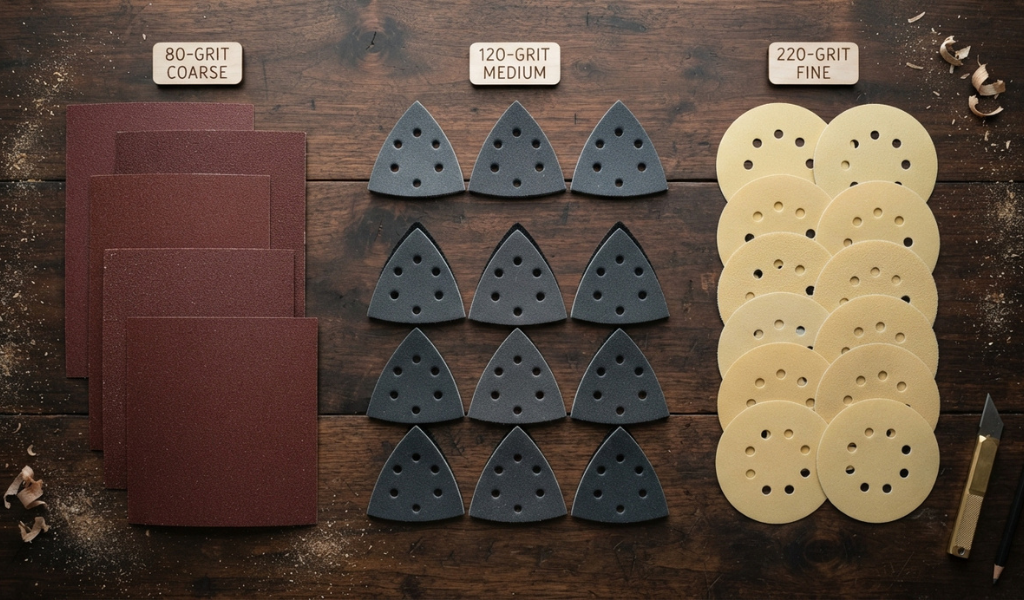
Regardless of which sander you’re using, always start with a coarser grit and work your way up to a finer one. Skipping grits can leave visible scratches that are hard to remove later.
Detail sanders use small, triangular pads, and sandpaper for these tools is typically sold as pre-cut sheets or hook-and-loop pads shaped to match. Because the pads are small, sandpaper wears out faster, especially on the pointed tip, which sees the most friction during detailed work.
Orbital sanders use round sanding discs, most of which attach using a hook-and-loop system for quick changes. These discs often come with pre-punched holes that line up with the sander’s dust collection ports, helping pull dust away from the surface as you work.
A good rule of thumb is to swap sandpaper once it stops removing material efficiently or looks visibly worn and shiny. Continuing to use worn sandpaper wastes time and can actually burnish the wood surface instead of smoothing it, which makes it harder for stain or finish to absorb evenly.
For DIY enthusiasts working on home projects, having both tools on hand offers the most flexibility. An orbital sander handles bigger jobs like sanding a deck, refinishing a large tabletop, or smoothing drywall patches. A detail sander steps in for smaller tasks like sanding window trim, door frames, or small furniture repairs.
If you’re just starting out and need to choose one, think about your most common projects. DIYers who mostly work on furniture flips and large flat surfaces will get more use out of a random orbital sander. Those who focus on trim work, small repairs, or detailed refinishing will find a detail sander more useful day to day.
Many hardware brands now sell combo kits that include both tools, which can be a smart way to build out your collection without buying two separate sanders over time.
One of the most common mistakes is trying to force one tool to do a job it wasn’t designed for. Using a detail sander to smooth an entire tabletop wastes time, while using an orbital sander to sand tight corners often leaves noticeable gaps or rounded edges where you didn’t want them.
Pressing too hard or using excessive force doesn’t speed up sanding, it usually just wears out the sandpaper faster and can create uneven spots. Let the tool do the work. Both detail sanders and orbital sanders are designed to remove material efficiently on their own with light, even pressure.
Starting with a grit that’s too fine wastes time, since it won’t remove material fast enough to fix rough spots. Starting too coarse without working your way up to finer grits leaves visible scratches in the final finish. Always match your grit to the condition of the surface.
Moving the sander too fast across the surface, or staying in one spot too long, both cause problems. Moving too quickly can leave uneven areas, while lingering in one spot too long can create low spots or even burn marks on wood. A steady, even pace produces the best results.
Sanding produces a lot of fine dust, and skipping dust collection or protective gear isn’t worth the risk. Wearing a dust mask and using the sander’s built-in dust collection, when available, keeps your workspace cleaner and protects your lungs from fine particles over time.
Choose a detail sander if your projects regularly involve corners, edges, or detailed woodworking that a round pad can’t reach. This tool is ideal for furniture restoration, trim work, and any project where precision matters more than speed. If you find yourself constantly hand-sanding tight spots, a detail sander will save time and improve your results significantly.
Choose an orbital sander if you regularly work with large, flat surfaces like tabletops, doors, or wide panels. This tool is the better choice for anyone who values speed and consistency over pinpoint precision. A quality orbital sander is often considered a must-have for general woodworking, furniture building, and home improvement projects.
For most people building a toolkit from scratch, a random orbital sander is usually the first purchase, since it handles a wider range of everyday sanding tasks. A detail sander can be added later once you find yourself needing more precision.
There isn’t a single winner in the detail sander vs orbital sander debate, because these tools solve different problems. A detail sander is ideal for precision, corners, and detailed work, while an orbital sander is better suited for smoothing large surfaces quickly and evenly. Understanding what each tool is designed for helps you decide which one is right for your next project, or whether it’s worth owning both.
Before your next sanding job, take a moment to assess the surface in front of you. If it’s flat and open, reach for the orbital sander. If it’s full of corners, trim, or detailed carvings, the detail sander will get you a cleaner result. Used correctly, both tools can save you time and help you achieve a professional-quality finish.
What is a detail sander good for?
A detail sander is good for reaching corners, edges, and tight spaces that larger sanders can’t access. It’s commonly used for furniture restoration, trim work, and detailed woodworking projects where precision matters more than speed.
What are the downsides of using an orbital sander?
An orbital sander struggles to reach tight corners and detailed areas because of its round sanding pad. It can also be harder to control for precision work, and heavier models may cause fatigue during long sanding sessions.
What type of sander gives the best finish?
A random orbital sander typically gives the smoothest, most even finish on large flat surfaces because its random motion prevents visible swirl marks. For small, detailed areas, a detail sander provides better control and a cleaner result.
What’s better than an orbital sander?
No single sander is universally better since it depends on the task. A detail sander is better for precision work and tight corners, while a belt sander may be better for heavy material removal on large, rough surfaces.
Do orbital sanders ruin wood grain?
When used properly, orbital sanders don’t ruin wood grain. Their random orbit motion is specifically designed to prevent the visible swirl marks that older sheet sanders and disc sanders often left behind. Problems usually happen when the wrong grit is used or too much pressure is applied.
Can a detail sander replace an orbital sander?
A detail sander can’t fully replace an orbital sander for large projects. While it excels at precision work, its small pad makes it impractical for sanding big surfaces like tabletops or floors, where an orbital sander saves significant time.
Do I need both a detail sander and an orbital sander?
Many woodworkers and DIYers benefit from owning both tools, since most projects combine large flat surfaces with detailed corners or trim. Using the right sander for each part of the job leads to a better, more consistent finish overall.