Physical Address
304 North Cardinal St.
Dorchester Center, MA 02124
Physical Address
304 North Cardinal St.
Dorchester Center, MA 02124

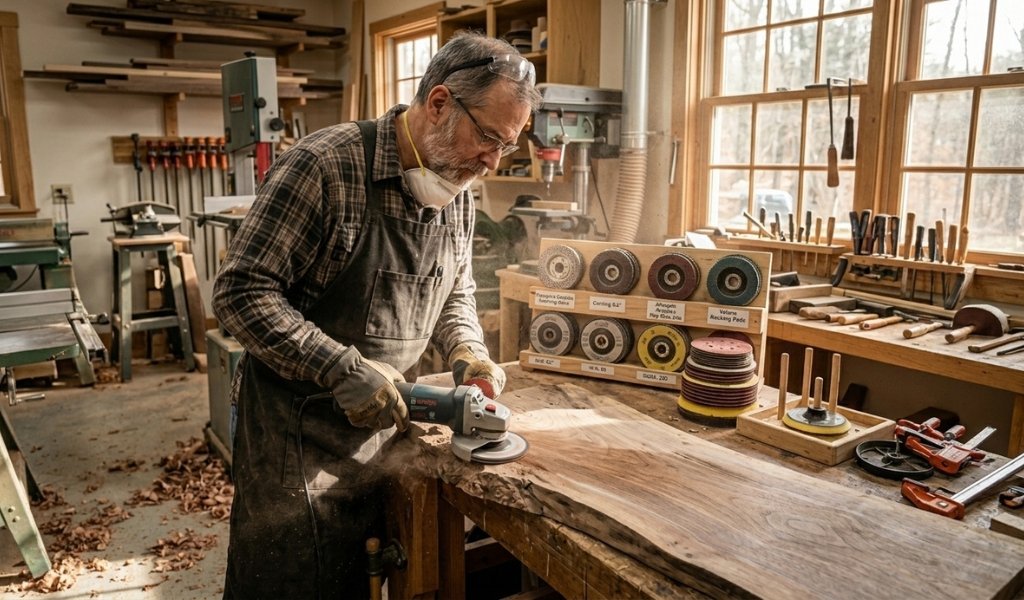
Few tools in a woodworker’s arsenal are as powerful or as misunderstood as the angle grinder. Most people associate it with metal fabrication, rust removal, or deburring steel. But mount the right abrasive disc, and it becomes one of the most capable wood sanding and shaping tools you can own.
Whether you’re sculpting a live-edge slab, removing heavy stock from rough-cut timber, or cleaning up a surface before applying paint or stain, the correct wood sanding disc for an angle grinder can accomplish in minutes what traditional methods take hours to complete. That said, knowing which disc to choose, how to use it safely, and when to switch to a different tool entirely makes all the difference between a professional result and a scorched, gouged mess.
If you’re newer to the broader world of abrasives and surface preparation, it’s worth exploring our ultimate guide to woodworking sanding techniques to build a solid foundation before diving into the specifics of grinder-mounted discs. Once you understand the full spectrum of sanding approaches from coarse material removal to fine finishing the role of the angle grinder becomes much clearer.
This guide covers everything: disc types, grit selection, tool comparisons, safety protocols, and how to integrate your angle grinder into a complete wood sanding tools workflow. By the end, you’ll know exactly which disc belongs on your grinder for every task.
The appeal is straightforward: raw power and versatility. A standard angle grinder operates at anywhere from 5,000 to 12,000 RPM, delivering aggressive cutting action that no handheld orbital sander can match. For heavy-duty woodworking tasks flattening wide panels, removing old paint or stain, or shaping curved surfaces that speed and torque are invaluable.
That said, an angle grinder isn’t a replacement for every sanding tool. It’s a specialist. Used correctly, it handles the work that would wear out other machines (and the operator) far too quickly.
When a project demands heavy stock removal evening out a warped surface, shaping a bowl blank, or aggressively sculpting wood an angle grinder fitted with the right abrasive disc works faster than almost any alternative. Traditional sandpaper discs on a random orbital sander simply aren’t designed for this kind of load.
Carbide sanding discs and coarse flap discs at 40 grit or 60 grit chew through material at rates that make short work of even extremely hard materials like oak, teak, or alloy steel composites in laminated woodwork. For DIY projects involving reclaimed timber with heavy surface contamination, or for professional woodworkers dealing with large slabs, this speed translates directly into saved time and reduced physical effort.
It’s also worth noting that a grinder’s consistent RPM under load unlike belt sanders that can bog down keeps the abrasive cutting efficiently. The result is cleaner material removal with less operator fatigue.
Here’s the trade-off: high RPM that makes an angle grinder so effective at material removal is also the main cause of wood burning. Burning happens when the abrasive disc stays in contact with one area too long, generating friction heat faster than the wood can dissipate it.
A variable speed angle grinder gives you better control over this problem, allowing you to dial down the RPM when working with softer material or when shifting toward finer grits. On a fixed-speed unit, the technique changes instead: keep the disc moving constantly, use a sweeping motion, and don’t apply excess downward pressure.
Disc clog is another issue at high speeds, particularly with resinous softwoods. When sawdust packs into the abrasive, the disc stops cutting and starts burning which generates heat without removing material. Choosing open-coat abrasives and cleaning the disc regularly with a disc cleaning stick prevents premature clogging and keeps the cutting action consistent.
Not all discs are created equal. Each type has a specific role, and matching the disc to the task is the first decision every woodworker should make before powering up the grinder.
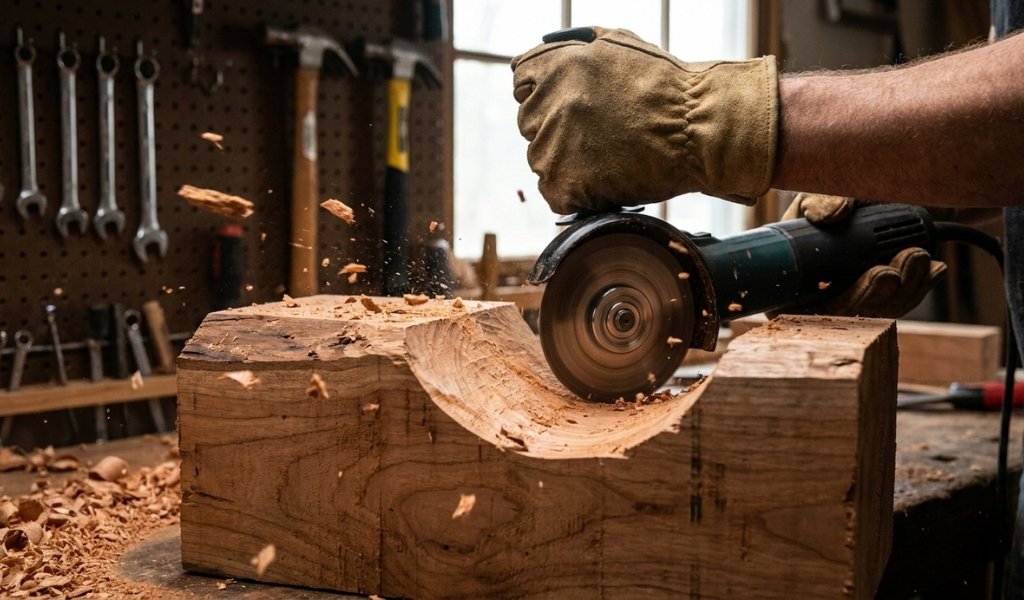
Tungsten carbide carving discs are built for one purpose: aggressive wood carving and sculpting. The carbide teeth are arranged in a pattern across a rigid disc cut rather than abrade, removing large amounts of material with each pass. This makes them the go-to choice for wood carving, hollowing bowls, shaping chair legs, or any task where you need to remove significant volume quickly.
Carbide sanding discs are highly durable and, unlike standard sandpaper discs, don’t wear out quickly even when working with extremely hard materials. They don’t clog with resin or sawdust the way abrasive-coated discs can, and they maintain their cutting geometry over extended use.
The key limitation is control. Carbide carving discs are aggressive by design, so they demand a steady hand and deliberate movement. They’re not suitable for finishing work once shaping is complete, you’ll transition to a finer abrasive to smooth the surface.
Flap discs are among the most versatile grinder attachments available. Constructed from overlapping “flaps” of abrasive-coated cloth arranged around a central arbor, they combine the cutting action of a grinding disc with a degree of surface flexibility that standard grinding wheels lack.
Zirconia flap discs are self-sharpening as each flap wears down, a fresh abrasive surface is exposed making them cost-effective for extended use. Ceramic flap discs take this further, offering even longer life and cooler cutting, which reduces wood burning risk. Both are available in Type 29 (conical) and flat profiles; the Type 29 geometry concentrates pressure at the disc’s edge, making it better for material removal and beveling on wood.
For most woodworking applications, a zirconia or ceramic flap disc in 40–80 grit handles beveling, shaping, and intermediate smoothing effectively. Moving to finer grits (100 grit and above) allows you to bring a surface to a near-finished state before switching to a dedicated finishing sander.
A hook and loop sanding pad attachment bolted directly to the angle grinder’s spindle converts the tool into a high-speed disc sander. These pads accept standard hook and loop discs in a full range of grits, from coarse sandpaper discs at 40 grit all the way up to wet and dry silicon carbide sanding discs for final polishing and buffing.
This system’s main advantage is convenience: backed sanding discs are inexpensive, widely available in 10 pack or bulk configurations, and quick to swap. The 100mm diameter size is the most common for 4-inch grinders, and discs in aluminum oxide or silicon carbide cover the full range of wood sanding tasks.
The limitation is that a rigid grinder spinning at maximum RPM doesn’t replicate the action of a true orbital sander. Without the eccentric orbital motion, swirl marks are more likely on fine-finished surfaces. For flat panels destined for a clear coat, a random orbital sander remains the better finishing choice but for intermediate sanding steps, the hook and loop grinder conversion is a practical and fast solution.
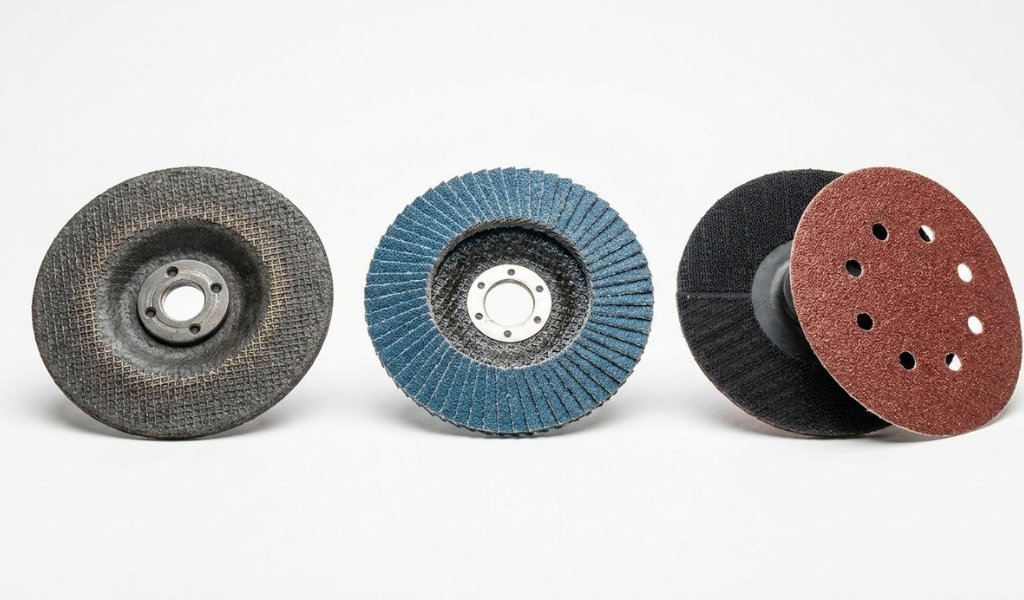
Understanding what separates these three disc categories prevents costly mistakes:
Selecting the right sanding disc or the right disc for angle grinders more broadly comes down to one question: how much material do you need to remove, and how smooth does the final surface need to be?
An angle grinder is a starting point, not the whole story. Effective woodworking requires knowing when to put the grinder down and reach for something else.
Once the angle grinder has done its heavy lifting shaping, leveling, or removing old paint or stain the random orbital sander takes over. The eccentric orbit of a random orbit sander eliminates the directional scratches that a spinning grinder disc leaves behind, producing a swirl-free surface ready for finishing.
The workflow is straightforward: use the angle grinder with a coarse flap disc or carbide sanding disc to handle heavy stock removal and shaping, then progress through the grits on a random orbital sander typically starting at 80 grit and finishing at 150 to 220 grit. For a detailed breakdown of this process, including technique, grit progression, and product recommendations, our dedicated random orbit sander guide covers everything you need.
For high-volume or production woodworking, handheld angle grinder sanding has its limits. Stationary wood sanding machines drum sanders, wide-belt sanders, and edge sanders provide consistent, repeatable results across large batches of material that handheld tools simply can’t match in terms of precision or throughput.
The angle grinder excels at tasks that stationary machines can’t reach: curved surfaces, carved details, sculptural forms, and on-site work where bringing a large machine isn’t practical. Stationary machines dominate flat panel processing, consistent thickness planing, and high-volume edge finishing. Understanding where each tool fits prevents frustration and ensures you’re not asking either tool to do a job it wasn’t designed for. For a thorough comparison of stationary options and how to choose the right wood sanding machine for your workflow, our dedicated article covers the full range of machines available.
A well-equipped workshop doesn’t rely on one tool for everything. A comprehensive sanding setup typically includes an angle grinder with multiple disc types, a random orbital sander, a detail sander for tight spaces, and depending on the scale of work a stationary sanding machine. Hand sanding blocks remain essential for final passes and delicate areas.
Each tool earns its place by handling a specific part of the sanding process better than any alternative. Building that collection deliberately starting with the tools that address your most common tasks is the most practical approach. For guidance on selecting the right combination of tools and accessories for different project types, our wood sanding tools resource breaks down the essential kit for every skill level.
Speed and power make angle grinders effective and those same qualities make them genuinely dangerous when used incorrectly. Safe grinder operation isn’t optional. It’s fundamental.
Kickback the sudden, violent rotation of the grinder when a disc catches or binds is the primary cause of angle grinder injuries. On wood, kickback risk comes from using the wrong type of disc, running a damaged disc, or catching the disc edge on a workpiece edge or irregularity.
Follow these rules without exception:
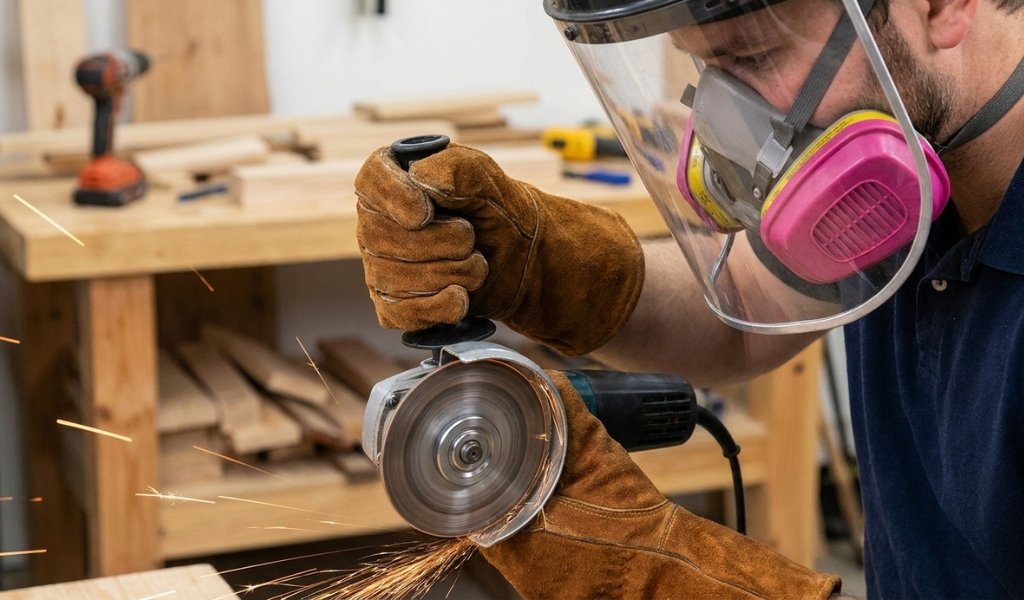
The angle grinder’s guard exists for a reason: to deflect disc fragments, sparks, and debris away from the operator if a disc fails. Never remove it. Position the guard between the disc and your body at all times, and adjust it so the opening faces away from you during operation.
PPE for angle grinder wood sanding includes:
Keep bystanders clear of the work area. Wood dust is combustible, maintains good ventilation and avoids allowing dust to accumulate near heat sources.
Yes, but only with discs specifically designed for wood. Carbide carving discs, zirconia or ceramic flap discs, and hook and loop sanding pad attachments are all safe and effective for wood when used with the correct PPE, a properly fitted guard, and appropriate technique. Never use a standard metal grinding wheel or circular saw blade on wood.
For aggressive sculpting and shaping, a tungsten carbide carving disc is the most effective choice. It cuts rather than abrades, handles extremely hard materials without clogging, and removes large volumes of material quickly. For slightly less aggressive work beveling edges, leveling surfaces a 40 grit zirconia flap disc is the practical alternative, combining fast material removal with a degree of surface smoothing.
Fit a hook and loop sanding pad attachment to the grinder’s spindle. This accepts standard hook and loop discs in any grit and converts the tool into a high-speed disc sander. Note that this does not replicate the true eccentric orbit of a dedicated random orbital sander; the motion is purely rotational, which can leave swirl marks on fine-finished surfaces. For final finishing passes, a dedicated random orbital sander produces better results.
Wood burning occurs when the abrasive disc stays in contact with one area too long, generating heat faster than the wood can dissipate it. The most common causes are running too high an RPM for the material, applying excessive downward pressure, using a clogged disc that has stopped cutting efficiently, or working with resinous softwoods that load the abrasive quickly. Using a variable speed grinder, keeping the disc moving continuously, and cleaning or replacing clogged discs resolves most burning issues.
A grinding wheel is a rigid bonded abrasive designed for metal cutting, weld blending, and deburring ferrous and non-ferrous materials. It should not be used on wood. A flap disc uses overlapping layers of abrasive cloth mounted on a backing plate; it’s flexible, self-sharpening (in zirconia and ceramic versions), and suited to both material removal and smoothing on wood surfaces. A standard sanding disc, whether backed sanding discs on a hook and loop pad or adhesive-backed sandpaper discs covers the widest grit range and is best for surface preparation and finishing rather than heavy stock removal.