Physical Address
304 North Cardinal St.
Dorchester Center, MA 02124
Physical Address
304 North Cardinal St.
Dorchester Center, MA 02124

There’s a particular kind of frustration that comes with stepping back from a freshly hung shelf, only to notice it tilts ever so slightly to the left. You thought you had it right. You eyeballed it carefully. And yet, there it is — crooked. The good news? This is almost always avoidable, and the fix is simpler than you might think.
Learning how to use a spirit level is one of those foundational DIY skills that pays dividends on every single project. Whether you’re hanging shelves, fitting a door frame, laying patio slabs, or just putting up a picture, getting things perfectly level or plumb makes the difference between a result you’re proud of and one you quietly tolerate. This guide covers everything you need to know — from understanding what a spirit level is and how it works, to choosing the right one, reading it accurately, and avoiding the mistakes that trip up most beginners.
By the time you finish reading, you’ll have the knowledge and confidence to tackle your next project and get it right on the first attempt.
A spirit level is a hand tool used to check whether a surface is perfectly horizontal (level) or perfectly vertical (plumb). It’s one of the most reliable and widely used measuring tools in both professional trades and home DIY.
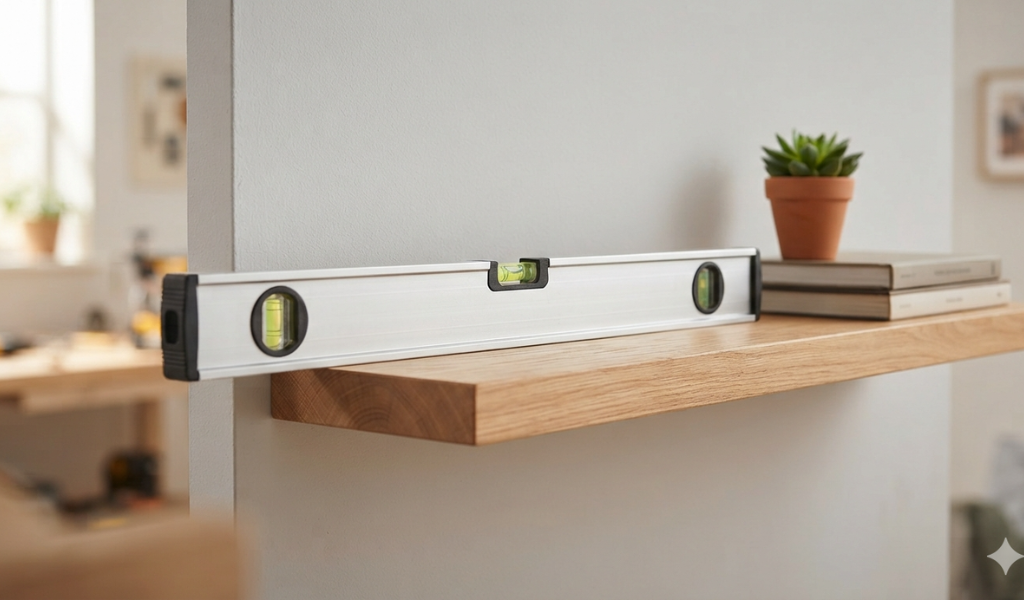
The science behind it is refreshingly simple. Inside the tool are one or more sealed, liquid-filled tubes called vials. Each vial contains a small air bubble. Because the vial is curved slightly upward, the bubble always floats to the highest point. When the bubble sits exactly between the two marked lines on the vial, your surface is perfectly aligned.
Most standard spirit levels include three vials:
That’s really all there is to it. No batteries, no calibration screens, no apps. Just physics doing its job.
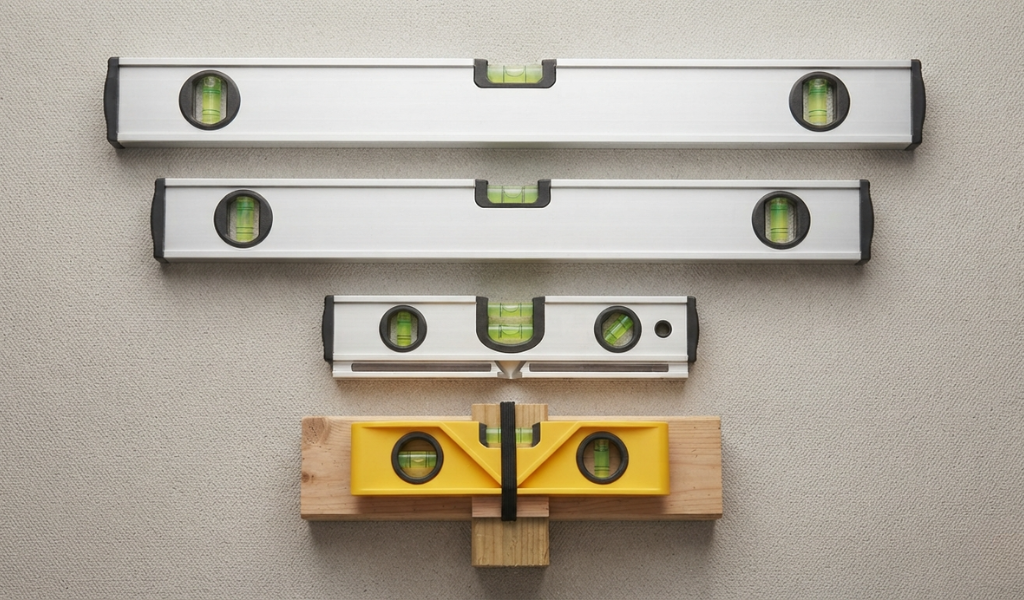
Before you can choose the right tool, it helps to understand what’s out there. Here’s a breakdown of the most common types of spirit levels explained:
Box-Beam / I-Beam Level
This is the standard all-purpose spirit level you’ll find in most toolboxes. It comes in a range of lengths typically 40cm to 120cm and is suitable for the vast majority of home DIY tasks. Box-beam models tend to be more rigid and durable, while I-beam versions are slightly lighter.
Torpedo Level
Small, compact, and often magnetic, the torpedo level is designed for tight or awkward spaces. It’s perfect for leveling appliances, checking pipework, or working inside cabinets and cupboards.
Post Level
This clever tool wraps around a square post and holds itself in place, leaving your hands free. It’s specifically designed for getting fence posts, gate posts, and decking supports perfectly plumb.
Scaffold Level
A heavy-duty, short-bodied level with powerful magnets, built for trade professionals working with metal structures. Not typically needed for home use, but worth knowing about.
Laser Level
Technically a different category, but worth mentioning. A laser level projects a beam of light across a room to mark a perfectly level line. It’s ideal for large-scale projects like tiling a full wall or hanging a gallery of frames, where a physical level would be impractical.
Choosing the right spirit level for your project comes down to two main factors: the size of the job and the space you’re working in.
For general home DIY, a 60cm (24-inch) box-beam level is the best all-rounder. It’s long enough to give accurate readings across most surfaces, handles enough to carry easily, and versatile enough for shelves, pictures, and curtain rails.
For larger jobs — fitting kitchen units, building a stud wall, or laying decking — go for a 120cm level. The longer the tool, the more accurately it bridges surface irregularities and dips.
For tight or awkward spaces, a torpedo level is your best friend. It fits into spots where a full-length level simply won’t go.
Beyond size, here are a few features worth looking for:
For materials, aluminum levels offer excellent durability and are worth the investment if you plan to use the tool regularly. High-quality plastic models work well for occasional DIY and tend to cost less.
Reading a spirit level sounds straightforward, but there’s one technique that trips up a lot of beginners: parallax error.
Parallax error happens when you look at the vial from an angle rather than directly above it. From the side, the bubble can appear to be in a slightly different position than it actually is. Always position your eye directly above the vial when taking a reading.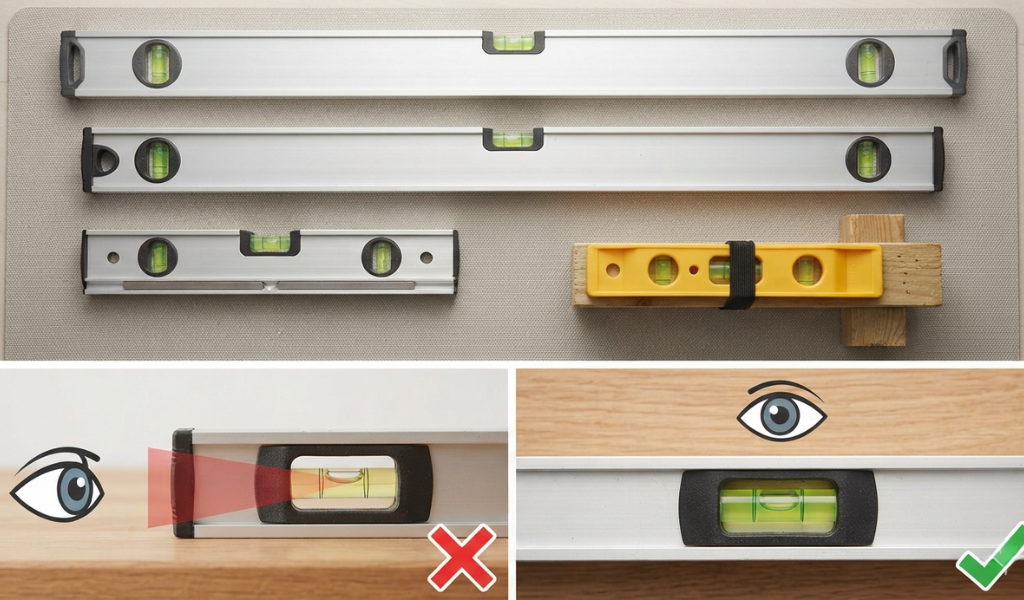
Here’s how to read it properly:
Apply light, even pressure when holding the level. Pressing down too hard — especially on a longer level — can flex the frame and throw off your reading.
This is where it all comes together. Follow these steps and you’ll hang a perfectly level shelf every time.
What you’ll need: Shelf and brackets, drill, pencil, tape measure, spirit level, wall plugs and screws.
Decide how high you want the shelf to sit. Use your tape measure to mark the exact height on the wall with a light pencil mark. Hold the first bracket against the wall at that height, then mark the wall through each screw hole. These are your drill guides.
Drill the holes, insert wall plugs if needed, and fix the first bracket securely in place.
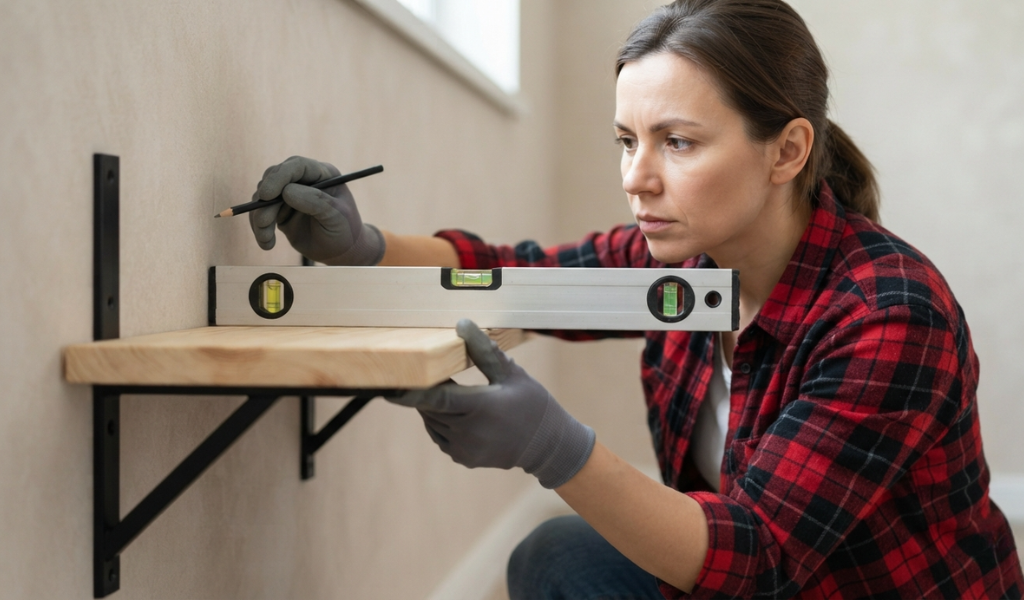
Rest one end of the shelf on the fixed bracket. Place your spirit level along the top of the shelf, as close to the wall as possible. Slowly lift or lower the free end of the shelf until the bubble centres perfectly between the two lines.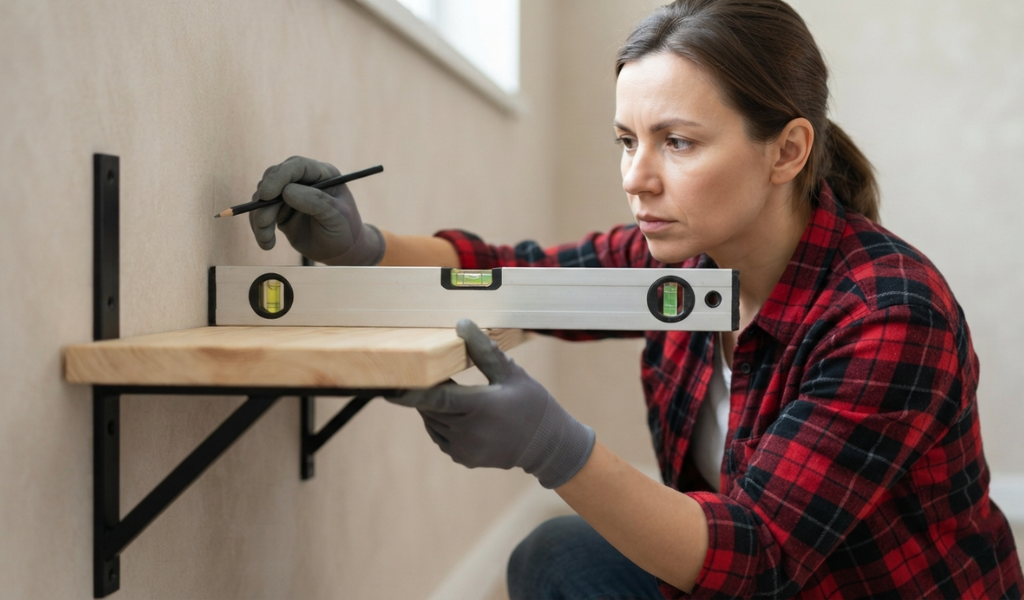
With the shelf held level, mark the wall through the screw holes of the second bracket. This is much more reliable than measuring from the floor, which is rarely perfectly flat.
Drill and fix the second bracket using your marks. Before you declare the job done, place the level across both brackets one final time. If the bubble is centred you’re done. If it’s slightly off, a minor adjustment to one bracket is all it takes.
For a thorough final check, also place the level on the front edge of the shelf to confirm it isn’t tilting toward or away from the wall.
Even a brand-new spirit level can arrive slightly out of calibration after being jostled in transit. Before starting any project, take two minutes to verify your tool is giving you accurate readings.
Here’s the test:
Perform this check every few months, or any time your level takes a significant knock or drop.
Even with the right tool in hand, a few common habits can undermine your results. Here’s what to watch out for:
Using a level that’s too short. A short level can only measure a small section of a surface. Small errors at that point can compound over the full length of a shelf or wall. Always use a level that spans at least two-thirds of what you’re measuring.
Not cleaning the surface first. A small piece of grit, dried paint, or wood shaving under the level can tilt it just enough to throw off your reading. A quick wipe takes seconds and is worth doing every time.
Looking at the vial from the side. As mentioned, parallax error is a real issue. Always look straight down over the vial when reading the bubble.
Pressing the level too hard against the surface. This is especially common with longer levels. Too much pressure can flex the frame, leading to inaccurate measurements. A light, firm contact is all you need.
Once you’ve mastered the basics, you’ll find this tool is useful far beyond hanging shelves. A few practical applications worth knowing about:
Getting things straight isn’t just about looks — it’s about function, longevity, and the quiet satisfaction of doing a job properly. A shelf hung slightly off-level will eventually cause things to slide. A fence post that isn’t plumb will lean further over time. Small misalignments compound into bigger problems.
The spirit level eliminates guesswork entirely. It’s one of the cheapest, most durable, and most reliable tools you can own. Combined with the techniques in this guide, it gives you everything you need to approach DIY projects with genuine confidence.
If you’re ready to upgrade your toolkit, look for a good-quality aluminium box-beam level in the 60cm to 120cm range as your starting point. Add a torpedo level for tighter spaces, and you’ll be well set for almost any project that comes your way.
A spirit level is a tool used to check whether a surface is horizontal (level) or vertical (plumb). It contains liquid-filled vials with an air bubble inside. When the bubble sits centred between the two lines on the vial, the surface is properly aligned. The bubble moves because it always floats to the highest point in the curved vial, making it a reliable and low-tech precision tool.
A 60cm (24-inch) spirit level is the best all-around choice for most home projects. It’s long enough to give accurate readings on shelves, picture rails, and curtain poles, while still being easy to handle. For larger jobs like fitting kitchen units or building a stud wall, a 120cm model provides better accuracy over longer surfaces.
Match the tool to the task. Use a full-length box-beam level for shelving, walls, and larger installations. Use a torpedo level for confined spaces, appliances, and plumbing. For fence posts and gate posts, a post level wraps around the post and holds itself hands-free. If you’re working on metal surfaces, a model with a magnetic edge makes the job significantly easier.
Place the level on a flat surface and note the bubble’s position. Then rotate the level 180 degrees end-to-end (not upside down) and place it in the exact same spot. If the bubble sits in the same position between the lines both times, the tool is accurate. If it has shifted noticeably, the level may be out of calibration and should be replaced before use.
This indicates the level is out of calibration. It means the vials are no longer set at true horizontal or vertical. This can happen after a significant knock or drop. Always perform the 180-degree accuracy check before starting a project, especially with tools that have been in storage or knocked around in a toolbox.
Parallax error occurs when you read the bubble from an angle rather than directly above. From the side, the bubble appears to sit in a slightly different position than it actually does, which can lead to inaccurate measurements. To avoid it, always position your eye directly above the vial, looking straight down, when taking a reading.
A phone app is fine for quick, casual checks — but it falls short for any project where accuracy matters. Dedicated spirit levels are precision-engineered and calibrated to a standard that phone sensors can’t reliably match. A physical level is also longer, which lets it bridge surface dips and bumps for a true reading over a greater span. For shelves, framing, and structural work, always use a proper spirit level.