Physical Address
304 North Cardinal St.
Dorchester Center, MA 02124
Physical Address
304 North Cardinal St.
Dorchester Center, MA 02124

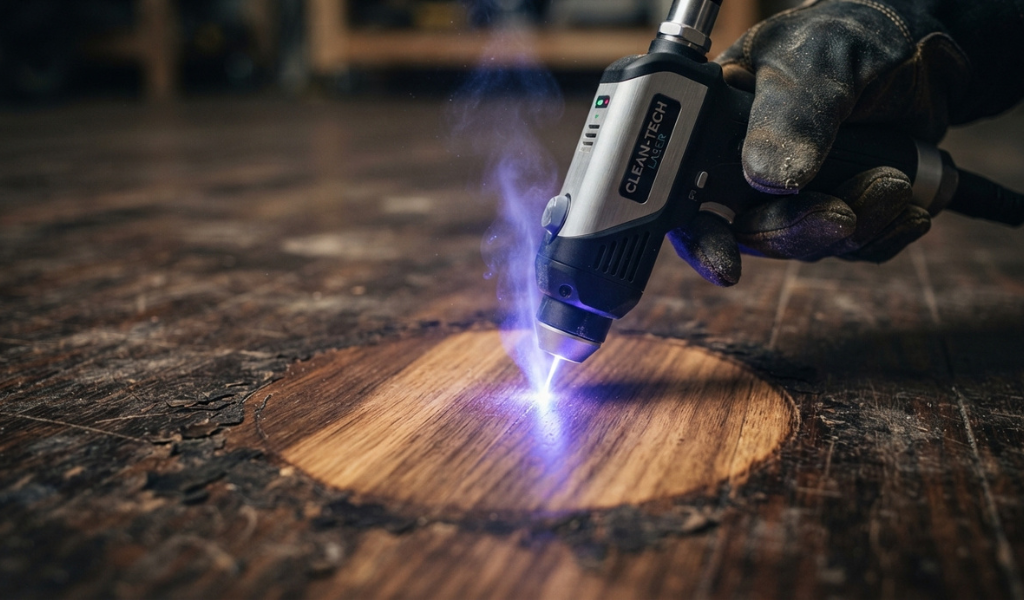
If you’ve spent any time working with wood, you know how frustrating traditional sanding can be. It’s messy, time-consuming, and never quite as precise as you’d like. That’s why more woodworkers and furniture restorers are turning to a laser sander for wood as a cleaner and more efficient alternative.
Laser sanding uses a focused laser beam to remove coatings, stains, and surface contaminants from wood without the physical abrasion of sandpaper. The result? A cleaner surface, better precision, and far less dust. Whether you’re stripping old paint from antique furniture or preparing raw wood for a fresh finish, laser cleaning technology is changing the way people approach wood surface treatment.
Before we go deeper, it’s worth grounding this topic with a quick note on sanding itself. If you’re new to woodworking, you might find it helpful to read “What is Sanding? A Beginner’s Guide” first, as it covers the fundamentals of surface preparation that laser sanding builds on. Understanding those basics will help you appreciate just how different, and how powerful, laser wood cleaning can be.
This guide covers everything you need to know about laser sanders for wood: how they work, what types are available, how to use them safely, and whether they’re worth the investment for your specific needs.
A laser sander for wood is a laser cleaning machine that uses high-energy laser pulses to clean, strip, or prepare wooden surfaces. Unlike traditional abrasive sanding tools, a laser cleaner doesn’t physically scrub the surface. Instead, it directs a concentrated laser beam onto the wood, causing surface contaminants, coatings, and old finishes to vaporize or break apart instantly.
The term “laser sander” is somewhat informal. These tools are more accurately called laser cleaning machines for wood, and they’re available in various power levels, from compact 300W handheld models to industrial 1500W systems designed for large-scale wood restoration and furniture refurbishment.
The core technology relies on a fiber laser or pulsed laser source that emits short, controlled bursts of energy. These pulses target only the surface layer, whether that’s old paint, stain, graffito marks, or mold, while leaving the wood texture and grain structure largely intact.
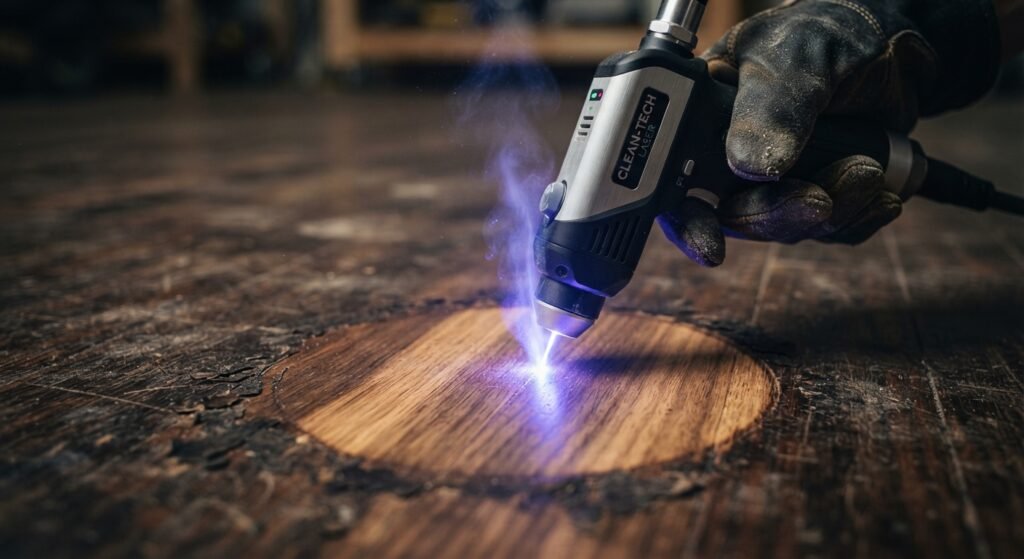
The science behind laser sanding is straightforward once you break it down. When a laser beam hits a wood surface, it rapidly heats the contaminants or coating sitting on top. This heat causes those materials to either vaporize, combust, or peel away from the surface. The process is called laser ablation.
Pulsed laser cleaning machines deliver energy in short bursts rather than a continuous stream. This pulse-based approach is especially important for wood cleaning because it reduces the risk of overheating or charring the wood underneath. A continuous laser (CW) can be too intense for delicate surfaces, which is why most laser sanders designed for wood use pulse settings.
Modern systems also use a scanning width mechanism, where the laser head sweeps back and forth across the surface. This double-wobble scanning motion ensures even coverage without burning one spot for too long. Some advanced models feature IoT smart controls and remote control operation, allowing precise adjustments to pulse frequency, power output, and scanning speed in real time.
Traditional sanding relies on physical abrasion. You press sandpaper against the wood surface and grind away material through friction. It works, but it creates fine dust, requires significant effort, and offers limited precision.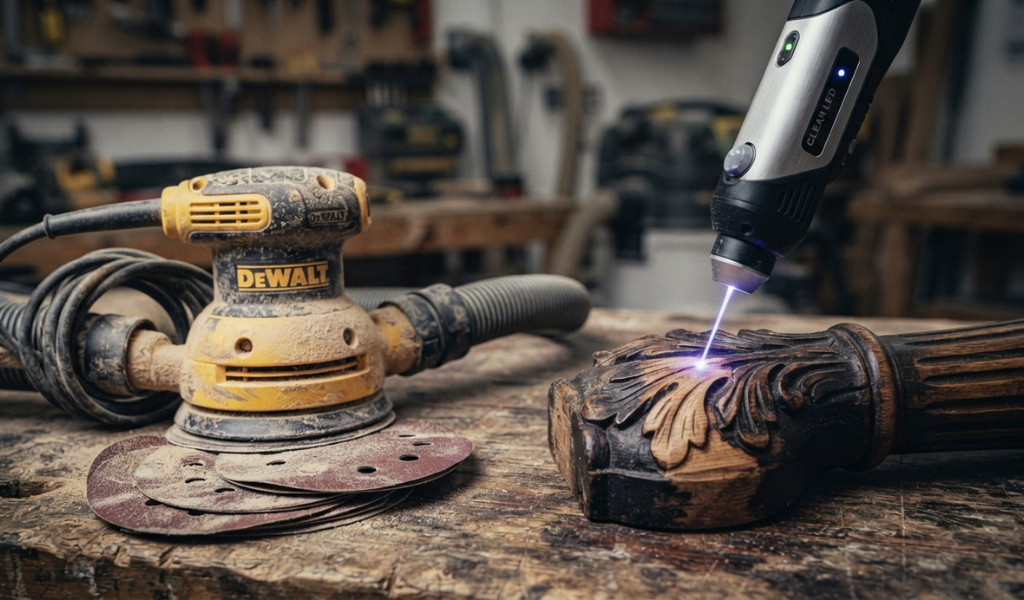
Laser sanding is non-contact cleaning. The laser beam never physically touches the wood, which means there’s no pressure, no scratching, and no risk of the grain being torn up by coarse grit. For delicate woodworking, restoration work, or pieces with intricate carvings, this matters a lot.
Another key difference is residue. Sandpaper produces wood dust and, when stripping coatings, a mix of paint particles and debris that requires careful cleanup. A laser cleaning machine for wood converts contaminants into smoke and fine particles that get captured by an extraction system, making the overall process significantly cleaner.
Yes, you can use a laser cleaning machine on wood, but with important caveats. Wood is a sensitive material. Unlike metal surfaces, where laser rust removal and coating removal are aggressive and straightforward, wood requires more careful power management.
The key is using the right settings. Low-power pulsed laser cleaners in the 100W to 500W range, with properly calibrated pulse duration and scanning speed, can clean wooden surfaces effectively without charring or scorching the grain. Higher-powered machines, like 1000W or 1500W industrial systems, are typically used for heavier coating removal on rough-cut lumber or exterior wood where some surface impact is acceptable.
The good news is that most professional laser cleaners for wood models come with adjustable settings specifically designed to handle the sensitivity of organic materials like timber.
Not all wood responds the same way to laser cleaning. Here’s a general breakdown:
Hardwoods like oak, walnut, and maple tend to handle laser sanding well. Their density provides some natural resistance to heat penetration, making them less prone to charring.
Softwoods like pine and cedar require lower power settings. They absorb laser energy more readily, which increases the risk of scorching if the machine isn’t calibrated correctly.
Engineered woods like MDF and plywood can be tricky. The adhesives and composite layers can react unpredictably to laser energy, so test a small area first.
Reclaimed and weathered wood is actually one of the best candidates for laser cleaning. Old paint layers, oxidation, stains, and even mold respond very well to pulsed laser treatment, and the non-contact cleaning method helps preserve the character of aged wood.
Laser cleaning technology is used across a wide range of woodworking scenarios. Furniture refurbishment is one of the most common, particularly stripping old varnish or paint from antique pieces without damaging the underlying wood. Wood restoration professionals use laser cleaners to remove graffito marks from wooden structures. Builders use them for surface treatment before refinishing or re-coating. And in industrial settings, laser cleaning machines handle deep cleaning of large timber batches before processing.
The advantages of using a laser sander for wood go beyond just convenience. Here’s why professionals are making the switch:
No consumables. Traditional sanding requires a constant supply of sandpaper, pads, and abrasive discs. A laser cleaning machine has no consumable parts beyond routine maintenance, which reduces long-term operating costs significantly.
Environmentally friendly operation. There’s no chemical cleaning solution involved, no hazardous solvent waste, and minimal solid debris. The process is far more eco-friendly than chemical paint stripping or sandblasting.
High precision. A laser cleaner for wood can target specific areas without affecting surrounding surfaces. This level of high-precision work is nearly impossible with abrasive methods.
Non-destructive to the base material. When calibrated correctly, laser cleaning removes only the unwanted layer, meaning there’s no damage to the base material, no gouging, and no loss of wood texture.
Efficiency. A 500W or 1000W laser cleaning machine can cover large wood surfaces much faster than manual sanding, making it ideal for commercial and industrial wood restoration projects.
Handheld laser cleaners are portable laser cleaning units that you hold and guide manually across the wood surface. They typically range from 100W to 500W and are ideal for furniture refurbishment, spot cleaning, and detailed woodworking. The portable laser cleaning design makes them versatile and easy to use in workshops or on-site. Most handheld models are air-cooled laser cleaning systems, meaning they don’t require a water cooling setup, which adds to their portability.
Automated laser sanding systems are designed for repetitive, high-volume work. They use motorized laser heads and pre-programmed scanning paths to clean wood surfaces consistently without operator guidance. These systems are common in furniture manufacturing facilities where the same cleaning process needs to be repeated hundreds of times. Automated systems can be integrated with conveyor setups and IoT smart monitoring systems for streamlined production.
Industrial laser cleaning machines are heavy-duty systems built for large-scale wood surface treatment. They typically run at 1000W to 1500W and can handle removing thick layers of paint, coating removal from large timber structures, mold cleaning in humid environments, and even surface preparation before laser welding or adhesive bonding. Some industrial models are self-propelled units designed for use on large wood panels or outdoor wooden structures.
Power output is one of the most important factors. For light cleaning tasks like stain removal or surface cleaning of finished furniture, a 300W to 500W pulsed laser cleaner is usually sufficient. For heavy-duty coating removal, deep cleaning of weathered wood, or industrial-scale work, you’ll want to look at 1000W to 1500W machines. Always consider whether you need a pulsed laser or a continuous laser (CW) system. Pulsed laser cleaning machines are generally safer for wood because they reduce heat buildup between pulses.
Look at the scanning width of the laser head. A wider scanning width means faster coverage of large surfaces. A narrower beam offers higher precision for detailed or small-area work. If you plan to work on intricate carvings or furniture with tight spaces, prioritize a model with adjustable laser lens settings and a compact laser head that can navigate small areas.
A quality laser cleaning machine for wood should include emergency stop controls, protective enclosures or safety shields, fume extraction compatibility, and real-time power adjustment. Remote control operation and IoT smart interfaces are valuable additions that give you more control over the cleaning process without needing to be directly in the laser’s path.
Using a laser sander isn’t complicated, but it does require some preparation. Start by setting up proper ventilation or connecting a fume extraction unit, since the vaporized contaminants released during cleaning can be harmful to breathe. Put on your laser safety goggles before powering on the machine.
Set the laser to a low power level first and run a test pass on a small, inconspicuous area of the wood. This tells you how the specific wood species responds to the laser beam at your chosen settings. Adjust the pulse frequency and scanning speed based on what you observe. If the wood is charring, reduce the power or increase the scanning speed. If the coating isn’t lifting cleanly, try a slightly higher power output.
Once your settings are dialed in, guide the laser head steadily across the surface, keeping a consistent distance between the laser lens and the wood. Most handheld models have a focal guide to help you maintain the correct distance. Work in overlapping passes to ensure complete, even coverage.
After cleaning, wipe down the surface with a dry cloth to remove any residual ash or loose particles. The wood is now ready for refinishing, staining, or further woodworking.
Laser cleaning machines cover surface area significantly faster than hand sanding or even power sanding. An industrial laser cleaning machine running at 1000W can strip a full door panel in minutes, a task that might take 30 to 45 minutes by hand. For high-volume wood restoration or furniture refurbishment businesses, this speed advantage adds up quickly.
Traditional sanding can leave cross-grain scratches, uneven depths, or damaged edges on intricate profiles. Laser cleaning avoids all of these issues because it’s a non-contact cleaning method. The result is a cleaner, more uniform wood surface that requires less prep work before finishing. The laser beam follows the surface precisely, and the wood texture is preserved rather than abraded away.
The upfront cost of a laser cleaning machine for wood is higher than a set of sandpaper or an orbital sander. A quality 500W fiber laser cleaner starts at several thousand dollars, while industrial 1500W systems can cost considerably more. However, the long-term savings on consumables, labor time, and rework often justify the investment for professional users. For hobbyists or occasional woodworkers, traditional sanding may still be the more practical choice.
Yes, laser sanding is safe for wood when the equipment is used correctly. The biggest risks come from using too much power on sensitive wood species, holding the laser beam in one spot too long, or working without adequate ventilation. Charring is the most common issue beginners encounter, and it’s almost always the result of incorrect power settings rather than a fundamental problem with the technology itself.
Modern laser cleaning technology includes built-in safety controls, pulse management systems, and automatic shutoff features that make it much harder to accidentally damage the base material. With the right settings and a bit of practice, laser cleaning while preserving the natural wood texture is very achievable.
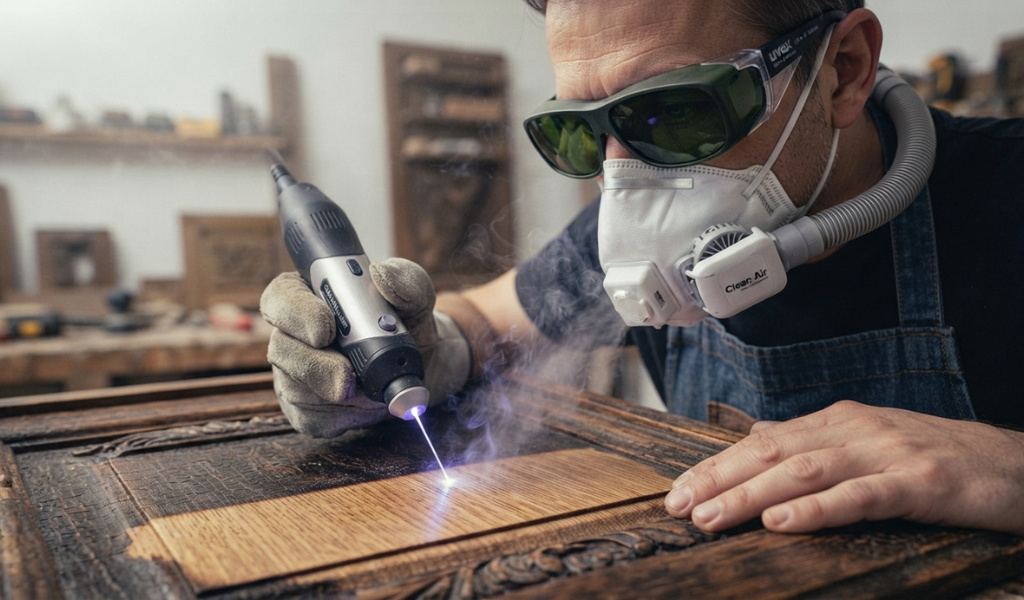
Laser beams are powerful enough to cause permanent eye damage in fractions of a second. Always wear laser safety glasses rated for the specific wavelength of your machine. Never point the laser at reflective surfaces, and keep bystanders out of the work area. For skin protection, wear long sleeves and gloves when operating high-power systems.
When the laser beam vaporizes coatings or wood contaminants, it produces smoke and fine particles. Some of these particles can be toxic, especially if the wood has been coated with lead-based paint or chemical treatments. Use a dedicated fume extraction system positioned close to the cleaning head, and work in a well-ventilated space. An N95 respirator or higher-rated mask adds an important layer of protection.
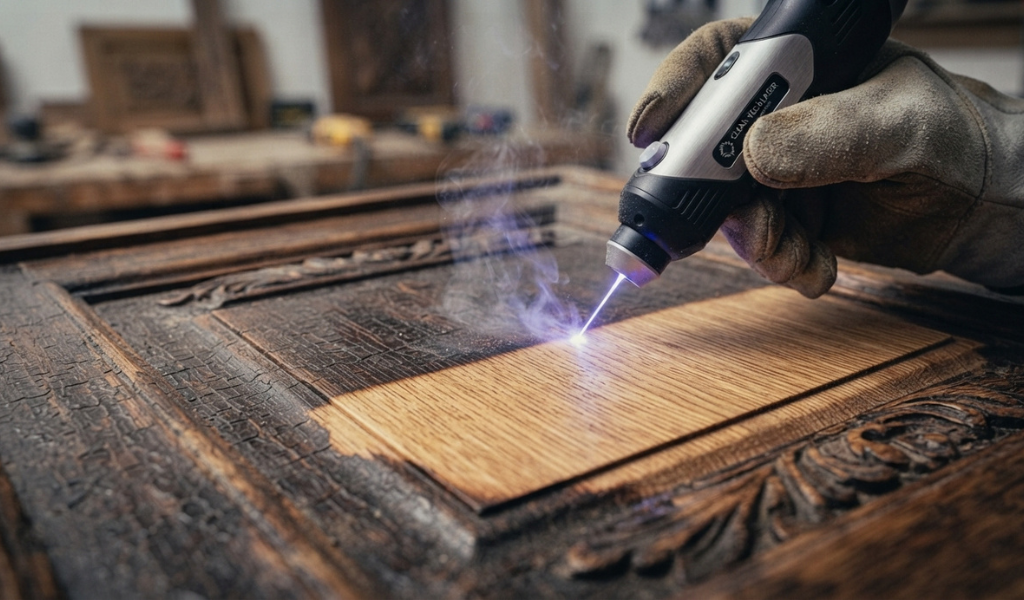
One of the most popular applications for a laser cleaner for wood is stripping old finishes. Varnish, lacquer, polyurethane, and oil-based coatings all respond well to pulsed laser treatment. The laser beam breaks the adhesion between the coating and the wood without cutting into the grain, making it a cleaner and more controlled method than chemical stripping or sandblasting.
Before applying a new coat of paint, stain, or protective finish, the wood surface needs to be clean and free of contaminants. Laser cleaning handles oil stains, oxidation, and surface mold effectively, leaving a clean substrate that accepts new coatings with better adhesion than mechanically sanded surfaces.
Carved furniture, decorative moldings, and antique wooden pieces often have complex profiles that are nearly impossible to sand evenly by hand. A laser cleaning machine can follow those contours with precision, removing old coatings or stains from recessed details without damaging the surrounding areas. This makes it particularly valuable for museum-quality wood restoration and high-end furniture refurbishment.
A laser sander for wood isn’t a tool for every workshop, but for those who regularly work with wood restoration, paint removal, or high-precision surface preparation, the benefits are hard to ignore. The combination of speed, precision, eco-friendly operation, and zero consumable costs makes a laser cleaning machine a compelling long-term investment.
If you’re working on a small scale or just getting started in woodworking, a traditional approach still makes practical sense. But if you’re a professional woodworker, a furniture restorer, or running any kind of commercial wood processing operation, upgrading to a laser cleaner for wood is worth serious consideration.
Start with a 300W or 500W portable laser cleaning unit to test the technology on your specific materials. Once you understand how different wood species and coatings respond to laser treatment, you’ll be in a strong position to decide whether a higher-powered system makes sense for your workflow.
Laser sanding does not damage wood when used correctly. The key is calibrating the power output and pulse frequency to match the specific wood type. Using too high a power setting on soft or thin wood can cause charring. However, with proper settings, a pulsed laser cleaner removes surface contaminants without damaging the base material or affecting the wood grain.
Yes, a laser cleaning machine is an effective paint removal machine for wood surfaces. The laser beam targets the paint layers, breaking their adhesion to the wood and vaporizing them. This works for multiple types of paint, including old latex, oil-based, and even lead-based coatings. For thick or multi-layer paint removal, a higher-powered system such as a 500W to 1000W unit will be more efficient.
For professional and commercial applications, laser sanding offers clear advantages over traditional sanding in terms of speed, precision, and surface quality. It’s cleaner, produces no consumable waste, and is better suited for detailed woodworking and restoration. For casual or small-scale projects, traditional sanding is still cost-effective and widely accessible. The better choice depends on the scale and frequency of your work.
For woodworking professionals, furniture restorers, and commercial operators, laser cleaning machines are worth the investment. The upfront cost is higher than conventional tools, but the savings on consumables, labor time, and the quality of results often offset that cost over time. For hobbyists or infrequent users, the price-to-value ratio is harder to justify.
The main disadvantages of laser cleaning for wood include the high initial equipment cost, the need for safety equipment and proper ventilation, and a learning curve around power settings. Some wood types, particularly very soft or thin veneers, require extremely careful calibration to avoid scorching. Additionally, laser cleaning machines require occasional maintenance of the laser lens and cleaning head to maintain performance.
Laser cleaning machines can effectively remove a wide range of coatings from wood surfaces, including varnish, lacquer, polyurethane, oil-based paint, latex paint, stain, and even adhesive residue. Thicker coatings or multiple paint layers may require multiple passes or a higher-powered machine. Coatings with heavy metallic pigments may require slower scanning speeds to ensure complete removal.
A portable laser cleaning unit is well suited for medium-sized projects like furniture, doors, window frames, and wooden fixtures. For very large surfaces such as timber beams, decking, or structural panels, an automated or industrial laser cleaning machine with a wider scanning width and higher power output will deliver more efficient results.