Physical Address
304 North Cardinal St.
Dorchester Center, MA 02124
Physical Address
304 North Cardinal St.
Dorchester Center, MA 02124

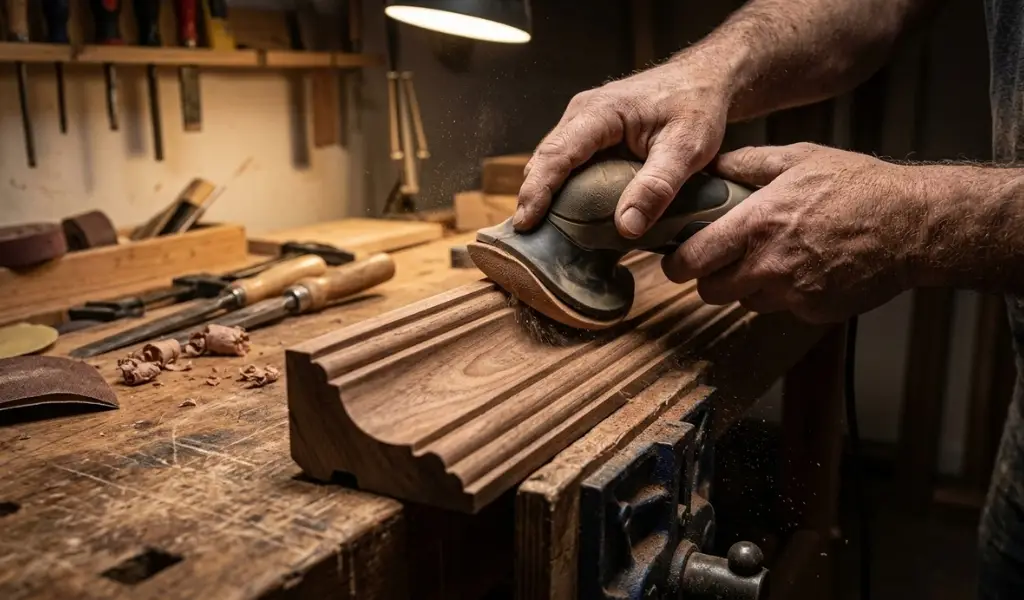
Crown moulding, fluted cabinet doors, and curved furniture edges all share one problem: a flat sander can’t touch them properly. Push a random orbital sander into a concave groove and you’ll round over the details you worked so hard to cut. This is where a profile sander earns its place in a serious woodworking shop.
A profile sander is built specifically to follow contours rather than flatten them, which makes it indispensable for moulding, trim work, and any project with curves or grooves. This guide walks through how these tools work, the different types available, where they’re used, and how to pick the right one for your projects. If you’re new to sanding fundamentals more broadly, our complete guide to sanding covers the grit charts, abrasive types, and techniques that apply across every sanding job in the shop.
Whether you’re a finished carpenter fitting baseboards, a cabinetmaker shaping raised panels, or a furniture restorer bringing curved surfaces back to life, understanding profile sanding will save you time and protect the details that make your work look professional.
A profile sander is a sanding tool manual or powered designed with a shaped pad or attachment that matches the contour of a moulding, groove, or curved surface. Instead of a flat pad that only contacts high points, a profile sander’s head is convex, concave, or custom-shaped to maintain full contact across an irregular surface.
Woodworkers reach for profile sanding tools whenever a flat sander machine would either miss detail or destroy it. Crown moulding, window frames, fluted columns, and raised panel edges all have profiled surfaces that require a sanding head shaped to match. Without the right contour, sandpaper either skips over the low points of a groove or aggressively rounds off the sharp arrises that give millwork its crisp, defined look.
The core purpose of profile sanding is preservation, preserving the intended shape of a profile while still removing mill marks, smoothing the surface, and preparing the wood for finish. It’s a precision task, not a bulk material removal task, and the tools reflect that.
Most profile sanders use linear motion rather than the rotary or orbital action found in standard sander machines. A random orbital sander spins and oscillates simultaneously, which is excellent for flat surfaces but disastrous for a sharp profile edge it will round over detail almost immediately.
Linear motion, by contrast, moves the abrasive back and forth along a single axis, similar to how you’d hand-sand with the grain. This linear control keeps sanding pressure evenly distributed along a profile without introducing the swirling action that erodes fine detail. Many powered profile sanders, including in-line detail sanders and pen sanders, use this linear stroke specifically because it mimics careful hand sanding while adding speed and consistency.
Some oscillating tools blur this line further. Oscillating multi-tool attachments move in a rapid, narrow arc rather than a full rotation, which still allows for controlled work in tight grooves and corners useful for irregular shapes that don’t fit a straight linear stroke.
The simplest profile sanding tools are manual: sanding blocks and contour grips shaped to match a specific convex or concave profile. These are often sold as assorted sets, with multiple shapes covering common cove, ogee, and round-over profiles found in millwork and window frames.
Manual sanding blocks give you the most tactile feedback of any option. There’s no motor, no vibration, and no risk of burning through a thin veneer just direct control over pressure and stroke. Ergonomic grips make extended hand sanding sessions more comfortable, which matters when you’re working through an entire run of crown moulding by hand.
For irregular shapes that don’t match a standard convex or concave block, many woodworkers make their own from scrap material, wrapping sandpaper around a dowel or shaped block cut to match the exact profile.
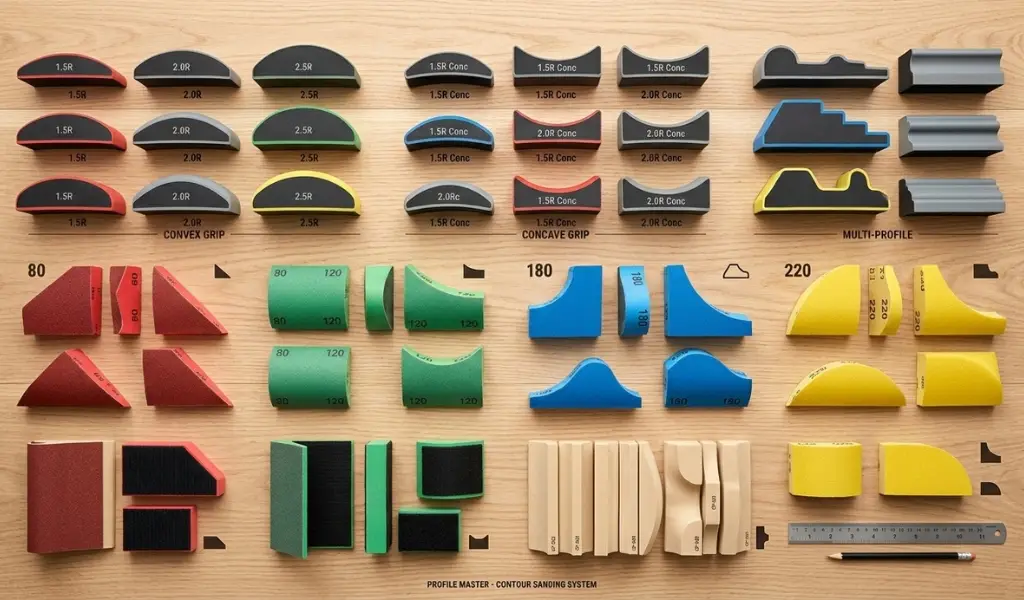
Powered in-line detail sanders and pen sanders bring speed to profile work without sacrificing much control. These tools use small, interchangeable sanding heads often shaped like files or fingers that move in a rapid linear stroke to reach into grooves, corners, and complex shapes that a full-sized sander can’t access.
Pen sanders, sometimes called detail sanders due to their slim, pen-like body, are particularly useful for fluted details, carved elements, and tight interior corners.
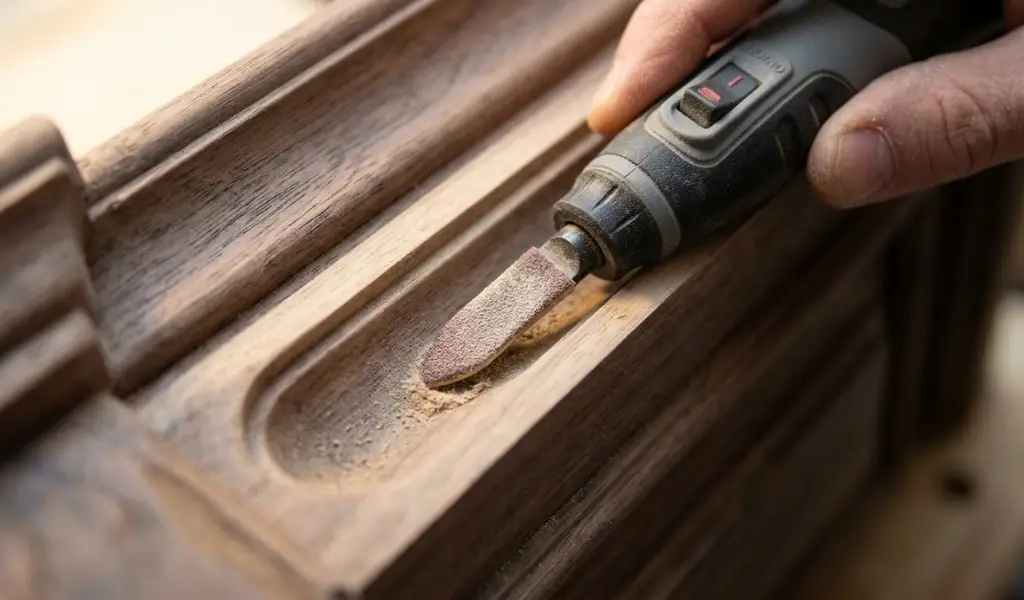
Brands like Fein and Dremel make well-known versions of these tools, and their small footprint makes them a natural companion to a palm sander or sheet sander already in the shop.
Oscillating multi-tools, such as those from Fein (the original inventor of the oscillating multi-tool) and DeWalt, accept sanding attachments that oscillate rapidly across a small arc. These attachments often include a triangular or finger-shaped interface pad that can slide into corners and along profiled edges that a standard finishing sander can’t reach.
Because oscillating detail sanders use interchangeable abrasive strips and pads, switching grit or attachment is quick. This versatility makes them a strong all-purpose option for cabinetmakers who need to move between flat surfaces and detailed profiles without swapping tools entirely.
At the production end of the spectrum, industrial profile sanding machines are designed for moulding manufacturers and high-volume millwork shops. These machines use a sanding head configured to a specific moulding profile, often paired with a wide belt sander or abrasive belt system upstream in the production line for initial flattening.
Some setups combine a planer with a downstream profile sanding machine, so a single pass turns rough stock into moulding that’s already profiled and sanded to a near-finished state. Height adjustment and configurable sanding heads let these machines adapt to multiple moulding profiles without a full retooling, and dust extraction is typically built directly into the housing given the volume of material removed.
Crown moulding and baseboards are the most common application for profile sanding in finish carpentry. These profiles often combine coves, ogees, and flat sections in a single continuous run, meaning a single flat sander simply cannot maintain consistent contact.
Contour sanding grips or a profile sanding machine let you follow the full curve of the moulding in one motion, smoothing mill marks left from the initial machining without flattening the design. This matters especially on paint-grade trim, where any missed spots or over-sanded high points will show clearly once light reflects across the painted surface.
Cabinet doors present two distinct sanding challenges: the flat panel faces, which take a standard finishing sander, and the profiled edges, grooves, and raised panel details, which need a profile sander. Raised panel doors typically feature a bevelled or coved transition around the panel field, and fluted details on stiles or rails add vertical grooves that require a rounded profile sander tip.
Getting these details right is often what separates production cabinetry from custom millwork an experienced cabinetmaker will spend as much time on the profiled edges as on the flat surfaces, because uneven sanding on a raised panel is immediately visible under a clear finish or lacquer.
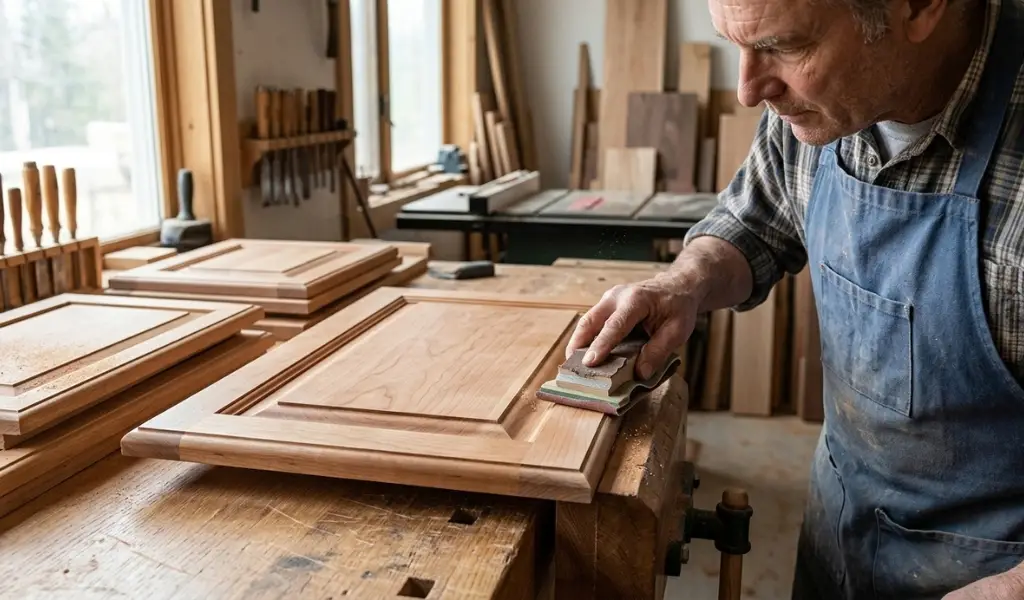
Furniture restoration frequently involves curved wood surfaces: cabriole legs, carved arms, turned spindles, and shaped aprons. Restoring these pieces means stripping old finish and smoothing the surface without erasing the carved or turned detail that gives the piece its character.
Flexible sanding pads, contoured foam blocks, and oscillating detail sanders all work well here, since they conform to the curve rather than fighting it. For white wood restoration where the goal is a completely bare, even surface before refinishing, working through a full grit progression on every curve is essential, since skipped grit stages show up clearly once new lacquer or stain is applied.
The single most important buying decision is matching the sanding head or pad shape to the moulding profile you work with most. If your shop regularly produces the same few profiles, an assorted set of convex and concave contour grips or interchangeable sanding heads sized to those specific profiles will deliver far better results than a generic flat pad forced into a curve.
For shops that handle a wide range of custom profiles, a system with interchangeable, field-shapeable pads like foam blocks that can be trimmed to match offers more flexibility than fixed-shape attachments.
Powered profile sanders vary significantly in stroke speed, and variable speed control is worth prioritizing. Slower speeds give better linear control for delicate or intricate profiles, particularly on softer woods or thin veneers where aggressive material removal risks burning through the surface. Higher speeds suit harder woods and coarser initial passes.
A sander with variable speed settings lets you match the tool’s aggressiveness to the wood species and the sanding stage, rather than being locked into a single speed that’s either too slow for efficient work or too fast for delicate profiles.
Abrasive strips and sandpaper sheets designed for profile sanders typically come in narrower widths than standard sheets, cut to fit the sanding head’s dimensions. Coarse grits handle initial material removal and mill mark elimination, while finer grits refine the surface before finishing.
Foam backing thickness affects how much the pad conforms to a profile. Thinner foam offers more precise control on sharper details, while thicker foam flexes more to follow broader, gentler curves. Matching foam thickness to your typical profile depth reduces the risk of flattening fine detail during sanding.
The same rule that applies to flat sanding applies to profile sanding: always sand with the grain wherever the profile’s shape allows. Cross-grain scratches on a curved surface are just as visible as they are on a flat one, and they’re often harder to correct once they appear on an intricate profile.
On profiles where the grain runs across a curve rather than along it common on some carved or turned details use finer grit and lighter pressure to minimize scratching, since sanding fully with the grain isn’t always possible.
Excess pressure is the most common cause of ruined profile work. A profile sander cutting too aggressively will round over the sharp arrises and crisp transitions that define a moulding profile, softening details that were carefully machined into the workpiece.
Let the abrasive do the cutting rather than forcing the tool into the wood. Frequent visual checks against the original profile or a sample block help catch material removal before it changes the shape rather than after.
Profile sanding rewards patience and the right tool for the job. A manual contour grip might be all you need for the occasional restoration project, while a shop running consistent moulding profiles will get far more value from a powered detail sander or a dedicated profile sanding machine. Whatever the scale of your work, matching the sanding head to your profile, controlling speed and pressure, and working through a full grit progression will protect the details that took real skill to create in the first place.
If you’re still working through the fundamentals of grit selection and sanding technique, our complete guide to sanding is a solid next stop before you invest in specialized profile sanding equipment.
A profile sander is a tool with a shaped pad, head, or attachment designed to match the contour of a moulding, groove, or curved wood surface. It typically uses linear motion rather than rotary or orbital action, moving the abrasive back and forth along the profile to smooth the surface while preserving the shape’s crisp detail.
For intricate profiles, powered in-line detail sanders, pen sanders, or oscillating multi-tool attachments with narrow interface pads generally perform best. They offer precise, linear control in tight corners and complex shapes that a standard palm sander or random orbital sander cannot reach without damaging the detail.
Not effectively. A regular orbital sander uses a flat pad with rotary or orbital motion, which only contacts the high points of a curved profile. This uneven contact rounds over sharp details and leaves low points in grooves and coves unsanded. A dedicated profile sander with a matching contour is necessary for consistent results on curved moulding.
Choose manual contour grips for occasional work, delicate profiles, or situations where maximum control matters more than speed such as furniture restoration on antique pieces. Choose a powered profile sander when working through longer production runs, repeating the same profiles regularly, or needing to balance efficient material removal with detail preservation.