Physical Address
304 North Cardinal St.
Dorchester Center, MA 02124
Physical Address
304 North Cardinal St.
Dorchester Center, MA 02124


Ask ten woodworkers whether a belt sander qualifies as a sanding machine, and you’ll likely get ten different answers. The terminology gets blurry fast especially when manufacturers market handheld power tools and stationary shop equipment under the same broad category. That confusion has real consequences. Reaching for the wrong tool at the wrong stage of a project wastes time, burns through sandpaper, and can leave a workpiece worse off than when you started.
The distinction matters most when you’re planning a workshop build-out, pricing a restoration job, or simply trying to figure out which tool to buy next. If you’ve already explored our ultimate guide to woodworking sanding techniques, you know that every stage of the sanding process from aggressive stock removal down to ultra-fine finishing demands a specific tool matched to the task. This article drills deeper into the core question: what separates a handheld wood sander from a stationary wood sanding machine, and how do you deploy each one intelligently?
Understanding the functional gap between portable power sanders and heavy-duty sanding machines isn’t just academic. It’s the difference between a smooth, professional surface and one that reveals every mistake under a coat of finish. The sections that follow break down each tool category, compare their performance metrics, and map out a practical two-stage workflow that serious woodworkers use to get the most from both.
A sander is a power tool designed to abrade surfaces using a moving sanding pad, sanding belt, or sanding disc. Portable electric sanders are hand-operated, meaning the operator moves the tool across the workpiece rather than feeding the workpiece through a machine. This portability makes them indispensable for on-site work, large assembled pieces, and any sanding task that requires the tool to come to the material, not the other way around.
Sanders are powerful relative to their size, but they’re optimized for control, versatility, and finish quality rather than raw material removal capacity. Most handheld sanders run on standard 120V household current, though the cordless sander segment has expanded dramatically, with brushless motors now delivering performance that rivals corded models for most finishing applications.
Dust collection is a standard feature on most modern sander models. Integrated dust bags or vacuum port connections help capture fine particulate before it settles back onto the workpiece, a critical feature when preparing wood for finishing.
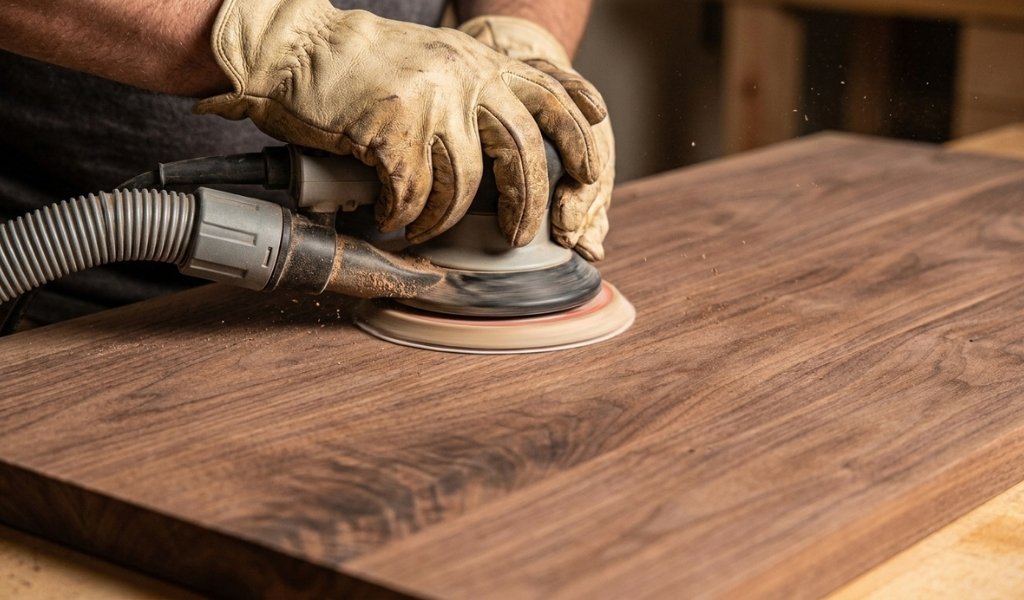
There are many different types of sanders available to woodworkers, each engineered for a distinct sanding motion and set of tasks:
Random Orbital Sander: The random orbital sander uses a sanding pad that moves in a simultaneous orbital and rotational pattern. This dual-axis motion is specifically designed to prevent swirl marks, making it one of the most popular sanders for wood surface preparation. Random orbital sanders accept hook-and-loop sanding discs in various grits and handle everything from 60-grit stock removal to 220-grit finish preparation.
Belt Sander: The belt sander drives a continuous sanding belt in a linear direction across two rollers. Belt sanders are highly effective at rapid material removal and flattening large surfaces. On flat boards and tabletops, a belt sander is a power tool that works faster than almost any other handheld option but it demands a skilled hand. Used incorrectly, belt sanders leave behind deep scratches that take considerable effort to sand out.
Detail Sander (Corner Sander): Also called a finishing sander or triangular sanding tool, the detail sander uses a triangular sanding pad to reach tight spaces, inside corners, and intricate profiles where a larger pad simply won’t fit. These sanders are excellent for trim work, furniture restoration, and any sanding project involving complex geometry.
Palm Sander (Sheet Sanders / Standard Orbital Sanders): The palm sander uses a square or rectangular sanding pad that oscillates in small orbits. Standard orbital sanders are less aggressive than random orbital models and are best suited to light finish sanding on flat surfaces. Sheet sanders accept quarter-sheet or half-sheet sandpaper cut from standard abrasive sheets.
Disc Sander (Handheld): Handheld disc sanders mount circular sanding discs to a backing pad and spin them at high RPM. They’re more aggressive than orbital tools and useful for shaping wood, edge work, and rapid contouring.
Handheld sanders are ideal when the workpiece is too large or too heavy to run through a stationary machine. Sanders can be used on assembled furniture, installed cabinetry, flooring in place, and job-site millwork. The random orbit sander excels at final surface prep before staining or finishing. Belt sanders work best for flattening glued-up panels and removing old finishes. Detail sanders handle the corners and edges that larger pads can’t reach.
Portability is the defining advantage. When the sanding process needs to follow the work, handheld electric sanders are the right tool for the job.
A wood sanding machine is a stationary or semi-stationary piece of shop equipment in which the workpiece is fed into or through the machine rather than the operator moving the tool across the surface. Sanding machines are engineered for high-volume production, dimensional accuracy, and consistent material removal across large quantities of workpieces.
These are heavy-duty tools built around powerful motors often ranging from 1.5 HP on benchtop spindle sander models to 15 HP or more on industrial wide-belt sanding machines. The defining characteristic is the fixed feed system: the abrasive element stays stationary (or moves in a controlled path), and the wood moves through it at a regulated rate.
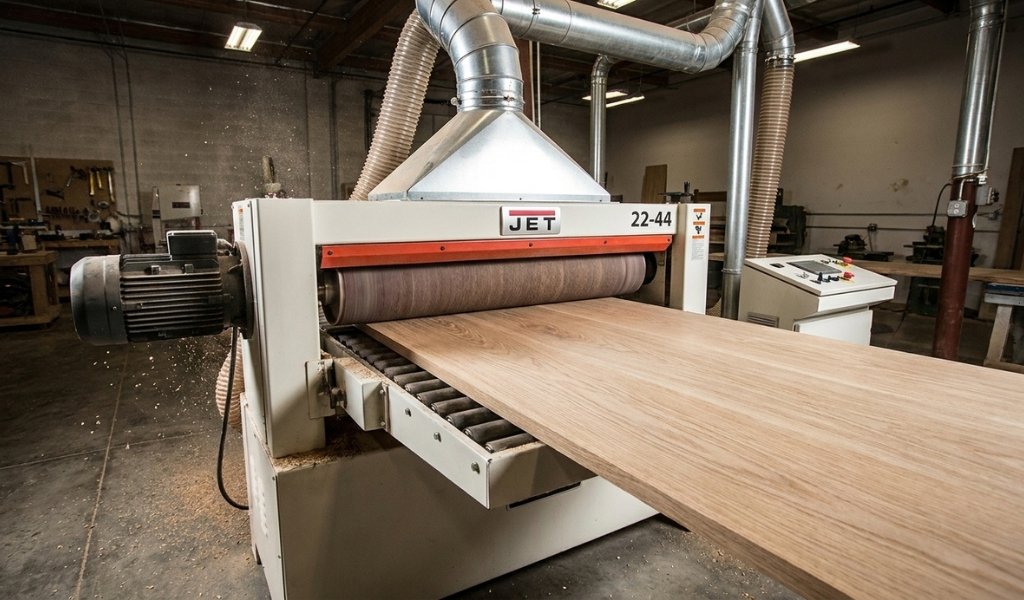
Drum Sander: A drum sanding machine feeds stock beneath a rotating cylindrical drum wrapped in sandpaper or a sanding sleeve. Drum sanders excel at thicknessing and flattening wide panels that exceed the capacity of a planer. Open-end drum sanders sometimes called open-drum or surface sanding machines can process panels wider than the drum itself by making overlapping passes.
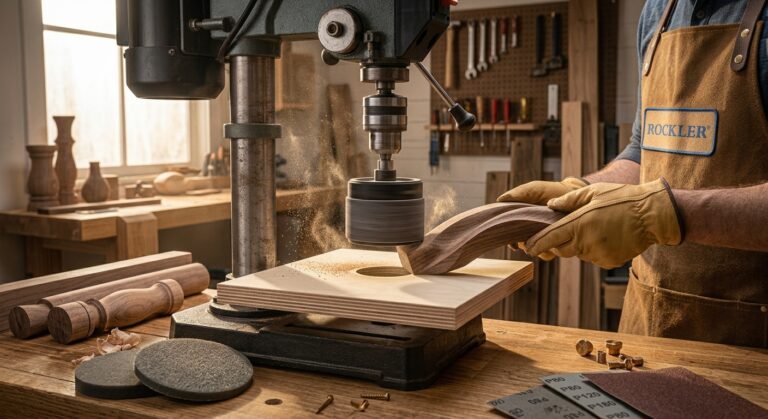
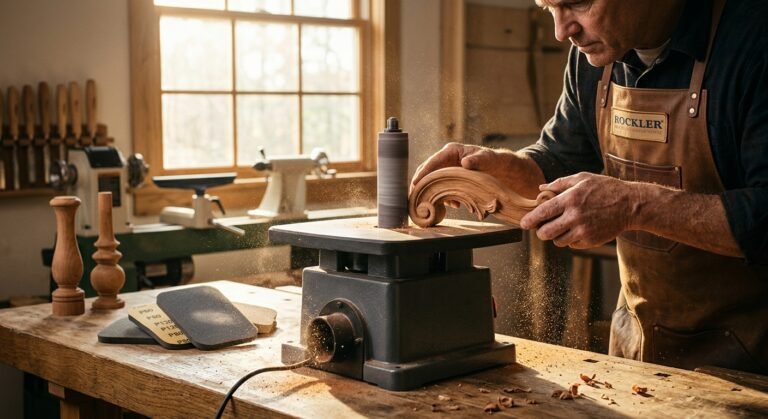
Spindle Sander (Oscillating Spindle Sander): The oscillating spindle sander uses a vertical sanding spindle that both rotates and oscillates up and down simultaneously. This combined motion distributes wear evenly across the sanding sleeves and produces a cleaner cut on curved edges. Spindle sanders are used for sanding curved workpieces inside curves, routed profiles, and irregular shapes that can’t be sanded efficiently any other way.
Wide-Belt Sanding Machine: The wide-belt sander is the workhorse of production shops. It drives a wide sanding belt sometimes 24, 37, or 52 inches across over a contact drum or platen, and workpieces are fed through on a conveyor. Wide-belt machines achieve precise thickness tolerances and produce uniformly finished surfaces at production volumes no handheld tool can match.
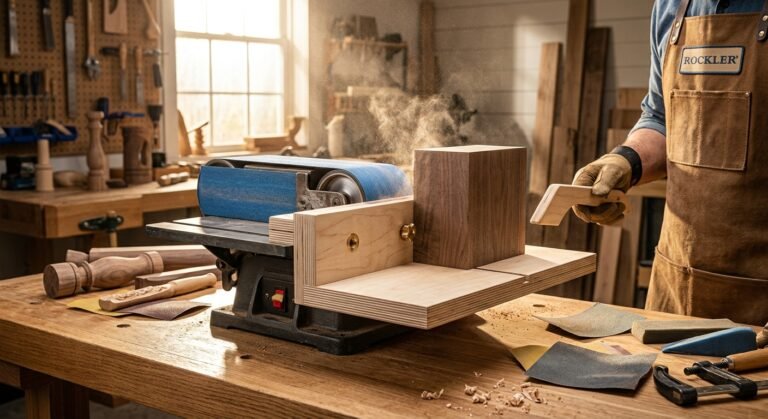
Disc Sander (Stationary): Stationary disc sanders mount a large abrasive disc to a fixed table. The operator holds the workpiece against the spinning disc to sand end grain, miter angles, and flat faces. Many shop disc sanders are combination disc/belt units.
Wood sanding machines are built for tasks where consistency, volume, and dimensional control matter more than portability. Drum sanders thickness rough-sawn lumber and level glue-up panels. Wide-belt machines process cabinet doors, flooring components, and solid wood panels at production speed. Oscillating spindle sanders handle the curved work that would take hours to accomplish by hand sanding or with a handheld detail sander.
If your shop produces more than a handful of pieces per week, stationary sanding machines dramatically reduce cycle time and improve surface consistency from part to part.
The distinction between a sander and a sanding machine isn’t just about size. Several technical dimensions separate these tool categories, each one relevant to different woodworking scenarios.
Handheld electric sanders typically draw between 2 and 12 amps at 120V, translating to roughly 240–1,440 watts of input power. Cordless sander platforms operate at 18V to 60V depending on the battery system, with brushless motors extracting maximum efficiency from available power.
Stationary sanding machines operate on a different scale. Benchtop spindle sanders may run on 120V at 5–7 amps, but floor-standing drum sanders and wide-belt machines require 240V single-phase or three-phase power, with motors ranging from 1.5 HP to 15+ HP. Motor capacity directly determines how aggressively a machine can remove material without bogging down a critical factor when thicknessing hardwoods like hard maple or white oak.
Belt sanders are highly effective handheld tools for rapid material removal, but even the most aggressive portable belt sander cannot match the material removal rate of a drum sander or wide-belt machine running coarse-grit abrasive. A wide-belt sanding machine can reduce a panel’s thickness by 1/32″ per pass at high feed rates, something no handheld sander can accomplish with comparable consistency.
Conversely, handheld random orbital sanders produce superior fine finish results because the operator can respond to surface feedback in real time adjusting pressure, speed, and grit progression based on what they feel and see. Stationary machines sand at fixed parameters, which is an advantage for consistency but a limitation for nuanced finish work.
Handheld sanders accommodate virtually any workpiece size including assembled cabinets, installed floors, and large panels because the tool travels to the work. Stationary sanding machines are constrained by their throat capacity, table size, and drum or belt width. A 20-inch drum sander cannot process a 24-inch panel in a single pass. A benchtop spindle sander handles small curved workpieces but cannot process a 6-foot curved rail efficiently.
Feed rate on stationary machines is also fixed or variable within a set range, which eliminates the operator variability that leads to uneven hand sanding results but it also means the woodworker must match the feed rate to the material, grit, and depth of cut to avoid burning or tearout.
Professional woodworkers rarely choose between handheld sanders and sanding machines; they use both, deploying each at the appropriate stage of the production workflow. The two-stage approach runs heavy material removal and dimensioning through stationary machines, then transitions to handheld power sanders for final surface preparation and finish work.
When a project involves dimensioning rough lumber, leveling glue-up panels, or processing multiple components to a consistent thickness, a heavy-duty wood sanding machine is the correct starting point. A drum sander running 60- or 80-grit abrasive can flatten a warped glue-up panel in two to three passes of work that would require significant time and skill with a hand-operated belt sander. For shops handling production runs of cabinet doors, drawer fronts, or flooring components, investing in a wide-belt or drum sanding machine compresses hours of manual sanding into minutes of machine time.
For a full breakdown of machine types, specifications, and purchasing criteria, the detailed analysis in our wood sanding machine guide covers the subject in depth.
Once the material is dimensioned and surfaces are flat, the sanding process shifts to fine preparation and this is where the random orbit sander becomes the primary tool. Random orbital sanders are ideal for progressing through grit sequences (typically 80 → 120 → 180 → 220) without introducing directional scratches that read through stain or clear finish. The random orbital motion eliminates the swirl marks associated with standard orbital sanders, and the tool’s ergonomics allow sustained work over large surfaces without fatigue.
Choosing the right random orbit sander for your shop considering pad size, motor power, dust collection efficiency, and corded versus cordless options is a decision worth making carefully. Our dedicated resource on the random orbit sander walks through every relevant sander feature and model consideration to help you choose the best option for your workflow.
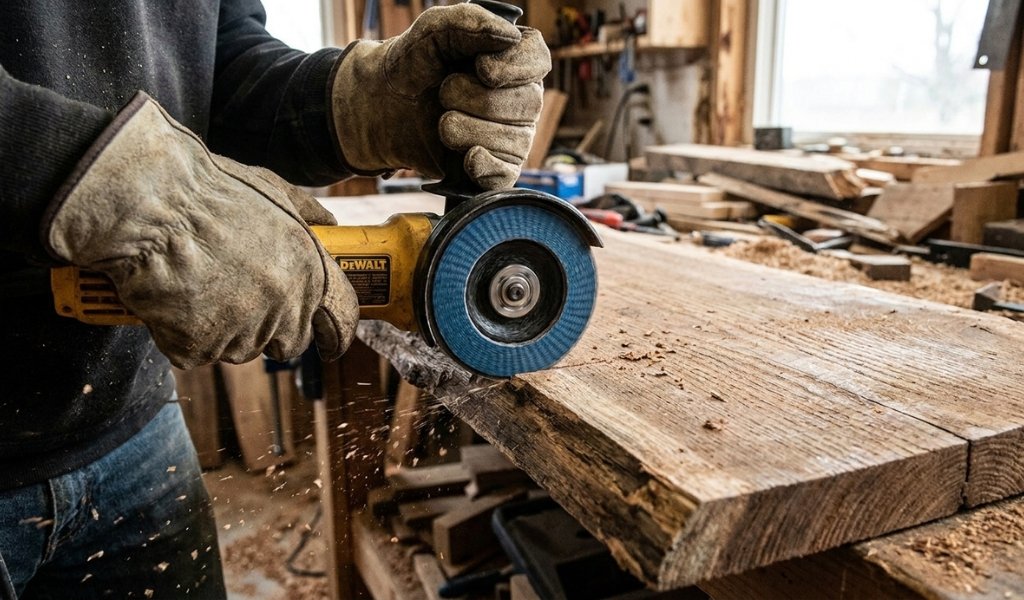
Not every sanding task fits neatly into the sander-versus-machine framework. When a project demands aggressive shaping of curved surfaces, exterior timbers, or reclaimed wood with heavy material variation, an angle grinder fitted with a wood sanding disc for angle grinder applications fills a role that neither a standard handheld sander nor a stationary machine can cover. Flap discs, fiber discs, and carving discs mounted to an angle grinder remove material at rates approaching those of a stationary machine while maintaining the portability of a handheld tool. This makes the angle grinder sanding disc a critical part of the two-stage workflow for sculptural work, timber framing, and surface reclamation. For a full technical review of disc types, grits, and safety protocols, refer to our comprehensive coverage of wood sanding discs for angle grinders.
No single tool covers every sanding scenario. A well-structured shop typically includes a random orbit sander for primary finish preparation, a belt sander for fast material removal on large flat surfaces, a detail sander for tight spaces and profiles, and at least one stationary machine usually a drum sander or oscillating spindle sander for dimensioning and curved work. Angle grinder sanding discs extend the toolkit into aggressive shaping territory.
Building this collection systematically, understanding which gaps to fill first based on the types of projects your shop handles is the subject of our wood sanding tools resource, which maps every major tool category to specific sanding tasks and recommends configurations for hobbyist, semi-professional, and production shop environments.
A sander is a handheld power tool that an operator moves across a workpiece. A sanding machine is stationary equipment through which the workpiece is fed. Sanders prioritize portability, control, and finish quality. Sanding machines prioritize throughput, dimensional consistency, and high-volume material removal. The right tool depends on whether the project demands the tool to move or the workpiece to move.
Yes significantly. Furniture restoration almost always requires handheld sanders because the piece is assembled and can’t be fed through a stationary machine. A random orbit sander handles flat surfaces and broad curves. A detail sander reaches tight spaces, carved profiles, and inside corners. A stationary drum sander or spindle sander might be appropriate for individual unassembled components before assembly, but not for finished or partially assembled furniture.
A benchtop combination disc/belt unit occupies a gray area. The belt component functions like a stationary machine when the workpiece is fed against the moving belt on a fixed table this qualifies as a sanding machine configuration. The disc component is also stationary. However, benchtop combination units are semi-portable and lack the feed mechanisms of true production sanding machines. Most woodworking classifications treat them as stationary sanders or light-duty sanding machines rather than production equipment.
A handheld belt sander fitted with 40- or 60-grit abrasive can remove thick paint layers from flat surfaces, though chemical stripping is often faster for heavy buildup. Random orbital sanders are too slow for thick paint removal at coarse grits. For large painted surfaces, a belt sander is the most efficient handheld option. On curved or profiled surfaces where a belt sander won’t track cleanly, an angle grinder with a fiber disc or flap disc removes paint faster than any orbital tool.
The transition point is driven by volume, precision requirements, and panel width. If you’re regularly processing more than 10 to 15 panels per project, if thickness consistency across parts is critical (as in frame-and-panel cabinetry), or if your panels exceed 12 to 14 inches in width making belt sander control increasingly difficult a drum sanding machine delivers better results with significantly less labor. A portable belt sander remains the right tool for on-site work, assembled pieces, and occasional shop use where the capital investment in a drum sander isn’t justified by project volume.