Physical Address
304 North Cardinal St.
Dorchester Center, MA 02124
Physical Address
304 North Cardinal St.
Dorchester Center, MA 02124

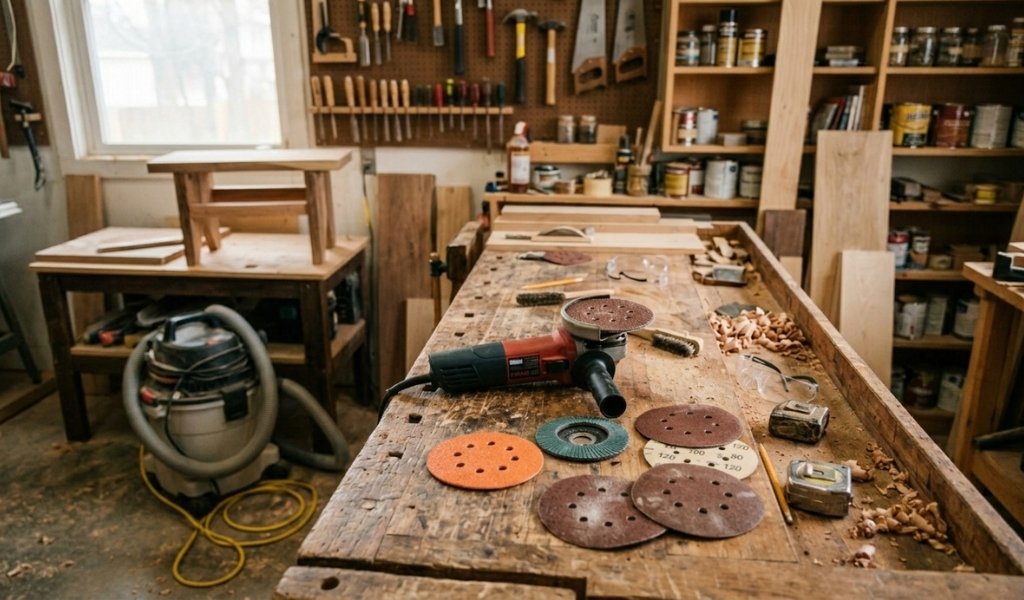
An angle grinder is one of the most hardworking tools in any woodworker’s arsenal. Most people reach for it when they need to cut or grind metal but with the right sanding disc or backing pad attached, it transforms into a surprisingly capable wood sanding machine. From aggressive stock removal on rough-sawn lumber to smoothing curved furniture profiles, the angle grinder can tackle sanding applications that other power tools simply can’t reach as efficiently.
If you’re serious about getting the most out of your equipment, we recommend starting with our ultimate guide to woodworking sanding techniques. It covers the full spectrum of sanding methods from hand sanding and belt sanders to orbital tools and gives you the strategic foundation to make smarter tool and abrasive choices on every project.
That said, this guide goes deep on one specific setup: pairing your angle grinder with the correct sanding pad, backing pad, and abrasive disc combination for woodworking. Whether you’re a DIY furniture restorer working on a dining table, a wood turner shaping a bowl blank, or a cabinetmaker leveling a glued-up panel, getting this combination right makes an enormous difference in your surface finish quality and working speed.
We’ll walk through every major disc and pad type, explain the 5/8″-11 arbor fitting system, break down grit progressions from 24-grit heavy stock removal to 240+ fine finishing, and give you a step-by-step mounting guide that prioritizes safety. By the end, you’ll know exactly which angle grinder sanding disc or pad suits your specific task and which ones to avoid when wood is involved.
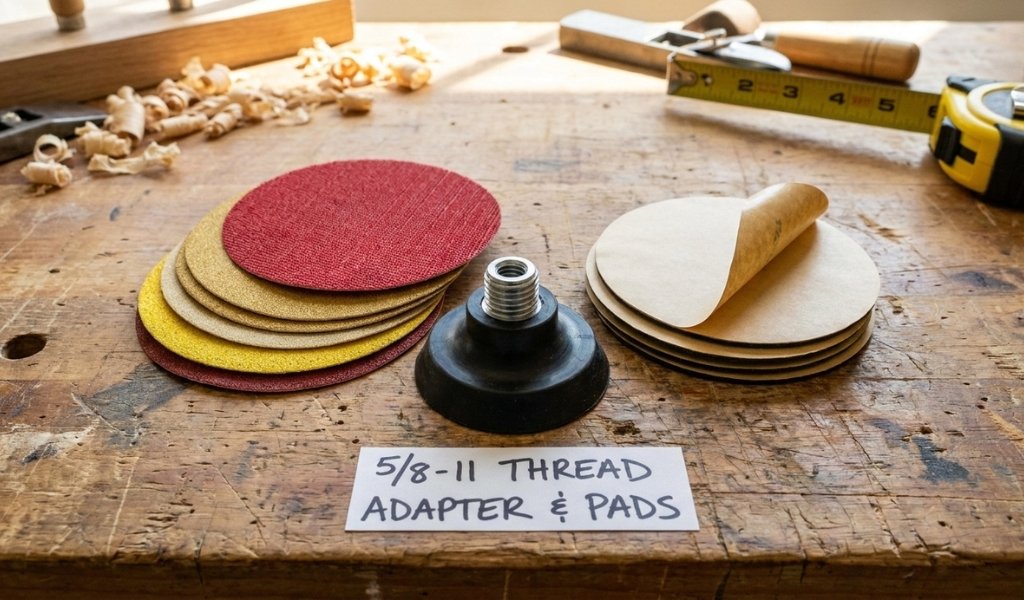
A sanding disc for an angle grinder is an abrasive disc typically ranging from 4 to 7 inches in diameter designed to attach to the grinder’s spindle via a backing pad or direct mounting adapter. Unlike flap discs, which use overlapping abrasive flaps, flat sanding discs provide consistent, even contact across the entire disc face. This makes them especially effective for leveling flat panels, removing old finishes, and shaping wood.
The backing pad is the rubber or foam interface that sits between the grinder’s spindle and the abrasive disc. It provides cushioning, flexibility, and the attachment system that holds the disc in place. Without the correct backing pad, even the best sanding disc will either spin dangerously or deliver inconsistent pressure across the surface.
The standard spindle thread on most angle grinders including popular models from DeWalt, Makita, and Ryobi is the 5/8″-11 arbor fitting. This is the same thread specification used across most North American-market grinders, meaning backing pads and adapter systems are widely interchangeable between power tool brands.
The threaded arbor adapter screws directly onto the grinder’s spindle. From there, the backing pad attaches to the adapter, creating a stable mounting platform for your sanding disc. Always verify thread compatibility before purchasing a new backing pad, and inspect the adapter threads for wear regularly. A poorly seated adapter can cause disc wobble, uneven sanding, and at worst a dangerous disc ejection at high RPM.
Two primary attachment systems dominate the sanding disc market: hook and loop (also called Velcro or hook-and-loop) and PSA (pressure-sensitive adhesive).
Hook and loop discs attach via interlocking fabric surfaces similar to the Velcro on a shoe strap. The major advantage is that discs can be swapped quickly without tools, making mid-project grit changes fast and convenient. Hook and loop sanding systems also allow you to reuse partially worn discs, which reduces waste and lowers abrasive costs over time. Most random orbital sander pads also use hook-and-loop, making discs interchangeable between tools in some cases.
PSA discs use a sticky adhesive backing that bonds directly to a smooth backing pad surface. These discs attach more permanently per session and tend to stay put under aggressive cutting conditions but swapping them is messier and slower. PSA backing works best for long, uninterrupted sanding runs where you won’t need to change grits frequently.
For most woodworking applications, hook and loop is the more practical choice. PSA discs shine in production environments where a single grit is used for extended periods.
Backing pads come in two broad categories: rigid rubber pads and flexible foam pads. Each serves a distinct purpose depending on your surface geometry.
Rigid rubber backing pads provide a flat, firm sanding surface ideal for leveling operations. When you’re flattening a glued-up panel or removing material from a wide, flat board, a rigid pad keeps the disc parallel to the surface and prevents it from dipping into low spots or riding over high points unevenly.
Flexible foam backing pads compress and conform to curved profiles, making them the go-to for contour sanding on chair legs, cabinet doors with routed profiles, or any surface with compound curves. The foam absorbs minor surface variations and distributes pressure more evenly across irregular geometry. For detailed sanding work such as refining a carved relief or smoothing a fillet, flexible foam pads dramatically reduce the risk of burning through edges or creating flat spots.
Resin fiber discs use a vulcanized fiber backing a compressed, resin-impregnated paper material that gives the disc rigidity and durability under high-load grinding. These are among the most aggressive discs available for angle grinders and are capable of heavy material removal on both wood and metal.
Quick-change discs (sometimes called quick-change twist-lock pads) use a proprietary center hub that locks into a compatible backing unit with a simple twist, eliminating the need for a backing pad altogether. These are particularly popular in metalworking and automotive finishing, but they work effectively in woodworking and metalworking hybrid shops where you alternate frequently between materials. Quick-change discs are available in hook and loop, PSA, and twist-lock formats depending on the system you use.
For production woodworking or furniture restoration where you’re stripping large areas of old finish quickly, resin fiber discs on a rigid backing pad are hard to beat for cutting power per dollar spent.
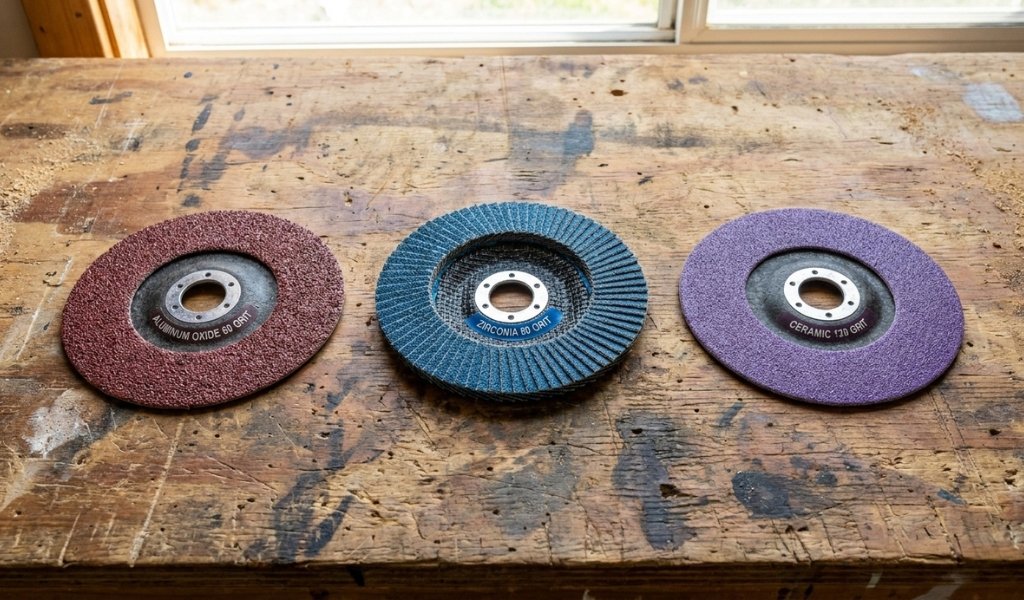
The abrasive grain bonded to a sanding disc determines how aggressively it cuts, how long it lasts, and how well it handles heat. Three materials dominate woodworking applications:
Aluminum oxide is the most common abrasive for wood sanding. It’s affordable, available in every grit from 24 to 400+, and works well on softwoods, hardwoods, and wood composites. Standard aluminum oxide discs are the right sanding disc choice for most general woodworking tasks.
Zirconia (also called zirc or zirconia alumina) is a self-sharpening abrasive grain that fractures under pressure to expose fresh cutting edges. This makes zirconia discs including the popular type 29 zirconia flap disc format last significantly longer than aluminum oxide under high-load conditions. Zirconia performs best on hardwoods, dense timbers, and in situations where you’re doing heavy stock removal. A zirconia flap disc on a 4.5-inch grinder, for example, can level a rough-sawn oak slab faster and with less disc changes than aluminum oxide.
Ceramic abrasives sit at the premium end of the market. Premium sanding discs with ceramic grain run cooler, cut faster, and outlast both aluminum oxide and zirconia in demanding applications. They’re worth the higher cost when working with very hard, abrasion-resistant species like maple, hickory, or reclaimed industrial hardwoods.
Silicon carbide discs, while more common in metalworking and wet sanding applications also appear in woodworking contexts. Silicon carbide’s sharp, brittle grain structure cuts cleanly on hardwoods and is particularly effective for finish sanding between coats of sealer or varnish when paired with a fine grit.
Non-woven surface conditioning discs are made from abrasive nylon fibers rather than bonded grain on a paper or fiber backing. These discs often sold in 10-pack bundles for convenience are designed for light scuffing, surface prep, and finish blending rather than aggressive material removal.
In woodworking, non-woven scuff pads excel at denibbing finishes (removing dust nibs between coats), scuffing dried sealers before top coating, and conditioning bare wood surfaces before staining. They’re gentler than conventional sandpaper discs and leave a uniform scratch pattern that accepts finishes evenly. Think of them as the final step in a multi-stage sanding sequence rather than a primary stock removal tool.
Surface geometry is the first filter for choosing your pad and disc combination. Flat surfaces tabletops, panels, wide boards need a rigid backing pad to maintain consistent contact and prevent dish-shaped low spots. Curved profiles and shaped workpieces need a flexible foam pad that can follow the contour without bridging across high points or concentrating pressure unevenly.
Beyond geometry, consider the type of material removal needed. Shaping wood aggressively calls for a coarser abrasive on a rigid pad. Detailed sanding or finish prep on a curved profile calls for fine-grit discs on a flexible pad. Matching the pad flexibility to the surface shape, and the grit to the removal goal, is the core decision-making framework for every angle grinder sanding disc selection.
Grit progression moving from coarser to finer abrasives in stages is fundamental to achieving a smooth, defect-free surface finish. Each grit level removes the scratch pattern left by the previous one, progressively refining the surface texture.
A practical progression for wood sanding with an angle grinder might look like this:
Never skip more than one or two grit levels in a single jump. Jumping from 40 to 150 grit, for example, leaves coarse scratches from the 40-grit session that the 150-grit disc can’t efficiently remove without excessive dwell time.
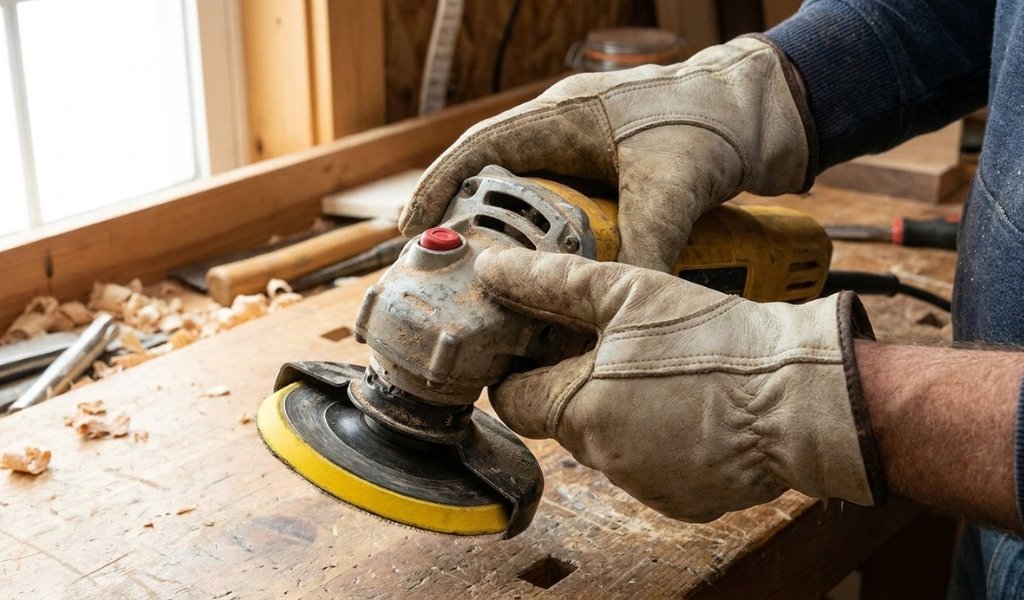
Before mounting any attachment, always disconnect the grinder from its power source either unplug it or remove the battery. This is non-negotiable.
Heat is the enemy of quality wood sanding. Angle grinders spin at high RPM typically between 7,000 and 12,000 RPM depending on the model which generates significant friction heat. On wood, excess heat scorches the surface, clogs the abrasive with resin, and can raise grain in ways that are difficult to correct.
Variable speed models from manufacturers like DeWalt and Makita allow you to dial down the RPM for wood sanding, reducing heat buildup significantly. If your grinder runs at a fixed speed, compensate by keeping the disc moving continuously and never dwell in one spot. Work in consistent, overlapping passes and let the disc do the cutting rather than applying heavy downward pressure.
Dust collection also plays a role in heat management. Dense sawdust packed around the disc acts as an insulator, trapping heat against the wood surface. Where possible, use a vacuum system or dust port attachment to keep the work area clear. Beyond heat management, effective dust collection protects your lungs from fine wood particulates, an underappreciated safety measure in woodworking and metalworking shops alike.
Flexible foam and rubber sanding pads are not the only angle grinder attachments used for shaping and smoothing wood. Rigid wood sanding wheels including carbide sanding discs, tungsten carbide cutting wheels, and dedicated shaping wheels offer a very different performance profile.
A tungsten carbide cutting wheel or carbide shaping disc uses brazed or sintered carbide teeth rather than bonded abrasive grain. These tools are designed for aggressive removal and shaping wood at a level that abrasive discs can’t match. A wood carving disc set, for example, can hollow a bowl blank or rough-shape a sculptural form far faster than any sandpaper disc.
However, carbide tools are cutting instruments, not sanding instruments. They leave a rougher surface texture that requires significant abrasive follow-up work. They also demand more skill and control. A carbide shaping wheel can remove material very quickly, and on smaller workpieces, that speed can lead to over-cutting in seconds.
For a full comparison of rigid grinding wheel wood options, including shaping wheels and carbide alternatives, explore our detailed coverage of wood sanding wheels for grinders within our broader wood sanding tools resource. These resources break down which rigid wheel types suit carving, shaping, and surface prep tasks across different wood species and project scales.
The angle grinder is a powerful, aggressive tool. Its strength is rapid stock removal, rough shaping, and working large surface areas quickly. But that same power becomes a liability at finer grit levels, where control and consistent pressure matter more than cutting speed.
As a general rule, most woodworkers should transition from the angle grinder to a random orbital sander at around the 120–150 grit mark. A random orbital sander produces a swirl-free scratch pattern, runs at lower RPM, and is far easier to control on surfaces that are approaching final finish quality. The ergonomics of a dedicated orbital sander also reduce fatigue during the longer, slower finishing stages.
For choosing the right abrasive discs to complete your final surface prep after switching tools, our guide to angle grinder wood sanding discs covers the transition grits and disc formats that bridge aggressive angle grinder work with refined orbital finishing.
The key insight is that these tools are complementary, not competitive. Use the angle grinder to do the heavy lifting, then hand the baton to the orbital sander for the final lap.
Pairing your angle grinder with the right sanding disc and backing pad is one of the highest-leverage upgrades available to woodworkers of any skill level. The right abrasive grain whether aluminum oxide for general hardwood work, zirconia for heavy-duty removal, or ceramic for premium applications combined with the correct backing pad flexibility and a disciplined grit progression, transforms what is often viewed as a rough metal tool into a precision wood finishing machine.
Start with a proper 5/8″-11 arbor adapter and a quality backing pad that matches your surface geometry. Choose hook-and-loop attachment for flexibility and ease of disc changes. Follow a systematic grit progression from heavy stock removal down to fine finishing grades. Manage heat through consistent movement, variable speed control, and effective dust collection. And know when to hand off the work to a dedicated random orbital sander for the final stages.
The result? Surfaces that are genuinely smooth, finish-ready, and free from the burn marks, swirl patterns, and deep scratches that careless sanding leaves behind. With the right setup and technique, glass-smooth results are entirely achievable with an angle grinder.
Yes. Most standard angle grinders accept hook-and-loop backing pads via the 5/8″-11 arbor thread, which is the universal spindle standard for North American grinders from DeWalt, Makita, Ryobi, and other major power tool brands. Purchase a compatible threaded backing pad adapter, mount it to your grinder’s spindle, and your hook and loop discs will attach directly to the pad surface. Always verify thread compatibility before purchasing.
For most woodworking applications, hook and loop is the better choice. Hook and loop discs swap in seconds without tools or adhesive, making grit changes fast and practical during multi-stage sanding progressions. Partially used discs can be removed and reused, reducing abrasive costs. PSA discs offer stronger adhesion per session and suit production runs where a single grit is used for extended periods, but the slower disc change process makes them less practical for typical furniture making or restoration work.
Zirconia and ceramic abrasives are the top performers for hardwood sanding with an angle grinder. Zirconia’s self-sharpening grain fractures under pressure to expose fresh cutting edges, extending disc life significantly compared to aluminum oxide on dense species like oak, maple, or hickory. Ceramic grain found in premium sanding discs runs cooler, cuts faster, and lasts longest of all, making it the best choice for prolonged hardwood sessions. Standard aluminum oxide remains a cost-effective option for softwoods and general-purpose sanding applications where longevity is less critical.
Use an angle grinder sanding pad for heavy stock removal, rapid shaping, stripping old finishes, and working large or rough surfaces efficiently. Switch to a random orbital sander pad for finish-stage work above 120 grit, detail sanding on smaller areas, and any surface approaching final coat readiness. Angle grinders provide cutting power and speed; random orbital sanders provide precision, swirl-free scratch patterns, and control. The two tools work best together in sequence rather than as direct substitutes for each other.
Start at the coarsest grit, your surface condition requires 24 to 36 grit for rough-sawn timber or heavy finish stripping, 40 to 60 grit for moderate stock removal, and 80 grit if the surface is already relatively smooth. From there, advance through 100, 120, and 150 grit in sequential steps before transitioning to a random orbital sander. Never skip more than one grit interval per step, as each grit level removes the scratch pattern left by the previous one. Rushing the progression leaves deep scratches that are difficult to remove at finer grit stages.