Physical Address
304 North Cardinal St.
Dorchester Center, MA 02124
Physical Address
304 North Cardinal St.
Dorchester Center, MA 02124

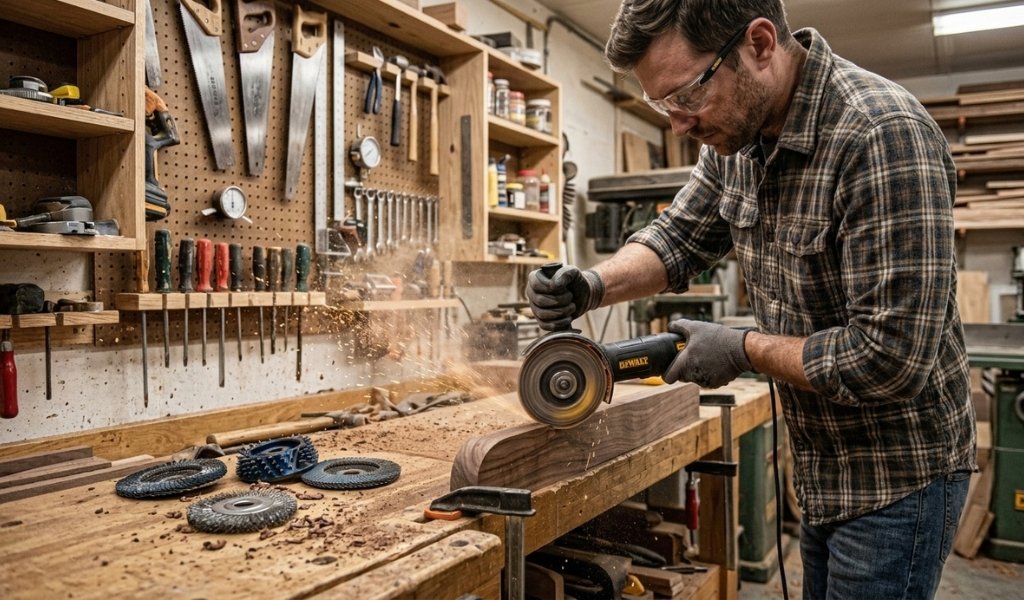
An angle grinder is one of the most versatile tools in any woodworking shop and most people only scratch the surface of what it can do. Fit it with the right wood sanding wheel, and it transforms from a metal-cutting workhorse into a precision wood shaping and smoothing machine capable of tackling jobs that would take portable sanders hours to complete.
Whether you’re stripping bark from a live-edge slab, carving contours into a chair seat, or leveling a gnarly burl surface, a grinder-mounted sanding wheel delivers speed and material removal rates that purpose-built sanders can rarely match. The trade-off? Angle grinders are aggressive tools that demand respect, the right accessories, and a clear understanding of technique.
This guide covers everything you need to know: wheel types, arbor sizing, application matching, step-by-step safety technique, and how grinder sanding wheels compare to other woodworking tools. For broader context on finishing wood surfaces, refer to our ultimate guide to woodworking sanding techniques, which covers the full spectrum of abrasive methods from hand sanding to power tool workflows. Here, though, the focus is squarely on the grinder: how to choose the right wheel, use it safely, and get exceptional results on your next woodworking project.
Expect practical advice backed by real-world application knowledge, no fluff, no filler.
A wood sanding wheel for an angle grinder is a purpose-engineered abrasive or carbide-tipped accessory designed to mount onto a standard angle grinder spindle. Unlike grinding discs built for metalwork, wood sanding wheels are specifically designed to cut through timber grain cleanly, shape curved profiles, and remove stock efficiently without burning or clogging.
Standard sanding discs the flat, paper or cloth-backed abrasive circles used on random orbital or belt sanders work through consistent, relatively low-speed contact across a surface. Grinder-mounted sanding wheels, by contrast, operate at much higher RPMs (typically 10,000–13,000 RPM for a 4″ to 4.5″ grinder) and are built to handle the rotational forces that come with that speed.
The design differences are significant. Wood sanding wheels include flap discs constructed from layered abrasive sheets, hook-and-loop backing pad systems for quick grit changes, tungsten carbide shaping wheels with sharp cutting teeth, and shank-mounted mop sander accessories for detail work in recesses. Each design solves a specific problem that a flat sanding disc simply cannot address efficiently.
Arbor size determines whether a wheel fits your grinder’s spindle. Most angle grinders sold in North America use a 5/8″ arbor, which is the standard for 4″ to 5″ grinders. European and some industrial-grade equipment often uses a 7/8″ arbor. Always confirm your grinder’s spindle specification before purchasing any wheel mismatched arbor sizing creates a dangerous fit that can cause wheel failure at speed.
Wheel diameter also matters. 4-inch wheels are better suited for detail work, tight curves, and smaller carving projects. 4.5-inch wheels cover more surface area per pass, making them ideal for large slabs, flat surface leveling, and high-volume stock removal. Match diameter to the job doesn’t default to the largest wheel available when precision is the priority.
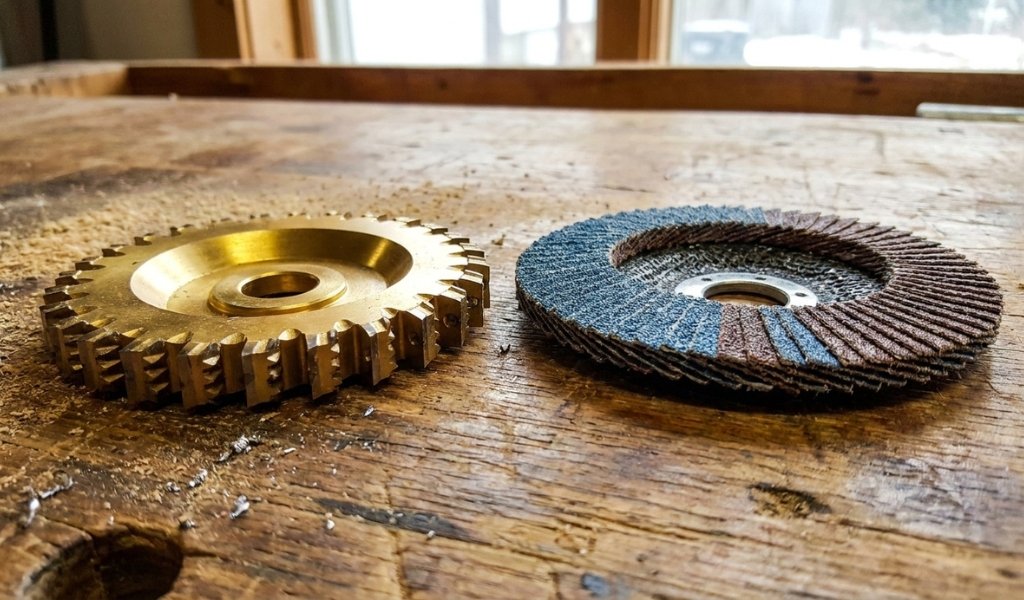
Tungsten carbide shaping wheels are the most aggressive option in the grinder accessory lineup. Engineered with sharp carbide teeth set into a steel disc available in flat, curved (convex), and inclined profiles these wheels remove significant amounts of material fast. Arbortech is one of the most recognized names producing carbide shaping wheels for woodworking, with tooth geometry designed specifically to cut cleanly across wood grain rather than tear it.
The flat profile suits surface leveling and rough shaping. Curved profiles excel at hollowing bowls, carving chair seats, or shaping organic forms. Inclined wheels handle bevel and edge shaping. Because these wheels cut rather than abrade, they stay sharp longer than abrasive alternatives, making them an efficient, high-value option for serious woodworkers tackling carving-heavy projects.
Use caution: carbide wheels are fast and powerful. They demand full concentration, a firm two-handed grip, and a clear understanding of the wood grain direction to prevent catches.
Abrasive flap discs consist of overlapping layers of coated abrasive cloth arranged around a central hub. As each layer wears, fresh abrasive is exposed underneath, giving the disc a longer usable life than a flat sanding sheet and a more consistent cut throughout.
For wood, flap discs are the go-to choice for smoothing rough surfaces, blending transitions between shaped areas, and cleaning up tool marks left by carbide wheels or chisels. They’re available in grits ranging from 40 (aggressive stock removal) to 120 (light smoothing and finish preparation). Zirconia alumina and ceramic alumina flap discs offer the best durability and performance on hardwoods; their abrasive design is sharp enough to cut efficiently at grinder speeds without loading up with wood dust.
Not every grinder sanding job involves wide, open surfaces. Tight recesses, carved channels, inside curves, and detail areas require a different accessory entirely: shank-mounted flap wheels or mop sanders designed to fit a grinder via a mandrel attachment.
These smaller wheel formats rotate on a central shaft, allowing them to reach areas a full-size disc cannot access. They’re particularly useful in furniture making, decorative carving, and restoration work where precision and control matter as much as speed. The soft, flexible nature of mop sanders makes them ideal for contouring around complex profiles without leaving flat spots or gouges.
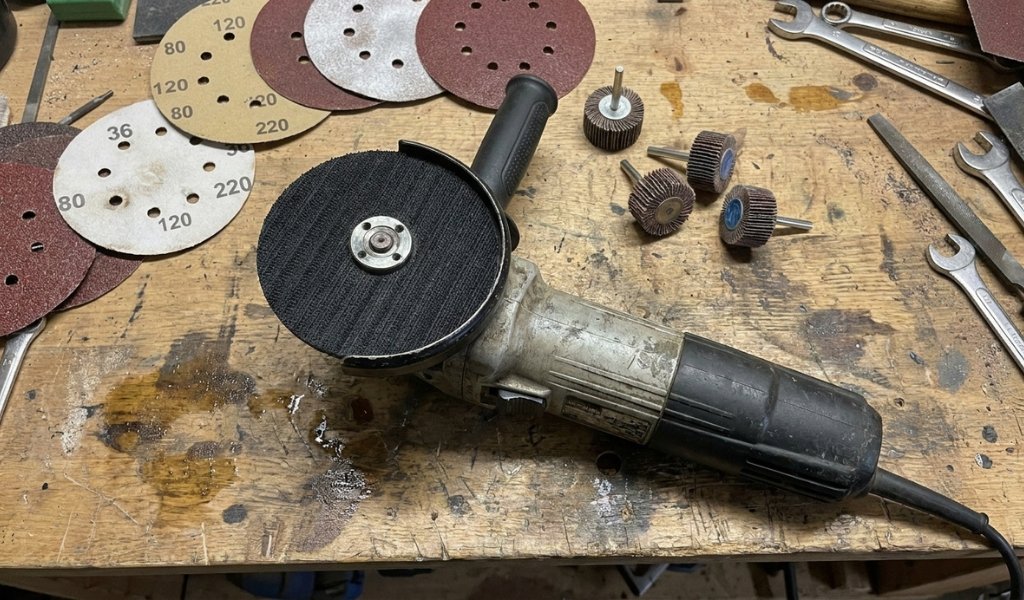
A hook-and-loop backing pad converts your angle grinder into a multi-grit sanding platform without purchasing a separate random orbital sander. The hook-and-loop pad mounts to the grinder spindle, and standard hook-and-loop abrasive discs snap on and off in seconds, enabling rapid grit changes as you progress through coarser to finer stages of a sanding project.
This system works best at lower grinder speeds if your tool features a speed dial. Running a hook-and-loop pad at maximum RPM can cause the disc to detach or wear unevenly. The payoff, though, is a highly efficient and affordable wood sanding setup that gives a single grinder the flexibility of multiple dedicated sanding tools.
When a project demands aggressive, fast stock removal, stripping bark from a live-edge board, cleaning a slab surface, or reducing high spots on rough-sawn timber tungsten carbide shaping wheels and coarse flap discs (40–60 grit) are the correct tools. At this stage, material removal rate is the priority, and both wheel types deliver industrial-level performance when paired with a grinder running at or near maximum RPM.
Bark stripping benefits most from a flat or slightly convex carbide wheel, which rides the surface contours cleanly. Stump and root grinding for decorative woodworking where you’re cleaning up irregular organic shapes calls for carbide wheels with curved profiles that can follow the wood’s natural form without digging in.
Once heavy removal work is complete, the goal shifts from speed to control and surface quality. Flap discs in the 80–120 grit range are ideal for this phase, smoothing tool marks, leveling grain transitions, and preparing surfaces for finishing or polish. Hook-and-loop systems allow you to step up through grits systematically 80, 100, 120 without swapping tools.
For contoured surfaces and carved profiles, mop sander accessories provide the flexibility to follow curves without flattening them. This stage is where patience determines final quality: rushing through grit progressions results in visible scratches that show up clearly under finish coats.
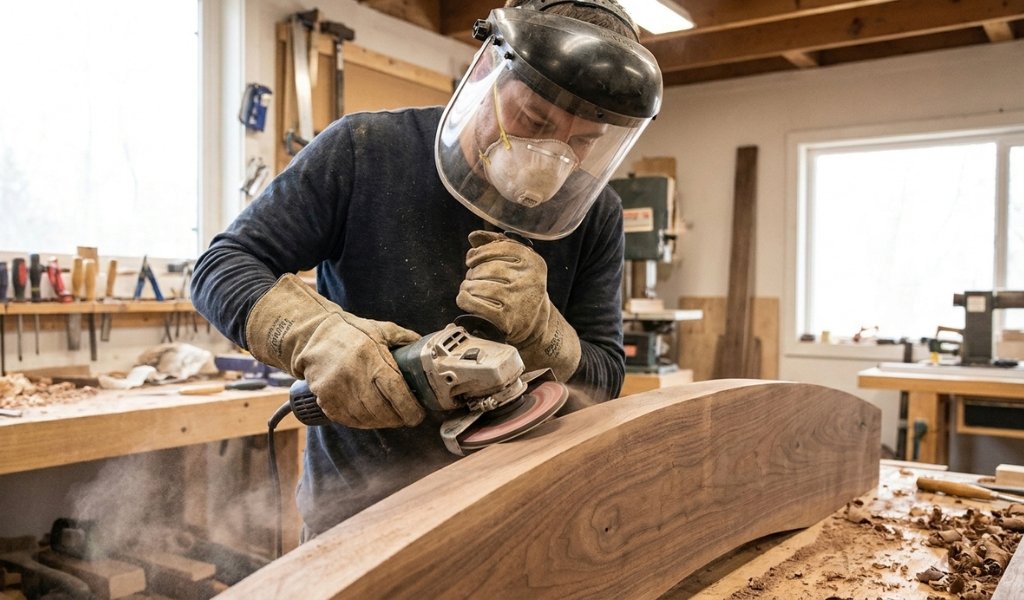
Safety is non-negotiable when operating a grinder. The high rotational speeds involved and the aggressive nature of carbide and abrasive wheels mean that even a momentary lapse in attention can result in serious injury. Before any grinder sanding session, ensure the following:
Kickback where the wheel catches the wood and the grinder violently jerks is the primary hazard in grinder wood sanding. Proper technique reduces this risk dramatically.
Maintain a 5–15 degree angle between the disc face and the workpiece surface. Flat contact at 0 degrees increases the risk of the wheel digging in. Work with the grain where possible, particularly with carbide wheels. Against-grain passes on heavily figured or knotty timber create unpredictable catches.
Applying light, consistent pressure lets the wheel do the cutting. Forcing the grinder into the wood stalls the motor, overloads the abrasive, and raises the risk of a kickback event. Keep both hands on the grinder at all times: one on the main handle, one on the auxiliary side handle. Never remove the side handle for any reason.
Move the grinder in smooth, overlapping passes rather than static holds. Holding the wheel in one spot generates heat, scorches the wood, and glazes the abrasive reducing both surface quality and wheel durability.
Portable power sanders, random orbital sanders, belt sanders, and detail sanders are precision finishing tools. They excel at producing smooth, consistent surfaces on flat or mildly curved stock. What they struggle with is heavy material removal, aggressive shaping, and the kind of organic, large-scale work that live-edge slabs and sculptural furniture pieces demand.
That’s where grinder-mounted sanding wheels earn their place in the shop. For a comprehensive comparison of how grinder accessories stack up against the full range of wood sanding tools including belt sanders, random orbitals, and spindle sanders the published sub-pillar resource on wood sanding tools covers each tool category in depth, helping you determine the right tool for each phase of your project.
Use a grinder sanding wheel when:
Grinder sanding wheels are not final-finishing tools. Once shaping and surface leveling are complete, transitioning to dedicated abrasive options produces better results with less risk of over-removal. Specifically, wood sanding discs for angle grinders purpose-built abrasive discs engineered for fine finishing rather than aggressive stock removal deliver the controlled, consistent scratch pattern that fine finishing requires.
These discs, used with a backing pad at reduced grinder speed or on a random orbital sander, allow you to step through finer grits cleanly and prepare surfaces for stain, oil, or lacquer finishes. The transition from grinder sanding wheel to dedicated finishing discs is a natural workflow step, not an either/or choice; each tool category handles the phase of the project it’s best suited for.
A wood sanding wheel for a grinder is not a substitute for every tool in the shop. It’s a specialist fast, aggressive, and capable of work that other tools simply cannot perform as efficiently. Paired with the right selection process and strict safety discipline, a grinder-mounted sanding wheel transforms what would be hours of manual effort into minutes of controlled, precise material removal.
Start with your project requirements: Is this a shaping job or a finishing job? What grit range does the surface need? What arbor size does your grinder use? Answer those questions first, and the right wheel becomes obvious. Progress through wheel types as the surface quality improves from carbide shaping wheels for raw stock, to coarse flap discs for leveling, to fine-grit hook-and-loop pads for pre-finish smoothing.
Invest in proper safety gear before you invest in accessories. A quality face shield and respirator cost less than one medical visit and considerably less than the downtime that follows a preventable workshop accident.
Master the angle, the pressure, and the grain direction. The grinder rewards technique. Approach it with respect, the right accessories for the job, and a clear understanding of each wheel type’s strengths, and angle grinder wood smoothing becomes one of the most powerful skills in your woodworking repertoire.
Yes with the right accessories and safety precautions. A standard 4″ or 4.5″ angle grinder fitted with a purpose-built wood sanding wheel, such as a flap disc or tungsten carbide shaping wheel, can safely sand and shape wood. The critical requirements are using a wheel with a maximum RPM rating equal to or higher than your grinder’s no-load RPM, wearing a full face shield and dust respirator, and maintaining proper two-handed grip and working angle at all times.
For sanding and surface smoothing, abrasive flap discs in 40–120 grit are the correct choice. They remove material progressively and leave a consistent surface texture suitable for finishing. For aggressive carving, shaping, or bark removal, tungsten carbide shaping wheels such as those made by Arbortech provide fast, controlled stock removal with sharp carbide teeth designed to cut cleanly through wood grain rather than abrade it.
Yes. A hook-and-loop backing pad, mounted to the grinder’s spindle via a threaded arbor, converts an angle grinder into a multi-grit sanding platform. Standard hook-and-loop abrasive discs attach and detach in seconds, allowing grit changes without tool swaps. For best results and pad longevity, use this setup at reduced speed if your grinder has a variable speed dial high RPM operation can cause disc detachment and uneven wear.
First, confirm your grinder’s spindle thread specification: most North American angle grinders use a 5/8″-11 UNC thread, while many European models use an M14 thread. Check the wheel’s arbor bore size against the spindle. If the wheel uses a 5/8″ arbor and your grinder has a 5/8″ spindle, it’s a direct fit. For wheels with a 7/8″ bore, an adapter or reducing bushing may be required. Always use the manufacturer-supplied flange and locking nut and never substitute improvised hardware.
Flap sanding wheels use overlapping layers of coated abrasive cloth to smooth, blend, and finish wood surfaces. They wear gradually, exposing fresh abrasives as the outer layers deplete. Tungsten carbide shaping wheels use fixed carbide teeth set into a steel disc to cut and carve wood; they remove material faster and more aggressively than flap discs, but leave a rougher surface that requires follow-up sanding. The practical rule: carbide wheels shape; flap discs finish.